



Delhi-Dehradun Expressway
|
General Studies Paper II: Government Policies & Interventions, Infrastructure & Development |
Why in News?
The Delhi–Dehradun Expressway is set to be inaugurated by the Indian Prime Minister on 14 April 2026, marking a major infrastructure boost that will reduce travel time and boost economic growth in the region.
Highlights of Delhi–Dehradun Expressway
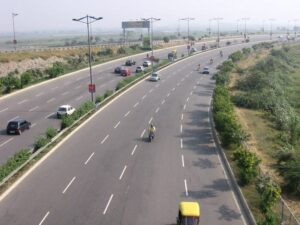
- About: The Delhi–Dehradun Expressway (Delhi–Saharanpur–Dehradun Economic Corridor) is a high-speed, access-controlled greenfield expressway connecting Delhi to Dehradun (Uttarakhand).
- It is developed under the Bharatmala Pariyojana to transform regional mobility with modern highway infrastructure and faster, safer travel.
- Authority: The project is developed by the National Highways Authority of India (NHAI) under the Ministry of Road Transport and Highways.
- Total Investment: The estimated cost for the Delhi-Dehradun Expressway is approximately ₹13,000 crore.
-
- Project Length: The total length of the main expressway is approximately 210 kilometres. It starts from the Akshardham Temple in North East Delhi and passes through major hubs like Baghpat, Baraut, Shamli, and Saharanpur in Uttar Pradesh before terminating at Dehradun in Uttarakhand.
- Four-Phase Development: Construction was executed in four distinct phases: Phase 1: Akshardham to Baghpat (32 km), Phase 2: Baghpat to Saharanpur (118 km), Phase 3: Saharanpur to Ganeshpur (40 km) and Phase 4: Ganeshpur to Dehradun (19.5 km).
- Travel Time Reduction: One of the most significant impacts of the expressway is the drastic reduction in journey time.
- Travelers can cover the distance in approximately 150 minutes, compared to the previous 5–6 hour crawl. The distance itself is being optimized from 250 km to 210 km.
- Lane Configuration: The expressway is designed with a high-capacity six-lane main corridor that is expandable to eight lanes to accommodate future traffic growth.
- In the urban Delhi section (Phase 1), the structure expands to 12 lanes, featuring 6 express lanes and 6 service lanes for local traffic.
- Elevated Wildlife Corridor: A hallmark of this project is the 12 km long elevated wildlife corridor passing through the eco-sensitive Rajaji National Park.
- It is recognized as Asia’s Longest Elevated Wildlife Corridor, allowing unrestricted movement of elephants, tigers, and leopards below while vehicles pass safely above.
- Datkali Tunnel Construction: The project includes a 340-metre long tunnel near the Dat Kali Temple in Dehradun.
- This is located at the southern end of the wildlife corridor, providing a seamless entry into the Doon Valley.
- Designated Speed Limits: To ensure high-speed transit, the speed limit for private cars is fixed at 100 kmph.
- Heavy vehicles are restricted to 80 kmph, while two-wheelers are capped at 60 kmph.
- Automated speed monitoring systems are being implemented to penalize overspeeding.
- Connectivity through Spur Routes: The expressway features two vital link roads (spurs) for broader connectivity:
- Saharanpur–Roorkee–Haridwar Spur: A 50.7 km link to Haridwar.
- Ambala–Shamli Spur: A 121 km link connecting the corridor to Haryana.
- Modern Wayside Amenities: NHAI has planned 14 wayside amenities located at intervals of approximately 25 km.
- These sites will include petrol pumps, restaurants, medical aid rooms, solar lighting, and dedicated parking spots, with 10% reserved for Electric Vehicles.
- Advanced Engineering Structures: Beyond the main highway, the corridor incorporates complex infrastructure, including 5 railway overbridges (ROBs), 4 major bridges, and 113 vehicular underpasses.
- Environmental Conservation Efforts: The project is labeled a “green corridor” due to features like rainwater harvesting and water recharge points installed every 500 metres.
- It also faced challenges, necessitating the felling of 7,575 trees. To compensate for this loss NHAI has committed to planting over 1.76 lakh trees as compensation for the loss.
- Operational Status: The expressway is scheduled for official inauguration on April 14, 2026, by Prime Minister Narendra Modi.
- While sections like Akshardham-Baghpat and the Daat Kali stretch have seen trial runs, the entire 210-km stretch will be open to the public post-inauguration.
Significance of This Expressway
- Integration with Char Dham Network: This highway serves as the critical “entry gateway” for the Char Dham Yatra, which attracts over 50 million pilgrims annually.
- By 2026, it will provide seamless access-controlled connectivity to the all-weather road project on NH-58, ensuring that spiritual travelers from the National Capital Region can reach the base camps of Kedarnath and Badrinath with significantly reduced fatigue and higher safety.
- Deployment of Smart Traffic Management: The corridor is a pioneer in Intelligent Traffic Management Systems (ITMS). It features high-tech speed detection cameras and automated tolling via FASTag 2.0 to maintain a steady 100 kmph flow.
- Since its trial runs in December 2025, the system has been calibrated to provide real-time updates on weather conditions and potential animal crossings.
- Transformation of Tier-2 Satellite Cities: The expressway is creating new economic hubs in Baghpat, Shamli, and Saharanpur, transforming them into vital Satellite Cities.
- Industrial plots in these areas have seen a 30-40% surge in demand by early 2026. This shift helps in decentralized urbanization, allowing businesses to set up logistics centers outside Delhi while maintaining a 60-minute reach to the capital’s markets.
- Enhancement of Regional Healthcare Access: The highway establishes a “Golden Hour” corridor for the hill state. Previously, critical patients from Dehradun and Rishikesh faced a 6-hour journey to reach Delhi’s AIIMS or Safdarjung Hospital.
- With the 2.5-hour transit time, the expressway functions as a life-saving artery, enabling rapid medical evacuation and the transport of specialized medical supplies.
- Reduction in National Logistics Costs: Aligned with the Gati Shakti Master Plan, the corridor aims to lower India’s logistics cost from 14% to 8% of GDP.
- By providing a direct, non-stop route for freight carriers, it significantly reduces fuel consumption and turnaround time for thousands of commercial vehicles daily.
|
Also Read: India’s Longest 6-Lane Extradosed Earthquake Resistant Bridge |