




Australia Appoints First Woman Army Chief
|
General Studies Paper II: Gender Equality |
Why in News?
Recently, Australia appointed Lieutenant General Susan Coyle as its first woman Army Chief, marking a historic milestone in the military’s 125-year history.
Who is Lieutenant General Susan Coyle?
- Intro: Lieutenant General Susan May Coyle (born 21 May 1970, Kyogle, New South Wales) is a senior officer of the Australian Army with nearly four decades of service (since 1987).
- She belongs to the Royal Australian Corps of Signals, specializing in communications and information systems.
- In April 2026, she was appointed Chief of Army, becoming the first woman in Australia’s 125-year military history to lead a service branch.
- She will assume office in July 2026, replacing Lt Gen Simon Stuart.
- She is married to an army engineer officer and has three children, balancing military and family life.
- Education: She holds a Bachelor of Science from ADFA, a Master of Management (Defence Studies), and a Master of Strategic Studies (US Army War College).
- She also attended Harvard Business School (2024), reflecting strong academic and strategic grounding.
- Early Career: Coyle joined the Army Reserve in 1987 as a teenager and later trained at the Australian Defence Force Academy (ADFA).
- She was commissioned in 1992 after graduating from the Royal Military College, Duntroon, marking her transition to a full-time officer.
- Roles: She has commanded multiple formations including 104th Signal Squadron, 17th Signal Regiment, 6th Combat Support Brigade, and Forces Command (2022–24)—responsible for generating over 70% of Australia’s land forces.
- Coyle has extensive international deployment experience in East Timor, Solomon Islands, Afghanistan, and the Middle East.
- She led Task Group Afghanistan (2015) and later commanded Joint Task Force 633 (2020) overseeing 1,200 personnel across the Middle East.
- She served as Head of Information Warfare (2021–22) and later became Chief of Joint Capabilities (2024). In this role, she oversees cyber, space, and logistics domains.
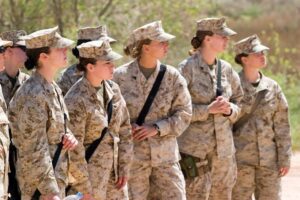
- Military Gender Inclusion: Coyle has broken multiple barriers: she was among the first women to reach three-star rank, and the first woman to lead a warfighting domain—symbolizing rising female representation (21% personnel in ADF).
- Recognition: Her honors include Member of the Order of Australia (AM), Distinguished Service Medal (DSM), and Conspicuous Service Cross (CSC) for leadership excellence.
|
Australian Army:
|
Background of Women Participation in Australia Defence Forces
- Early Entry: From 1899 until the Second World War, women’s service was almost exclusively restricted to the Australian Army Nursing Service. They provided critical care near battlefields and on hospital ships, but were not considered part of the mainstream combatant force.
- Expansion: Facing acute manpower shortages in 1941, the government formed female branches for each service: the WAAAF (Air Force), WRANS (Navy), and AWAS (Army). By 1945, over 53,000 women had served in roles like signallers, mechanics, and drivers to release men for the front lines.
- Following the war’s end in 1945, most female services were disbanded as society pressured women to return to domestic roles.
- However, the onset of the Korean War and personnel shortages led to their re-establishment in the early 1950s, eventually becoming permanent components of the military.
- Legislative Shifts: A landmark moment occurred in 1979 when women in the services achieved equal pay.
- This was followed by the Sex Discrimination Act 1984, which initially granted the ADF an exemption to exclude women from combat but set the stage for further integration.
- Full Integration: By 1985, the separate female branches like the WRANS were fully absorbed into the mainstream Royal Australian Navy.
- In 1992, women were permitted to serve in all units except direct combat roles, and in 1998, Australia became the fourth nation to allow women on submarines.
- In September 2011, the Australian Government announced the removal of all gender-based restrictions from combat roles.
- By January 2016, even Special Forces were opened to direct entry for women, making every role in the ADF accessible regardless of gender.
- Current Representation: As of 2024, women comprise 20.7% of the ADF’s 100,000 personnel.
- The force has set a recruitment target of 25% by 2030 to ensure sustainability.
- Female participation has steadily increased: from 11.4% (1990) to 20.7% (2023–24) in permanent forces.
- Representation varies by service, with the Air Force at 27%, the Navy at 24.1%, and the Army at 15.3%.
Significance for Gender Equality in Armed Forces
- Enhanced Operational Effectiveness: Diverse teams exhibit higher collective intelligence, leading to superior problem-solving in complex environments.
- Research indicates that mixed-gender units in UN Peacekeeping are more effective at intelligence gathering and engaging with local populations, particularly women and children, who comprise over 60% of displaced persons in conflict zones.
- Women’s participation in peace negotiations increases the likelihood of a deal lasting 15 years or more by 35%.
- Talent Pool Optimization: Limiting recruitment to one gender ignores 50% of the national talent pool.
- By 2026, the Indian Armed Forces have expanded entry via the National Defence Academy (NDA), with 158 women cadets joined as of early 2026 to address specialized skill shortages.
- In NATO, women’s representation reached 13.9% in 2024, reflecting a global effort to utilize the best “talent, courage, and resilience” available regardless of gender.
- Diplomatic and Global Standards: Adhering to the UN Security Council Resolution 1325 on Women, Peace, and Security (WPS) is now a benchmark for modern military legitimacy.
- India, for instance, has reached 22% representation in UN staff officer roles, exceeding the 15% target for 2028.
- Globally, 113 countries had active National Action Plans for WPS by 2025, framing gender equality as a prerequisite for international military cooperation.
- Leadership and Structural Reform: Gender equality forces a shift from “masculinized” cultures to merit-based systems.
- The appointment of leaders like Lieutenant General Susan Coyle in Australia or the growth to 11,000 women officers in India signals the dismantling of the “glass ceiling”.
- This reform improves overall institutional equity, leading to better retention and reduced attrition in critical technical and aviation wings.
- Social Alignment and Trust: Militaries that reflect the diversity of the societies they protect enjoy higher levels of public trust and support.
- Institutionalizing equality through initiatives like the “Nari Shakti” in India or NATO’s 2024 WPS policy ensures that military values align with evolving 21st-century community standards, making the armed forces a preferred career path for the next generation.
|
Also Read: Supreme Court Upholds Pension Rights of Women Short Service Officers |