




IMD Forecasts Below Normal Monsoon for 2026
|
General Studies Paper II: Important Geophysical Phenomena, Agricultural Resources |
Why in News?
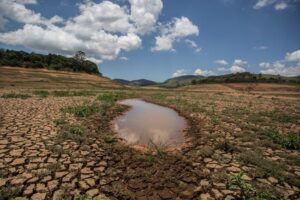
Recently, the India Meteorological Department (IMD) forecast a below-normal 2026 monsoon at around 92% of the long-period average, raising concerns over agriculture, water availability, and rural economy.
Highlights of IMD Monsoon Forecast 2026
- Rainfall Forecast: IMD has projected the 2026 Southwest Monsoon rainfall at 92% of the Long Period Average (LPA), categorising it as “below normal” (90–95% of LPA).
- The LPA, based on 1971–2020 data, is 87 cm, with a model error margin of ±5%, indicating moderate forecast uncertainty.
- It is considered one of the weakest projections in nearly three decades, indicating a significant shift.
- Probability Distribution: IMD’s probabilistic forecast shows a higher likelihood of deficient and below-normal rainfall than climatological averages.
- Specifically, deficient rainfall (<90% LPA) has 35% probability, while below normal (90–95%) has 31% probability, compared to lower historical baselines.
- Conversely, above-normal and excess rainfall probabilities are significantly reduced, highlighting an overall weak monsoon outlook.
- Spatial Distribution: The forecast indicates below-normal rainfall across large parts of central and monsoon core zones, including rain-fed agricultural regions.
- However, some areas of Northeast, Northwest, and South Peninsular India may receive normal to above-normal rainfall, reflecting spatial heterogeneity.
- Regions like central India show 45%–65% probability of below-normal rainfall, raising regional disparity concerns.
- El Niño Conditions: A key driver is the expected transition from ENSO-neutral to El Niño conditions during the monsoon season, which historically leads to suppressed rainfall in India.
- IMD’s Monsoon Mission Climate Forecast System indicates a high likelihood of El Niño development after June 2026, increasing risks of dry and hotter conditions, especially during the second half of the monsoon.
- Indian Ocean Dipole Influence: Currently, the Indian Ocean Dipole (IOD) is neutral, but models suggest a possible shift to positive IOD conditions later in the season.
- A positive IOD generally enhances monsoon rainfall, potentially offsetting some negative impacts of El Niño, though its predictability remains limited and uncertain.
- Climatic Indicators: IMD notes that Northern Hemisphere snow cover (Jan–March 2026) was slightly below normal, which has an inverse relationship with monsoon strength.
- Reduced snow cover can influence atmospheric circulation patterns, indirectly contributing to weaker monsoon conditions over India.
- Model Framework: The forecast is based on a Multi-Model Ensemble (MME) approach, combining dynamical (climate models) and statistical forecasting techniques.
- IMD uses the Monsoon Mission Climate Forecast System (MMCFS), integrating global climate models to improve accuracy.
- Forecasts are released in two stages (April and May updates) with further monthly revisions.
- Upcoming Forecast: IMD will issue a second-stage updated forecast in May 2026, including regional and monthly rainfall projections.
- Continuous monitoring of Pacific SST, ENSO evolution, and IOD patterns will refine predictions.
Role of El Niño and Climatic Factors Affecting Indian Monsoon
- ENSO–Monsoon Relationship: The El Niño–Southern Oscillation (ENSO) is the primary driver of interannual variability in the Indian monsoon.
- During El Niño, warming of the central and eastern Pacific Ocean weakens trade winds and Walker circulation, reducing moisture transport to India and leading to weaker monsoon rainfall.
- Statistical Correlation: Empirical data shows a strong correlation: about 70% of El Niño years since 1980 have witnessed weak monsoons in India.
- Major drought years such as 1972, 2002, and 2009 were linked to El Niño events.
- However, variability exists, as some strong events (e.g., 1997) did not cause drought due to other compensating factors.
- Magnitude of Rainfall Deficit: Scientific studies indicate that El Niño can cause up to 26% negative rainfall deviation in affected regions, impacting nearly 30% of India’s geographical area.
- The effect is strongest in central and northwestern India, while regional variability persists, highlighting uneven spatial distribution of deficits.
- Atmospheric Circulation: El Niño alters pressure gradients, creating high pressure over the Indian region and weakening monsoon trough formation.
- This reduces moisture-laden winds from the Arabian Sea and Bay of Bengal, leading to delayed onset, long dry spells, and uneven rainfall distribution, affecting crop cycles and hydrology.
- Other Climatic Factors: The monsoon is also influenced by Indian Ocean Dipole (IOD) and Eurasian snow cover.
- A positive IOD can partially offset El Niño effects, sometimes resulting in near-normal rainfall.
- Conversely, reduced snow cover weakens land-sea thermal contrast, further suppressing monsoon circulation, amplifying El Niño-induced deficits.
- Climate Change: Recent research highlights that while El Niño generally reduces rainfall, it can increase extreme rainfall events locally, indicating rising climate variability.
- Additionally, climate change is modifying ENSO–monsoon linkages, making predictions complex, with fluctuating strength and shifting regional impacts across India.
Impact of Below-Normal Monsoon on India
- Agriculture and Cropping Patterns: A below-normal monsoon (92% of LPA) directly affects India’s rain-fed agriculture, which still covers a large share of cultivated land.
- Around 54% of net sown area remains rain-dependent, making crops like rice, pulses, and oilseeds highly vulnerable to rainfall deficits, potentially reducing kharif output and farm incomes.
- Economic Growth and Inflation: Monsoon rainfall supports nearly 70% of agricultural water needs and significantly influences India’s $4 trillion economy.
- A weak monsoon can reduce GDP growth (estimated 6.8–7.2%), increase inflation above 4.5%, and weaken rural consumption demand, impacting sectors like FMCG, textiles, and fertilizers.
- Food Security and Commodity: Lower rainfall threatens foodgrain production, particularly staples like rice, sugar, and pulses, leading to supply shortages.
- This may increase imports (e.g., edible oils) and restrict exports, affecting food security and price stability, especially for vulnerable populations dependent on subsidized food systems.
- Uneven Rainfall Distribution: IMD projections show 45–65% probability of below-normal rainfall in central India, including key agricultural zones. While some regions may receive normal rainfall, uneven spatial distribution leads to localized droughts, crop stress, and widening regional economic inequalities.
- Water Resources and Energy Security: India receives over 70% of annual rainfall during monsoon, crucial for reservoir storage, groundwater recharge, and hydropower generation.
- A deficit reduces drinking water availability, irrigation supply, and can lower hydroelectric output, stressing both rural and urban water systems.
- Disaster Risks: Below-normal monsoons increase risks of meteorological and agricultural droughts, especially in semi-arid regions.
- Simultaneously, climate variability may trigger intense localized rainfall events, causing floods alongside droughts, along with heatwaves, creating a complex multi-hazard risk scenario across India.
|
Government Policy Measures:
|
|
Also Read: Indian Monsoon: Why Rainfall Increases and Decreases |