




GE Aerospace–HAL Jet Engine Deal
|
General Studies Paper II: Defence, Bilateral Groupings & Agreements |
Why in News?
GE Aerospace and Hindustan Aeronautics Limited (HAL) have advanced a deal to co-produce F414 jet engines in India, though final contracts, timelines, and engine delivery clarity remain pending.
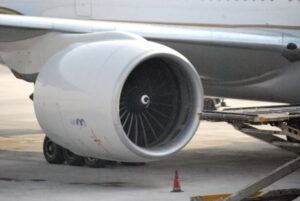
Highlights of GE Aerospace–HAL Deal
- Current Status: The GE Aerospace–HAL jet engine deal originated with a 2023 MoU during India–US strategic engagement and has progressed to a technical agreement stage by April 2026, with final commercial contract expected soon.
- It represents a multi-phase negotiation involving ToT, licensing, and co-production frameworks.
- Engine Type: The deal focuses on co-production of GE F414 engines, intended to power Tejas Mk-II like platforms, making it central to India’s future combat aviation ecosystem.
- Transfer of Technology (ToT): The deal proposed the 80% Transfer of Technology, significantly higher than earlier limits (58%).
- It includes critical technologies such as hot-section coatings, single-crystal blades, and laser drilling, marking one of the deepest US technology transfers to India in defence manufacturing.
- Manufacturing: Under the agreement, HAL will manufacture engines in India, with initial units supplied by GE and later localized production.
- The first indigenous F414 engine is expected around 2029, after setting up production lines and testing infrastructure.
- Under this agreement, 99 F414 engines will be co-produced in India to power the Tejas Mk-II.
- Parallel deals, such as the $1 billion contract for 113 F404 engines for Tejas Mk-1A, ensure immediate fleet requirements.
About F414 Jet Engines
- Classification: The GE F414 is an afterburning turbofan jet engine developed by GE Aerospace, representing a modern evolution of the earlier F404 series.
- Engine Type: The GE F414 is a low-bypass afterburning turbofan engine with a two-shaft design, consisting of fan, compressor, combustor, turbines, and afterburner modules.
- Its modular architecture improves maintainability, scalability, and operational flexibility in modern fighter aircraft.
- High Thrust: The engine delivers about 22,000 pounds (≈98 kN) thrust with afterburner, placing it in a high-performance fighter category.
- It offers 30–40% more thrust in critical combat conditions compared to earlier engines, enhancing acceleration, payload capacity, and combat maneuverability.
- Thrust-to-Weight Ratio: With a thrust-to-weight ratio of 9:1, the F414 provides excellent power efficiency relative to its mass (2,450 lbs). This ensures better climb rates, agility, and fuel efficiency, which are crucial for multi-role fighter aircraft operations.
- Advanced Materials: The engine uses single-crystal turbine blades, powder-metal disks, and advanced thermal coatings, enabling operation at very high temperatures.
- Digital FADEC: It incorporates a Full Authority Digital Engine Control (FADEC) system that manages fuel flow, thrust modulation, and engine safety. This ensures precision control, reduced pilot workload, and optimized performance across flight conditions.
- Fuel Efficiency: The F414 achieves 3–4% better fuel efficiency than earlier F404 engines, while maintaining high reliability and longer service life (2000-hour hot section life). Its on-condition maintenance system reduces downtime and lifecycle costs significantly.
- Platform Integration: The engine powers multiple advanced fighter aircraft including Boeing F/A-18E/F Super Hornet, Saab Gripen E/F, and KF-21 Boramae, demonstrating its global reliability and interoperability.
- Modular Design: Its modular construction allows easy upgrades and maintenance, while future variants can deliver up to 20% higher thrust. This provides long-term scalability for next-generation fighters like AMCA and Tejas Mk-II.
Significance of This Deal
- Air Power Strengthening: The deal directly addresses the declining fighter squadron strength of the Indian Air Force, which is below the sanctioned level, by enabling faster induction of indigenous Tejas Mk-II and future jets. This enhances combat readiness for a two-front threat (China–Pakistan).
- Strategic Autonomy in Engines: India has historically depended on foreign jet engine imports, a major vulnerability in defence. This agreement enables domestic production of critical propulsion systems, reducing strategic dependence during conflicts or sanctions, a key gap exposed in past defence procurements.
- Indigenous Ecosystem Expansion: The deal catalyzes a full aerospace manufacturing ecosystem, including private sector participation, MSMEs, and supply chains. With local production lines expected, it strengthens India’s high-value defence industrial base beyond assembly to core technologies.
- Economic & Technological Multiplier: The deal is expected to contribute to economic growth, high-skill employment, and technology absorption, especially in advanced metallurgy, precision engineering, and turbine technologies. It strengthens India’s entry into the global aerospace value chain, a sector dominated by few nations.
- Indo-Pacific Strategic Leverage: The agreement reflects deepening India–US defence convergence, aimed at balancing China’s growing military influence in the Indo-Pacific. It elevates India’s role as a strategic partner rather than a buyer, enhancing geopolitical leverage in regional security frameworks.
|
India–US Defence Partnership:
|