India–South Korea Strategic Partnership
|
General Studies Paper II: Agreements Related to or Affecting India’s Interests |
Why in News?
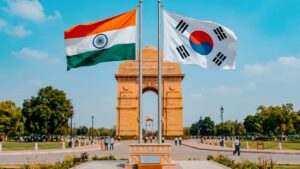
Recently, South Korean President Lee Jae Myung visited India and held high-level talks with the Indian Prime Minister, where both nations signed multiple agreements under India–South Korea Special Strategic Partnership and set an ambitious target to raise bilateral trade to $50 billion by 2030.
Highlights of India–South Korea Partnership 2026
- Partnership Elevation: The partnership was elevated to a “Futuristic Partnership” following summits in April 2026, aiming to move beyond traditional economic ties toward strategic, long-term cooperation in technology and security.
- The leaders officially designated 2028-2029 as the “Year of India-Korea Friendship” to celebrate a decade of the Special Strategic Partnership.
- Bilateral Trade Target: Both nations set a target to increase bilateral trade to USD 50 billion by 2030, a significant jump from current levels, by upgrading the existing comprehensive economic pact.
- CEPA Upgrade Negotiations: Negotiations to upgrade the Comprehensive Economic Partnership Agreement (CEPA) were formally resumed. This aims to address the underutilization of the agreement, enhance product coverage, and improve services integration.
- Economic Security Dialogue: A new Economic Security Dialogue was launched to strengthen supply chains, protect critical technologies, and manage trade risks, aligning with South Korea’s strategy to diversify its economic dependencies.
- Industrial Cooperation Committee: An Industrial Cooperation Committee was established, involving ministers responsible for industries to oversee cooperation in shipbuilding, steel, and manufacturing, with a focus on supply chain stability.
- NPCI-KFTC Payments Link: NPCI International Payments Limited signed an MoU with the Korean Financial Telecommunications & Clearings Institute to integrate digital payment ecosystems across borders.
- ROK Joins IPOI: South Korea officially joined India’s Indo-Pacific Oceans Initiative (IPOI), emphasizing collaboration on maritime security, marine ecology, and disaster risk reduction.
- South Korea also announced its decision to join the India-led International Solar Alliance (ISA), strengthening global cooperation on green energy.
- Global South Development 2+2: The 2+2 Policy Dialogue was expanded to focus on joint development projects in the Global South, allowing India and Korea to partner on infrastructure in Africa and Southeast Asia.
- India Joins GGGI: India joined the Global Green Growth Institute (GGGI), a Seoul-based treaty-based organization, to boost cooperation in sustainable development and green technology.
- Digital Bridge Initiative: A framework for the India–Korea Digital Bridge was established, focusing on collaborative advancements in Artificial Intelligence (AI), semiconductors, and 5G/6G technology.
- Defense Industrial Collaboration: India’s Defence Minister is scheduled to visit South Korea in May 2026 to enhance defense production, specifically regarding naval technologies and ammunition, following the summit.
- India and South Korea have initiated the third phase of the K9 Vajra howitzer project, which focuses on significantly higher technology transfer and the production of an additional 100 units.
- War Memorial Inauguration: The two sides agreed to jointly inaugurate a war memorial in South Korea in May 2026 to honor India’s participation in the Korean War, cementing security ties.
- Shipbuilding Sector Cooperation: A specialized framework for cooperation in shipbuilding was signed, aiming to bolster India’s maritime infrastructure with Korean expertise in LNG carrier construction.
- Strategic Steel Supply Chain: A new agreement ensures a stable steel supply chain, crucial for both India’s infrastructure growth and Korea’s industrial production requirements.
- South Korea’s POSCO Holdings signed a regulatory filing to invest $1.09 billion by 2031 for an integrated steel plant in Odisha with JSW Steel.
- Clean Energy Security: A joint statement on energy resource security was signed, prioritizing cooperation in green hydrogen, ammonia, and renewable energy to meet net-zero goals.
- SME Cooperation: A memorandum of understanding (MoU) was signed to enhance collaboration between Small and Medium Enterprises (SMEs), fostering innovation in technology manufacturing.
- KOMEA Office in Mumbai: The Korea Marine Equipment Association (KOMEA) opened its first overseas office in Mumbai to build an ancillary ecosystem and support the local maritime industry development.
- Korean Investment in India: Following the 2026 summit, Korean giants, including Hyundai and LG Electronics, confirmed major investments in Andhra Pradesh and Maharashtra to expand manufacturing capacity, including EV manufacturing.
- Electronics Manufacturing Hubs: South Korea reaffirmed its commitment to using India as a global manufacturing hub, leveraging existing factories like Samsung in Uttar Pradesh and new projects.
- Maritime Partnership Framework: A robust maritime partnership framework was established to enhance connectivity, trade, and safety along critical sea lines of communication.
- The Korea International Cooperation Agency (KOICA) signed a Plan of Implementation with India’s Ministry of Ports to provide research and workforce training.
- Both nations agreed to align South Korea’s shipbuilding expertise with India’s Maritime Amrit Kaal Vision 2047.
- Critical Minerals Pact: A specialized agreement was secured for the exploration and supply of critical minerals necessary for electric vehicles and defense electronics.
- Cultural Exchange 2026-2030: A comprehensive cultural exchange programme was signed for 2026–2030, boosting cooperation in film, animation, and creative arts, reflecting rising Korean content popularity in India.
- Both nations plan for a dedicated Korea Enclave in India, a modern industrial township designed to provide “plug-and-play” infrastructure for Korean firms.
- A new Mumbai-Korea Centre will be established to serve as a cultural and business hub for the entertainment industry, specifically linking K-pop and Bollywood.
- India-Korea Friendship Festival: An India-Korea Friendship Festival will be organized in 2028, commemorating deeper cultural ties and people.
- The festival is part of a broader cultural exchange plan spanning 2026–2030.
- It aims to celebrate shared creativity across music (K-pop and Bollywood), cinema, food, and traditional arts.
India–South Korea Relations
- Diplomatic Foundation: India and South Korea established consular relations in 1962 and full diplomatic ties on 10 December 1973.
- The relationship reached a milestone in 2015 when it was elevated to a Special Strategic Partnership during PM Modi’s visit to Seoul.
- This status reflects the deep trust and convergence between India’s Act East Policy and Korea’s Indo-Pacific Strategy.
- Trade Statistics: Bilateral trade reached $26.89 billion in FY25, growing at a steady pace despite global uncertainties.
- India currently experiences a significant trade deficit, with imports from Korea totaling approximately $21.07 billion against exports of $5.82 billion.
- CEPA Upgradation: The Comprehensive Economic Partnership Agreement (CEPA), in force since 2010, is undergoing major upgrades.
- In February 2026, negotiators met to finalize terms aimed at reducing non-tariff barriers and easing rules of origin.
- Foreign Direct Investment: South Korea is India’s 13th largest FDI investor, with cumulative inflows reaching $6.81 billion from April 2000 to June 2025.
- Significant investments are concentrated in metallurgy, automotive, and electronics.
- Recent trends show a shift toward infrastructure and renewable energy sectors as the Indian market matures.
- Defense: Defense cooperation is centered on the K9 Vajra-T 155mm self-propelled howitzer.
- In December 2024, a contract worth ₹7,628.7 crore was signed for an additional 100 units to be manufactured by Larsen & Toubro with technology from Hanwha Aerospace.
- The Korea-India Defence Accelerator (KIND-X) was launched to link defense startups and researchers. It aims to foster innovation in anti-aircraft guns.
- The inaugural India–South Korea Naval Bilateral Exercise (IN–RoKN) commenced on October 13, 2025, at the Busan Naval Base, South Korea, marking a significant milestone in maritime cooperation.
- Automotive Leadership: Korean giants Hyundai and Kia have become synonymous with the Indian auto market.
- In late 2025, Hyundai India prepared for a landmark IPO, reflecting its long-term commitment.
- Both companies are now shifting focus toward Electric Vehicles (EVs), with plans to establish localized battery assembly lines in India.
- Steel Mega-Projects: In 2024, South Korean steel leader POSCO renewed its Indian ambitions by signing a $7.3 billion agreement with JSW Steel.
- The project aims to build an integrated steel plant in Odisha with a capacity of 6 million tonnes per annum by 2031, targeting high-end steel for the automotive sector.
- Semiconductor Cooperation: Under India’s PLI scheme, South Korean firms are exploring high-tech corridors for chips and AI. Collaboration focuses on trusted supply chains and R&D.
- Initiatives like the “Chips-to-Startup” program aim to train thousands of professionals, leveraging Korea’s technical prowess and India’s talent pool.
- Electronics Manufacturing: Samsung and LG continue to lead the consumer electronics sector in India.
- Samsung’s facility in Noida remains one of the world’s largest mobile manufacturing units.
- These firms are critical to India’s goal of becoming a global electronics export hub, contributing billions to FY25 export.
- Supply Chain Resilience: The Korea-India-U.S. Triangular Partnership, reinforced in April 2025, focuses on securing critical mineral supply chains.
- This “1.5 Track Dialogue” seeks to build resilient networks for semiconductors and green energy components, reducing over-reliance on single-source markets like China.
- Energy Resource Security: In early 2026, both nations emphasized cooperation in energy security.
- India remains a key supplier of naphtha to Korea, while Korea provides lubricant base oils.
- They are jointly exploring Green Hydrogen technologies to meet respective Net Zero targets by 2070 (India) and 2050 (Korea).
- Shipbuilding Synergy: Shipbuilding is a “driving passion” for the Indian government. HD Korea Shipbuilding and Cochin Shipyard are exploring partnerships for shipyard modernization.
- Strategic Indo-Pacific Alignment: Both countries are “natural partners” in the Indo-Pacific.
- They share concerns regarding unilateral attempts to alter the regional security architecture.
- Through regular Foreign Policy and Security Dialogues, they coordinate on maritime security and the promotion of a rules-based order.
- Start-up Ecosystem: The India-Korea Startup Hub fosters innovation in DeepTech and AI.
- In December 2025, the Indian startup “Konnect” won the overall prize at the COMEUP festival in Seoul.
- The ‘Korea Plus’ desk, launched in 2016, facilitates Korean investments in India. It operates under Invest India to provide a single-point contact.
- Space Collaboration: The space agencies ISRO and KASA have established a Joint Working Group.
- They are exploring cooperation in satellite navigation and space-tech startups following the India-ROK Space Day.
- Historical Korean War Role: India’s role during the Korean War (1950-53) is a cornerstone of the modern relationship.
- The 60th Parachute Field Ambulance treated over 200,000 wounded, and Indian diplomats were central to the Neutral Nations Repatriation Commission.
- Civilizational Links: The legendary marriage of Princess Suriratna (Queen Heo Hwang-ok) of Ayodhya to King Kim Suro in 48 AD forms a unique cultural bond.
- Millions of Koreans trace their ancestry to this lineage. This heritage is celebrated through the Queen Heo Memorial Park in Ayodhya.
- Indian Diaspora: Approximately 18,000 Indian nationals reside in South Korea as of December 2025.
- The community consists primarily of STEM scholars, researchers, and IT professionals working for chaebols, serving as a vital human bridge between the two cultures.
- Logistics and Infrastructure: In February 2025, India’s DPIIT and the Korea Transport Institute signed an MoU to boost collaboration in logistics.
- South Korea has provided significant financing via the EDCF for projects like the Nagpur-Mumbai Expressway’s Intelligent Traffic System.
- Cultural Exchange: The Korean Wave (Hallyu) has seen a massive surge in India, with K-Pop and K-Dramas becoming mainstream.
- Conversely, Indian Bollywood and yoga are gaining popularity in Korea.
- The Indian Culture Centre (ICC) in Seoul plays a pivotal role in promoting people-to-people ties.
|
Also Read: 75th Anniversary of India-China Diplomatic Relations |