



World 2nd-Largest Battery Energy Storage System in Gujarat
|
General Studies Paper II: Growth & Development, Effect of Policies & Politics of Countries on India’s Interests |
Why in News?
Recently, Adani Green Energy inaugurated the world’s second-largest single-location battery facility in Gujarat, strengthening India’s renewable grid stability.
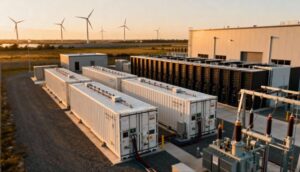
Highlights of World’s 2nd-Largest Battery Energy Storage System (BESS)
- Location: The project is located at Khavda in Kutch district, Gujarat, where AGEL is developing a massive 30 GW renewable energy park across 538 sq km, nearly five times the size of Paris.
- It is recognized as the world’s second-largest single-location battery storage system and the largest outside China.
-
- Developed By: This infrastructure was engineered and commissioned by Adani Green Energy Limited (AGEL), India’s premier renewable power producer.
- Capacity: The system has a storage capacity of 3.37 Gigawatt-hours, including an additional 1.37 GWh added in March 2026.
- This scale enables storage of surplus renewable electricity for peak-demand supply and grid balancing.
-
-
- The park is expected to generate nearly 87.4 billion units of electricity annually, enough to power approximately 17.4 million households.
-
- Technology Used: The BESS integrates advanced lithium-ion battery technology with intelligent Energy Management Systems (EMS) for optimized charging, discharging, efficiency, and grid responsiveness.
- It supports real-time renewable energy balancing.
- Construction Speed: The project was completed within just 10 months, making it among the fastest utility-scale battery storage deployments globally.
- Power Supply Capability: The system can store enough clean electricity to power nearly 1 million homes for one day.
- It can operate over 12 million LED bulbs continuously for 10 hours.
-
-
- Its immediate capacity is capable of powering cities like Indore, Chandigarh, or the entire state of Goa.
- Grid Infrastructure: The project is connected through advanced 765 kV transmission corridors and high-capacity evacuation systems integrated with India’s Green Energy Corridor.
-
- Contribution: The project supports India’s 2070 Net Zero target by enabling reliable round-the-clock renewable electricity and reducing dependence on coal-based peaking power plants.
-
-
- The project positions India among global leaders in utility-scale storage infrastructure, strengthening energy security.
- Khavda may help avoid nearly 63.6 million tonnes of CO₂ emissions annually, equivalent to removing around 13.8 million vehicles from roads.
- The project also uses robotic waterless cleaning systems, saving over 1.7 billion litres of water annually in the arid desert ecosystem.
-
- Economic Impact: AGEL plans investments of nearly ₹15,000 crore for expanding storage capacity beyond 10 GWh in FY27 and targeting 50 GWh within five years, boosting domestic green manufacturing and jobs.
-
- Khavda is expected to generate over 15,200 green jobs while attracting investments exceeding ₹1.5 lakh crore.
|
What is Battery Energy Storage System (BESS)?
|
India’s Battery Energy Storage System Status
- Installed Capacity: India’s commissioned grid-scale battery storage capacity reached approximately 1.5 GW by late 2025, a significant jump from under 0.1 GW in 2024.
- India added 547 MWh BESS capacity in 2025, taking cumulative installed battery storage capacity beyond 1,082 MWh by December 2025.
- The total pipeline of under-construction and actively tendered assets has surged to between 92 GWh and 102 GWh.
- The Ministry of Power stated that 35.8 GWh of BESS capacity is under active construction across various states.
- Major Projects: The largest single-location battery asset is the Adani Khavda BESS Project located in Gujarat, operating at 3.37 GWh capacity.
- Led by Avaada Group, Pugal Bikaner BESS installation pairs a 1,560 MW solar plant with a 2,500 MWh BESS. It is designed to provide clean electricity outside of typical daylight hours.
- Developed by SECI, Rajnandgaon BESS (Chhattisgarh) pioneering project pairs a 100 MW solar plant with a 40 MW/120 MWh lithium-ion BESS. It ensures power stability by supplying peak-hour electricity to the local grid.
- Koppam and Ghani BESS (Andhra Pradesh), under NHPC contracts, ReNew is developing a massive 275 MW/550 MWh standalone BESS. These installations supply critical peak power daily, improving overall grid reliability.
- Awarded to SPML Infra, Barauni Thermal Power Station BESS (Bihar) 1 GWh battery facility is specifically designed to work alongside conventional thermal generation to balance local grid loads and ensure power consistency.
- Kilokri BESS (New Delhi), installed by BSES Rajdhani Power Limited, this 20 MW/40 MWh utility-scale setup is India’s first commercially approved, distribution-level storage system, using advanced lithium iron phosphate technology.
- Key Developers: Major public and private entities are driving massive project rollouts. Key market leaders include Adani Green Energy Limited (AGEL), NTPC’s Vidyut Vyapar Nigam (NVVN).
- Reliance Nu Suntech, recently secured a 1.86 GWh four-hour battery contract.
- Regional Leaders: Project development is heavily concentrated across Gujarat, Rajasthan, Tamil Nadu, Andhra Pradesh, Maharashtra and Karnataka.
- Government’s Policy: The central government is driving deployment through the ₹9,400 Crore ($1.129 billion USD) BESS Scheme. This policy leverages Viability Gap Funding (VGF) grants covering up to 40% of initial capital costs to make grid-scale battery installations financially viable.
- The Union Government expanded the Viability Gap Funding (VGF) scheme target from 4 GWh to 13.2 GWh by FY2027-28 with ₹3,760 crore support covering up to 40% project cost.
- To reduce reliance on imported components, India runs an ₹18,100 Crore Production Linked Incentive (PLI) scheme. The initiative targets 50 GWh of domestic Advanced Chemistry Cell (ACC) manufacturing.
- The Ministry of Power enforces a strict Energy Storage Obligation (ESO) for power distributors. It mandates that state utilities source a minimum percentage of their electricity from storage assets
- Projections: The Central Electricity Authority (CEA) outlines a required national baseline of 8.68 GW / 34.72 GWh of standalone BESS by fiscal year 2026-27.
- Achieving this target demands an estimated capital funding injection of ₹56,647 Crore.
- The official long-term roadmap projects a storage requirement of 47.24 GW / 236.22 GWh from battery systems by 2032.
- This massive scaling forms part of a broader 411.4 GWh combined energy storage goal.
- The CEA has drafted extreme long-term projections ahead of India’s 2070 net-zero targets. By 2047, the national power network will require 230 GW / 1,840 GWh of dedicated BESS capacity.
|
Also Read: India’s First Off-Grid Green Hydrogen Plant |