



DRDO Tests Multi-Layer Ballistic Missile Defence System
| General Studies Paper lII: Defence Technology, Indigenization of Technology |
Why in News?
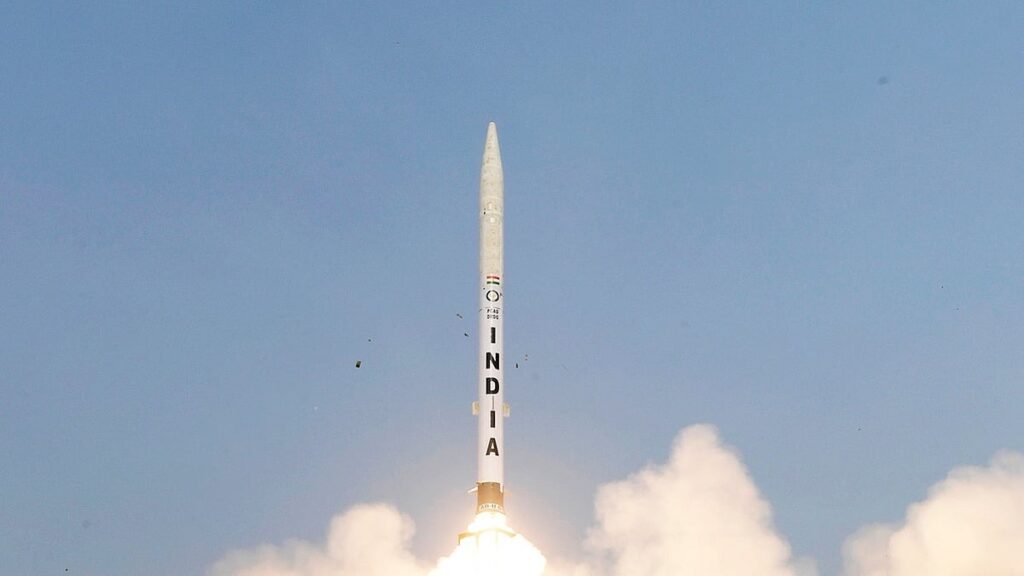
Recently, DRDO successfully demonstrated a Multi-Layer Ballistic Missile Defence (BMD) System through three consecutive flight tests.
What is Multi-Layer Ballistic Missile Defence (BMD) System?
- About: Multi-Layer Ballistic Missile Defence (BMD) System is an indigenous missile shield to detect, track and destroy hostile ballistic missiles at multiple altitudes before they reach their targets.
- It provides an impenetrable multi-layered interceptor shield against adversarial ballistic missiles.
- Its primary objective is to protect strategic cities, military assets and critical infrastructure from ballistic missile attacks.
- It secures India’s second-strike capability in alignment with its “No First Use” nuclear policy.
- Developed By: The system is designed by the Defence Research and Development Organisation (DRDO).
- Strategic manufacturing partners include Bharat Electronics Limited (BEL) and Bharat Dynamics Limited (BDL).
- Origin: BMD system is developed under Indian Ballistic Missile Defence (BMD) Programme.
- It was initiated in 2000 after the Kargil War, aimed to protect India from missile threats, particularly from Pakistan and China.
- Components: The architecture comprises Long-Range Sensors, tracking radars, Battle Management Command systems, communication networks and interceptor missiles such as AD-1 and AD-2.
- The architecture integrates long-range Swordfish tracking radars and geographically distributed Launch Control Centres.
- The software-intensive Mission Control Centre (MCC) automates target classification and real-time kill assessments.
- Features: The network leverages kinetic-kill vehicles, low-latency fiber networks, and multi-spectral sensors.
- It provides comprehensive all-weather, 360-degree protection against short to intercontinental-range threats.
- The system features a multi-tiered architecture configured for exo-atmospheric (outside atmosphere) and endo-atmospheric (inside atmosphere) interceptions.
- Working Mechanism: Radars detect the threat and transmit data via a secure Wide Area Network (WAN) to the MCC.
- The command center dynamically commands a synchronized launch battery to execute high-speed interception.
- Interceptors are launched to physically collide with the target at supersonic speeds, neutralizing it via the hit-to-kill mechanism.
- Trials: Phase I (2019) destroys adversarial threats up to a 2,000 km range. It uses Prithvi Air Defence (PAD) for exo-atmospheric neutralisation (50–80 km) and Advanced Air Defence (AAD) for endo-atmospheric interception.
- Phase II (2024) tackles long-range and Intercontinental Ballistic Missiles (ICBMs). It utilizes AD-1 and AD-2 interceptors to neutralise supersonic targets spanning ranges up to 5,000 km.
- DRDO finalized Phase II with three consecutive flight trials on June 10–11, 2026. These tests successfully destroyed simulated ICBM-class threats in both atmospheric regimes.
- Future Roadmap: DRDO has initiated Phase III development for next-generation interceptors.
- The forthcoming AD-AH and AD-AM variants will counter hypersonic cruise missiles and Multiple Independently Targetable Re-entry Vehicles (MIRVs).
- Significance: This development placed India into an elite group of nations alongside the US, Russia, and Israel.
- The proven capability of the shield acts as a critical equalizer in the shifting strategic landscape of the Indo-Pacific region.
- The trials demonstrated advanced indigenous technologies including long-range tracking sensors and low-latency communication networks, highlighting India’s growing defence self-reliance.
Ballistic Missiles of India
- Agni Series: The Agni Series forms the backbone of India’s nuclear triad. Developed by DRDO, it spans from short-range to intercontinental ranges:
- Agni-I: Short-range ballistic missile (SRBM); range of 700–1,200 km.
- Agni-II: Medium-range ballistic missile (MRBM); range of 2,000–3,000 km.
- Agni-III: Intermediate-range ballistic missile (IRBM); range of 3,000–3,500 km.
- Agni-IV: Intermediate-range ballistic missile (IRBM); range of 4,000 km.
- Agni-V: India’s first operational Intercontinental Ballistic Missile (ICBM); range of 5,000–8,000 km; equipped with Multiple Independently Targetable Re-entry Vehicle (MIRV) technology.
- Agni-P (Prime): Next-generation, canisterised MRBM with a range of 1,000–2,000 km, designed to replace older variants.
- Agni-VI: An advanced ICBM currently under development with a projected range exceeding 6,000–10,000 km.
- Prithvi Series: The Prithvi Series represents India’s first indigenously developed ballistic missiles under the Integrated Guided Missile Development Programme (IGMDP).
- Prithvi-I: Tactical, single-stage liquid-fueled surface-to-surface missile used by the Indian Army; range of 150 km.
- Prithvi-II: Upgraded, nuclear-capable variant utilized primarily by the Indian Air Force; range of 250–350 km.
- Prithvi-III: Naval variant featuring a solid-fueled first stage and liquid-fueled second stage; range of 350–600 km.
- Dhanush: A specialized variant of the Prithvi-III missile. The Dhanush is a ship-launched, surface-to-surface short-range ballistic missile with a range of 350–400 km, built to strike both sea and land targets.
- Shaurya: A canister-launched, hypersonic surface-to-surface tactical ballistic missile. It has a range of 700–1,000 km and provides a rapid-response capability.
- Prahaar: A solid-fueled, highly accurate battlefield support tactical missile designed to provide the Indian Army with a quick-reaction strike capability. It has a range of 150 km and effectively replaced the liquid-fueled Prithvi-I.
- Pralay: A newer, canister-launched short-range tactical ballistic missile developed for conventional battlefield use. It features a range of 150–500 km. It is capable of changing its trajectory mid-flight to evade interceptors.
- Pragati & Pranash: The close relatives of the Prahaar family. Pragati is the export-variant tactical missile with a range of 170 km, while Pranash is an advanced, non-nuclear tactical rocket development aimed at striking targets up to 200 km away.
- K-15 Sagarika (K-Series SLBM): The submarine-launched ballistic missile (SLBM) arm of the K-missile family named after Dr. A.P.J. Abdul Kalam.
- Fired from INS Arihant-class nuclear submarines, the K-15 Sagarika provides a range of 700–750 km to seal India’s second-strike survivability.
- K-4 (K-Series SLBM): It is an intermediate-range submarine-launched ballistic missile that greatly extends the sea-based leg of the nuclear triad.
- It has a range of up to 3,500 km, enabling nuclear submarines to operate from safer, deeper waters while maintaining deterrence depth.
- It uses a highly accurate Inertial Navigation System (INS) with satellite guidance (NavIC/GPS) for mid-course correction.
FAQs:
1. What missile systems were tested by DRDO?
DRDO tested multi-layer Ballistic Missile Defence interceptors and successfully conducted the maiden trial of the Naval Anti-Ship Missile-Medium Range (NASM-MR).
2. How do the successful tests strengthen India’s missile shield?
They validated multi-layer interception capability against long-range ballistic missiles, improving India’s ability to detect, track and destroy incoming threats.
3. What is India’s missile defence program?
It is an indigenous Ballistic Missile Defence (BMD) programme developed by DRDO to protect India from ballistic missile attacks through layered interception.
4. Why are missile interceptor tests important?
They verify interceptor accuracy, radar performance, command systems and readiness against evolving missile threats under realistic operational conditions.
5. How does this improve national security?
The tests enhance strategic deterrence, protect critical assets and place India among nations capable of countering even ICBM-class threats.
| Also Read: Agni-VI Ballistic Missile Project |