Sea King 42B Squadron Retirement
| General Studies Paper III: Defence Technology |
Why in News?
Recently, the Indian Navy retired the iconic Sea King 42B helicopter fleet and deactivated INAS 330 “Harpoons” after over 55 years of distinguished service.
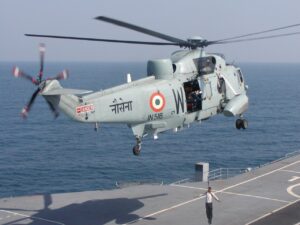
What is Sea King 42B Helicopter?
- About: The Sea King 42B is a specialized multi-role maritime helicopter operated by the Indian Navy for Anti-Submarine Warfare (ASW), Anti-Surface Warfare (ASuW), surveillance, and fleet support.
- It was developed by the British Westland Sea King platform.
- The 42B variant was customized for India’s maritime requirements, strengthening naval dominance across the Indian Ocean Region (IOR).
- Induction: India signed contracts in the early 1980s for the Sea King 42B, with deliveries occurring between 1988 and 1992.
- Around 20 helicopters were inducted to enhance shipborne combat capabilities and replace older platforms.
- The Sea King family entered Indian naval service in 1971 through INAS 330 “Harpoons.”
- Twin-Engine Power System: The helicopter is powered by two Rolls-Royce Gnome turboshaft engines, improving reliability during over-sea operations.
- Twin-engine redundancy significantly increases operational safety during long maritime missions.
- Advanced Sensor Suite: It is integrated with radar, sonar, electronic surveillance systems, and tactical avionics.
- These sensors enable detection and tracking of submarines and surface vessels beyond the horizon.
- Anti-Submarine Warfare Capability: The Sea King 42B carries dunking sonar, torpedoes, and depth charges for submarine hunting.
- It became one of India’s most effective airborne ASW platforms and earned the nickname “Flying Frigate.”
- Anti-Surface Strike Role: The platform was designed for anti-ship missions and integrated with Sea Eagle missiles and later indigenous anti-ship missile trials, providing significant maritime strike capability.
- Maritime Security and Surveillance: Sea King 42B helicopters conducted exclusive economic zone monitoring, fleet reconnaissance, search-and-rescue operations, maritime domain awareness, and carrier-borne surveillance, acting as the fleet’s “eyes and ears.”
- Service Legacy: The original Sea King Mk.42 helicopters played a significant role during the 1971 Indo-Pak War, conducting extensive ASW patrols and logging more than 156 operational hours.
- The more capable Sea King 42B variant enhanced anti-ship strike capabilities and became a core component of carrier battle groups operating from INS Vikrant and later INS Viraat.
- Retirement: In June 2026, the Indian Navy retired the Sea King 42B fleet and INAS 330.
- Advancements in stealth submarines and anti-ship weaponry made the 1980s-era Sea King 42B sensors insufficient. Over three decades of service caused airframe fatigue and severe spare parts shortages.
- Their role is being assumed by modern platforms such as the MH-60R Seahawk, reflecting India’s transition toward next-generation network-centric maritime warfare.
- About 8 variants of the Sea King will continue limited operations under squadrons like INAS 350 operating from INS Dega in Visakhapatnam.
- The ultimate objective is to replace legacy models with the developing Indian Multi Role Helicopter (IMRH) and Deck-Based MRH platforms, aligning with long-term “Make in India” defense mandates.
INAS 330 ‘Harpoons’
- About: Indian Naval Air Squadron (INAS) 330, popularly known as the “Harpoons,” was the Indian Navy’s premier ship-borne helicopter squadron.
- Based at INS Shikra, Mumbai, it operated the Sea King Mk 42/42B helicopters and specialized in anti-submarine, anti-surface, and maritime surveillance missions.
- The squadron received its “baptism by fire” during the 1971 Indo-Pakistan War.
- Commissioning: The squadron was commissioned on 17 April 1971 under Commander M.P. Wadhawan.
- INAS 330 initially received Sea King Mk 42 ASW helicopters from Britain’s Westland Helicopters.
- It was established during a period of growing submarine threats in the Indian Ocean and became India’s first dedicated Sea King helicopter squadron.
- Naming: The title “Harpoons” symbolizes precision, reach, and lethality against maritime threats.
- The squadron’s motto—“Any Sea, Any Mission, Any Deck”—reflects its ability to operate from diverse naval platforms under all-weather conditions.
- Significance: A Sea King from INAS 330 landed on INS Vikrant on 26 July 1971. The squadron conducted its first operational ASW mission on 18 October 1971 and executed India’s first vectored helicopter attack against a suspected submarine contact in November 1971.
- For decades, the Harpoons served as the “eyes and ears” of the fleet. Operating from aircraft carriers, destroyers, and frigates, they enhanced Maritime Domain Awareness (MDA) and protected India’s strategic interests.
- Awards: The squadron won the prestigious Best Frontline Squadron and Best Naval Air Squadron awards multiple times.
- Its all-weather, day-and-night operational capability made it one of the most respected aviation units in the Indian Navy.
- Retirement: After more than 55 years of service, INAS 330 was formally “number plated” (deactivated) in June 2026 along with the retirement of the Sea King 42B fleet.
Indian Navy Helicopter Squadrons:
- INAS 321 “Angels”: Commissioned on 15 March 1969, INAS 321 is among the oldest active helicopter squadrons of the Indian Navy.
- Operating HAL Chetak helicopters, it is based at INS Garuda, Kochi and performs search-and-rescue (SAR), casualty evacuation, logistics support, and training missions.
- INAS 331: Commissioned on 15 May 1972, INAS 331 operates Chetak helicopters for fleet support and utility roles.
- The squadron pioneered shipborne helicopter operations and significantly enhanced naval mobility and surveillance capabilities.
- INAS 333 “Eagles”: Commissioned on 11 December 1980, INAS 333 initially operated Kamov Ka-25 and later Ka-28 helicopters.
- Operating from major warships, it specialized in Anti-Submarine Warfare (ASW), extending underwater detection and engagement capabilities.
- INAS 336 “Flaming Arrows”: Commissioned on 20 December 1974, INAS 336 operates Sea King Mk 42A helicopters from INS Garuda, Kochi.
- INAS 339 “Falcons”: Commissioned on 4 November 1990, INAS 339 operates Kamov Ka-31 helicopters. These helicopters provide Airborne Early Warning (AEW) and long-range radar surveillance.
- INAS 350 “Saaras”: Commissioned on 12 May 2009, INAS 350 operates Sea King 42C/UH-3H helicopters. Based at INS Garuda, it supports MARCOS special operations and humanitarian missions.
- INAS 323 “Harriers”: The Indian Navy commissioned INAS 323 as its first MH-60R Seahawk squadron in March 2024 at INS Garuda, Kochi.
- INAS 324 “Kestrels”: Commissioned on 4 July 2022 at INS Dega, Visakhapatnam, INAS 324 became the first eastern-seaboard squadron operating indigenous ALH Mk III (MR) helicopters.
- INAS 325: Commissioned on 31 May 2022 at INS Utkrosh, Port Blair, INAS 325 operates ALH Mk III helicopters. The squadron enhances surveillance capability in the strategically important Andaman and Nicobar Islands region.
- INAS 335 “Ospreys”: Commissioned on 17 December 2025 at INS Hansa, Goa, INAS 335 is the Navy’s second MH-60R helicopter squadron.
FAQs:
1. What is the Sea King 42B Squadron?
The INAS 330 “Harpoons” was the Indian Navy’s premier Sea King 42B helicopter squadron, specializing in anti-submarine warfare, maritime surveillance, and fleet support operations.
2. Why is the squadron being retired?
The squadron is being retired as part of the Navy’s modernization drive, replacing aging Sea King helicopters with more advanced and network-centric maritime aviation platforms.
3. What role did Sea King helicopters play in the Navy?
Sea King 42B helicopters conducted anti-submarine warfare, anti-surface warfare, maritime reconnaissance, surveillance, search-and-rescue, and fleet protection missions across the Indian Ocean.
4. Which aircraft will replace the Sea King fleet?
The Indian Navy is replacing the Sea King fleet primarily with the Sikorsky MH-60R Seahawk, a modern multi-role maritime helicopter.
5. How long did the squadron serve in the Indian Navy?
INAS 330 served for over 55 years, from its commissioning on 17 April 1971 until its deactivation in June 2026.
| Also Read: MiG-21 Fighter Jets to retire in September |