




NCERT Class 9 New Social Science Book Introduces Section On Emergency
| General Studies Paper II: Education, Modern History |
Why in News?
Recently, NCERT introduced a dedicated section on the 1975–77 Emergency in its new Class 9 Social Science textbook, describing it as a major democratic challenge.
NCERT Class 9 Social Science Book: Key Changes
- NCERT has introduced “Understanding Society: India and Beyond – Part 1” for Class 9 under NEP 2020 and NCF-SE 2023.
- It replaces the earlier separate History, Geography, Civics and Economics books with an integrated thematic approach, emphasizing conceptual learning over rote memorisation.
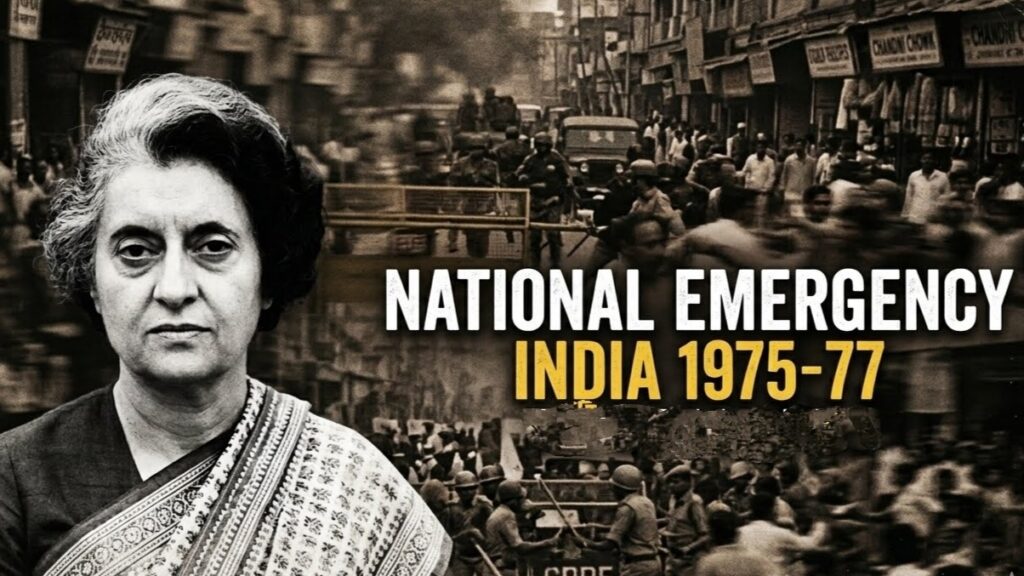
- For the first time, the textbook includes a dedicated section on the 1975–77 Emergency, describing it as a major challenge to Indian democracy.
- The chapter explains the suspension of rights, institutional stress and restrictions on civil liberties during the period.
- Unlike the previous Democratic Politics-I textbook, the revised edition does not reproduce the Constitution’s Preamble or explain each term contained in it.
- Instead, constitutional values are discussed through the Constitution-making process, institutions and rights.
- The textbook starts by explaining why India needed a Constitution, how it was framed, and how it protects democratic governance.
- The earlier explanation of “Secular” and “Secularism” has been removed.
- However, the book continues to discuss freedom of religion, equality, justice, liberty and fraternity through constitutional provisions.
- The revised text highlights the Constituent Assembly (1946), Constitution-making, Fundamental Rights, democratic institutions and citizenship, presenting the Constitution as a robust, flexible and transformative document.
- The judiciary is described as an “impartial and independent institution” that safeguards constitutional values, protects citizens’ rights, reviews government actions and hears Public Interest Litigations (PILs).
- Beyond the Emergency, the book examines misinformation, social inequality, citizen participation and democratic accountability, linking historical lessons with contemporary governance challenges.
- The curriculum adopts competency-based learning, interdisciplinary themes, inquiry-based activities and real-life case studies to improve analytical thinking, aligning with NEP 2020 reforms.
What is Mentioned in New NCERT Class 9 Textbook on Emergency?
- For the first time, NCERT’s Class 9 Social Science textbook contains a separate section on the 1975–77 Emergency, integrating it into the chapter on India’s democratic strengths and challenges.
- The textbook characterises the Emergency as “one of the major challenges to Indian democracy”, explaining that democratic institutions and constitutional safeguards came under severe stress during this period.
- The Book mentioned that the Emergency was proclaimed on 25 June 1975 under constitutional provisions then in force and remained until March 1977, making it one of India’s most significant constitutional episodes.
- The chapter explains that most Fundamental Rights were suspended, significantly restricting citizens’ constitutional protections and altering the balance between individual liberty and executive authority.
- A major focus is press censorship. The book states that newspapers and media faced strict government censorship, limiting public access to independent information and criticism.
- The textbook notes that many opposition leaders and political activists were arrested, illustrating how political dissent was curtailed during the Emergency period.
- The book mentioned that civil liberties, including freedoms of expression and political activity, were severely restricted, demonstrating the consequences of concentrated executive power.
- The inclusion comes nearly 50 years after the Emergency, marking a major curriculum revision aimed at strengthening students’ understanding of constitutional history and democratic values and governance.
Emergency & Related Facts:
- Meaning: The Emergency is a special constitutional provision that allows the Union Government to assume extraordinary powers during grave national crises.
- Constitutional Basis: These provisions are contained in Part XVIII (Articles 352–360) of the Constitution of India.
- The Constitution provides three types of emergencies: National Emergency (Article 352), President’s Rule or State Emergency (Article 356), and Financial Emergency (Article 360).
- Objective: Their objective is to protect the sovereignty, unity, security and constitutional governance of the country during exceptional situations.
- National Emergency: A National Emergency under Article 352 may be proclaimed by the President of India if the security of India or any part of it is threatened by war, external aggression, or armed rebellion.
- Before issuing the proclamation, the Union Cabinet must communicate its decision to the President in writing.
- The proclamation must be approved by both Houses of Parliament within one month by a special majority and, once approved, remains valid for six months, with extensions possible every six months through fresh parliamentary approval.
- Powers: When a National Emergency is in force, the Central Government’s powers expand significantly.
- Parliament can legislate on matters in the State List, the Union may issue binding directions to states, and India’s federal structure temporarily becomes more centralised.
- Certain Fundamental Rights may be restricted; however, after the 44th Constitutional Amendment (1978), the rights under Articles 20 and 21—protection in criminal cases and the right to life and personal liberty—cannot be suspended.
- The amendment also replaced the earlier ground of “internal disturbance” with the stricter term “armed rebellion” to reduce the possibility of misuse.
- History: India has declared a National Emergency three times: 1962 during the Sino-Indian War, 1971 during the Indo-Pakistan War and National Emergency, 1975–1977.
- In 1975–1977, Prime Minister Indira Gandhi advised President Fakhruddin Ali Ahmed to proclaim an Emergency citing internal disturbance, the wording then in the Constitution.
- Duration: The 1975–77 Emergency, lasting 21 months, remains the most controversial.
- Reasons: Before the Emergency, India faced high inflation (over 20%), unemployment, food shortages, labour strikes and widespread public dissatisfaction following the 1973 oil crisis.
- Mass protests led by Jayaprakash Narayan (JP Movement) demanded electoral reforms and the resignation of the government. These developments created a severe political crisis.
- Also, the Allahabad High Court found Prime Minister Indira Gandhi guilty of electoral malpractice in her 1971 Lok Sabha election from Rae Bareli.
- The Court invalidated her election and barred her from holding elected office for six years, although the Supreme Court later granted a conditional stay pending appeal. This intensified the political confrontation.
- Proclamation: On the advice of Prime Minister Indira Gandhi, President Fakhruddin Ali Ahmed proclaimed a National Emergency. The proclamation took effect on the night of 25 June 1975.
- Major Events: Within hours, thousands of opposition leaders, activists and journalists—including Jayaprakash Narayan, Morarji Desai, Atal Bihari Vajpayee and L.K. Advani—were detained, mainly under the Maintenance of Internal Security Act (MISA), 1971. Political protests were effectively suppressed.
- The government imposed pre-publication censorship on newspapers. Many Fundamental Rights, including the ability to seek judicial remedies for certain rights, were suspended. Public meetings, demonstrations and criticism of the government were heavily restricted.
- During the Emergency, Parliament passed the 38th, 39th and 42nd Constitutional Amendments. The 42nd Amendment (1976) significantly expanded Parliament’s powers, strengthened the Centre, curtailed aspects of judicial review and added the words “Socialist”, “Secular” and “Integrity” to the Preamble.
- The government launched Indira Gandhi’s Twenty-Point Programme to reduce poverty, control prices, improve land reforms and increase production. Simultaneously, Sanjay Gandhi’s Five-Point Programme promoted literacy, family planning, tree plantation, abolition of dowry and eradication of caste discrimination.
- However, the family planning campaign became controversial due to reports of coercive sterilisation in several regions.
- End: In January 1977, Indira Gandhi announced general elections. The Emergency was formally revoked on 21 March 1977.
- In the subsequent elections, the Janata Party won a historic victory, and Morarji Desai became India’s first non-Congress Prime Minister.
- In 1975–1977, Prime Minister Indira Gandhi advised President Fakhruddin Ali Ahmed to proclaim an Emergency citing internal disturbance, the wording then in the Constitution.
- Post-Emergency Reforms: The 44th Constitutional Amendment Act, 1978 introduced safeguards against misuse of Emergency powers.
- It replaced “internal disturbance” with “armed rebellion” in Article 352, required written Cabinet advice, and ensured that Articles 20 and 21 could never be suspended during a National Emergency.
FAQs:
What changes have been made to the new NCERT Class 9 textbook?
It integrates subjects, adds the Emergency chapter, and revises constitutional content under NEP 2020.
Has the Preamble been removed from the new textbook?
The Preamble’s full text is omitted, though constitutional values remain discussed.
Why was the Secularism chapter removed?
NCERT has not officially explained the omission; constitutional rights and religious freedom remain covered.
Why has the Emergency been added to the syllabus?
NCERT says it teaches students about a major democratic challenge and constitutional governance.
What is the objective of the new NCERT curriculum?
It promotes competency-based, interdisciplinary learning aligned with NEP 2020 and NCF-SE 2023.
Disclaimer: Information in this article is based on official announcements and public records. Regulations and implementation details may evolve over time.
| Also Read: NCERT Class 8 Textbook Judiciary Controversy |