



72nd National Film Awards – Article 370 Named Best Film, Check Complete Winners List
| General Studies Paper I: Awards, Important Personalities |
Why in News?
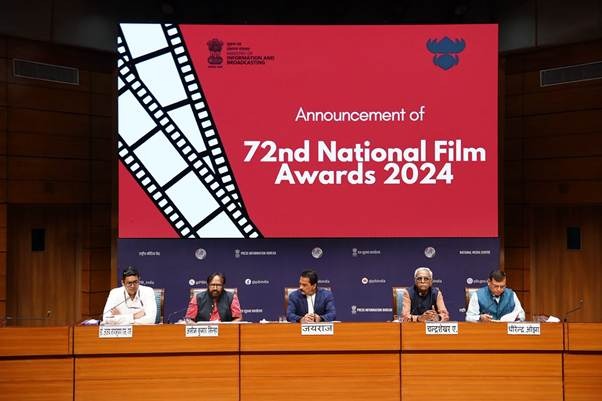
Recently, the 72nd National Film Awards for the year 2024 were announced by the Ministry of Information & Broadcasting, recognising winners across feature, non-feature, and technical categories.
Highlights of 72nd National Film Awards
- Announcement: The 72nd National Film Awards were announced on 18 July 2026 at the National Media Centre, New Delhi.
- Only films that received Central Board of Film Certification (CBFC) certification between 1 January and 31 December 2024 were eligible and recognised this year.
- Jury Members: Total 11 jury members were there. Core jury chairpersons:
- The acclaimed Malayalam filmmaker Shri Jayaraj (Feature Films Jury Head) led the primary 11-member Central Jury.
- He managed the screening process where regional panels trimmed 400 entries down to 52 core films for final central evaluation.
- Shri Aseem Sinha (Non-Feature Films Jury Head) led the dedicated panel evaluating documentaries, short films, and non-theatrical productions.
- Shri A. Chandrasekhar (Best Writing on Cinema Jury Head) headed the committee reviewing film literature, research books, and cinematic critiques.
- Selection followed a two-stage process involving regional juries and a central jury, ensuring balanced representation.
- The acclaimed Malayalam filmmaker Shri Jayaraj (Feature Films Jury Head) led the primary 11-member Central Jury.
- Award Categories: This year the awards covered Feature Films, Non-Feature Films, Writing on Cinema, and Technical Excellence. Primary National Film Award Winners across these categories include:
- Feature Film Awards:
- Best Feature Film: Article 370 (Hindi), directed by Aditya Suhas Jambhale.
- Best Actor in a Leading Role (Shared): Kartik Aaryan for Chandu Champion (Hindi) and Mammootty for Bramayugam (Malayalam).
- Best Actress in a Leading Role: Yami Gautam for her performance in Article 370.
- Best Direction: Rajkumar Periasamy for the biographical action film Amaran (Tamil).
- Best Debut Film of a Director: Randeep Hooda for Swatantrya Veer Savarkar (Hindi).
- Best Popular Film Providing Wholesome Entertainment: Kalki 2898 AD (Telugu), directed by Nag Ashwin.
- Best Supporting Actor: Sanjay Mishra for Bhakshak (Hindi).
- Best Debut Director: Randeep Hooda for Swatantrya Veer Savarkar.
- Best Supporting Actress (Shared): Sachana Namidass for Maharaja (Tamil) and Ropashree Varkady for Mithya (Kannada).
- Best Feature Film Promoting National, Social, and Environmental Values: Captain Miller (Tamil).
- Best Children’s Film: 35 – Chinna Katha Kaadu (Telugu).
- Non-Feature Film & Writing Awards:
- Best Non-Feature Film: Bhangaar (Marathi & English), produced and directed by Sumira Roy.
- Best Documentary: Ram-Nami (Hindi), directed by Bharatbala Ganapathy.
- Best Film Critic: Sanjeev Shrivastava (Hindi).
- Best Book on Cinema: Naaniruvude Nimagaagi Naadiruvude Nanagaagi: Kannada Cinemada Thathva matthu Rajakeeya by Kenchanuru Pradeep Kumar Shetty.
- Major Technical Awards:
- Best Screenplay (Original): Bandreddi Sukumar for Pushpa: The Rule – Part 2 (Telugu).
- Best Music Direction (Songs): Shashwat Sachdev for Article 370.
- Best Music Direction (Background Score): G. V. Prakash Kumar for Amaran.
- Best Choreography: Vijay Ganguly for the song “Aaj Ki Raat” in Stree 2 (Hindi).
- Best Action Direction (Stunt Choreography): Anl Arasu for Maharaja.
- Best Male Playback Singer: Abhay Jodhpurkar for “Navasachi Gauri Mazi” (Marathi).
- Best Female Playback Singer: Vaikom Vijayalakshmi for “Angu Vaana Konilu” (Malayalam).
- Best Lyrics: Manoj Muntashir for “Jaane Do” from Maidaan.
What are National Film Awards?
- About: The National Film Awards are India’s premier, government-sponsored cinematic honors.
- They are presented annually by the President of India in New Delhi to recognize excellence across the nation’s diverse, multilingual film industry.
- The awards are generally announced annually.
- Establishment: Established in 1954, the awards were initially conceived as “State Awards for Films” to encourage high aesthetic, technical, and educational.
- They were officially renamed to the National Film Awards in 1967.
- Administering Authority: The awards are currently organized by the National Film Development Corporation (NFDC), functioning under the Ministry of Information and Broadcasting (I&B).
- Historically, this role was managed by the Directorate of Film Festivals (DFF).
- Categories: The accolades are divided into three core sections: Feature Films, Non-Feature Films, and Best Writing on Cinema.
- Major Honours: The principal honours include the Swarna Kamal and Rajat Kamal accompanied by certificates and cash prizes in eligible categories.
- Golden Lotus (Swarna Kamal): The Swarna Kamal represents the highest tier of recognition. It is awarded in major categories including Best Feature Film, Best Direction, Best Children’s Film, and the Best Film in AVGC (Animation, Visual Effects, Gaming, and Comic).
- Silver Lotus (Rajat Kamal): The Rajat Kamal is awarded to outstanding individual and technical achievements. This includes awards for Best Actor, Best Actress, Best Cinematography, Best Editing, Best Sound Design, and Best Choreography, along with regional language film awards.
- Dadasaheb Phalke Award: The Dadasaheb Phalke Award, India’s highest lifetime honour in cinema, is presented as part of the National Film Awards framework.
- It was instituted in 1969 to commemorate Dadasaheb Phalke‘s monumental contribution as the director of India’s first full-length feature film.
- The recipient receives a Swarna Kamal, a shawl, and a cash prize worth ₹15 Lakhs.
- Eligibility Criteria: Only films that are primarily produced in India and certified by the Central Board of Film Certification (CBFC) between January 1 and December 31 of the preceding year are eligible.
- The director and key creators must normally be Indian nationals, though specific provisions exist for eligible co-productions.
- Selection Process: Winners are selected through an independent jury system comprising eminent personalities from cinema, literature, arts and humanities.
- The evaluation emphasizes merit, creativity, originality, technical excellence and social impact rather than box-office success.
- The Feature Film section utilizes a rigorous two-tier process: regional panels first shortlist the entries, and a national panel decides the final winners.
- National Film Festival: Following the award ceremony in New Delhi, the government inaugurates the National Film Festival.
- During this festival, all award-winning films are screened for the public and international viewers.
- Significance: Awards are presented for the Best Film in each language specified in the Eighth Schedule of the Constitution of India, thereby promoting national integration, and regional cultures.
- The awards promote the constitutional ideals of unity in diversity, and preserve India’s cultural heritage.
| Renamed Awards: The Indira Gandhi Award is now the Best Debut Film of a Director. The Nargis Dutt Award is now the Best Feature Film Promoting National, Social, and Environmental Values. |
FAQs:
1. Who won the National Film Awards 2026?
Mammootty and Kartik Aaryan jointly won Best Actor; Yami Gautam won Best Actress.
2. Which film received the Best Feature Film award?
Article 370 won the Best Feature Film award.
3. Who won the Best Actor award at the National Film Awards 2026?
Mammootty and Kartik Aaryan jointly won the Best Actor award.
4. Who won the Best Actress award?
Yami Gautam won the Best Actress award for Article 370.
5. Which ministry announces the National Film Awards?
The Ministry of Information and Broadcasting announces the National Film Awards.
Disclaimer: Information in this article is based on official announcements and public records. Regulations and implementation details may evolve over time.