New Delhi BRICS Declaration 2026- Empowering Global South for Sustainable Growth
| General Studies Paper II: Important International Institutions, Agreements Involving India or Affecting India’s Interests |
Why in News?
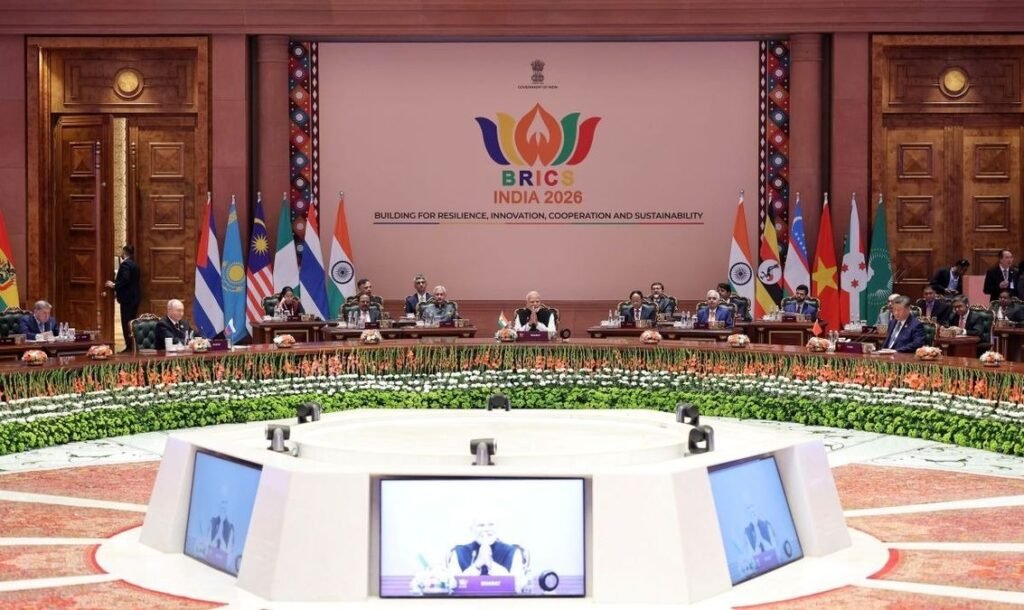
Recently, the 18th BRICS Summit 2026 hosted by India concluded with the unanimous adoption of the New Delhi Declaration, signalling a monumental shift toward inclusiveness.
What is the New Delhi BRICS Declaration 2026?
- About: The BRICS New Delhi Declaration 2026 is the consensus-based joint declaration adopted by BRICS leaders at the 18th BRICS Summit in New Delhi.
- The declaration was adopted on 12 September 2026 under India’s 2026 BRICS chairship theme, “Building for Resilience, Innovation, Cooperation and Sustainability.”
- Under India’s presidency, more than 400 ministerial, official and technical meetings were organised across 30 Indian cities, reflecting a broad, decentralised and development-oriented agenda.
- It records the members’ shared positions on global governance, peace & security, and cooperation.
- Prime Minister Narendra Modi announced that no member had raised an objection, confirming its unanimous adoption.
- The New Delhi Declaration contains 140 numbered points and is approximately 45 pages long.
- It covers issues ranging from international security and terrorism to trade, finance, climate, technology and development.
- The declaration was adopted on 12 September 2026 under India’s 2026 BRICS chairship theme, “Building for Resilience, Innovation, Cooperation and Sustainability.”
- Major Highlights:
- Reform of the United Nations: BRICS reaffirmed its commitment to comprehensive UN reform, including greater representation of developing countries in the UN Security Council.
- The declaration recognised African aspirations under the Ezulwini Consensus and Sirte Declaration and noted support from China and Russia for greater roles for Brazil and India in the UN system, including the Security Council.
- Gender and Geographical Representation in Global Institutions: The declaration noted that no woman has ever been elected UN Secretary-General and called for greater equitable geographical representation in senior positions across international organisations.
- It opposed institutional monopolisation by particular states and emphasised broader representation in global governance.
- Opposition to Protectionism and Trade Barriers: BRICS strongly opposed unilateral protectionist tariffs and non-tariff barriers.
- It specifically highlighted concerns regarding Carbon Border Adjustment Mechanisms (CBAMs), arguing that such measures can distort international trade and place additional burdens on developing countries while being presented as environmental measures.
- Reform of Bretton Woods Institutions: BRICS called for faster IMF quota increases under the 16th General Review of Quotas and meaningful quota realignment under the 17th General Review, guided by the Diriyah Guiding Principles.
- The objective is to better reflect the growing economic weight of Emerging Markets and Developing Economies (EMDEs).
- Reforming the World Trade Organisation: The declaration advocated the immediate restoration of a fully functional, two-tier, binding WTO dispute-settlement mechanism and called for the prompt appointment of Appellate Body members. This seeks to strengthen the rules-based multilateral trading system.
- WTO Accession of Ethiopia and Iran: The declaration endorsed the WTO accession bids of Ethiopia and Iran, reflecting BRICS support for broader participation in the multilateral trading system and deeper integration of developing economies into global trade institutions.
- Zero Tolerance Towards Terrorism: BRICS condemned terrorism in all its forms and manifestations and reiterated a policy of zero tolerance.
- It rejected double standards in dealing with terrorism and called for coordinated international action against terrorist organisations designated by the United Nations.
- Pahalgam Terrorist Attack: The declaration specifically condemned the 22 April 2025 terrorist attack in Jammu and Kashmir, which resulted in 26 deaths.
- This gives particular diplomatic significance to India’s long-standing demand for stronger international cooperation against terrorism.
- Counter-Narcotics Cooperation: The declaration welcomed the Guwahati Declaration adopted by the BRICS Heads of Anti-Drug Agencies.
- The initiative seeks stronger coordination among members against drug trafficking and related threats.
- Comprehensive Convention on International Terrorism: BRICS called for the swift finalisation and adoption of the Comprehensive Convention on International Terrorism (CCIT) within the UN framework. It also supported coordinated multilateral action against UN-designated terrorist entities.
- Local-Currency Settlements: BRICS tasked the BRICS Payment Task Force (BPTF) with advancing practical, fast and low-cost cross-border payment interoperability.
- It encouraged settlements and investment using BRICS local currencies, rather than pursuing a single top-down BRICS currency.
- BRICS Insurance Resilience Centre: The declaration welcomed discussions on establishing a BRICS Insurance Resilience Centre (BIRC) to strengthen collective reinsurance capacity.
- It also noted member support for India’s proposal to establish a BRICS Risk Lab at GIFT City IFSC, Gujarat.
- Jaipur Consensus and MSME Financing: BRICS endorsed the Jaipur Consensus to develop an Invoice Discounting Mechanism for member countries.
- The mechanism aims to unlock working capital for export-oriented MSMEs, strengthening trade finance and small-business participation in international commerce.
- BRICS Grain Exchange: The declaration endorsed discussions on operationalising a BRICS Grain Exchange and expanding its scope to other agricultural commodities.
- This is aimed at strengthening agricultural trade and food-security cooperation among members.
- BRICS AGRIN: BRICS established AGRIN — Agro-Inputs, Genetic Resources, and Information Network as a farmer-centric collaborative platform.
- It also launched the Global Forum on Farmers’ Rights in Seed Systems, linking agricultural cooperation with farmer interests and seed resources.
- Gaza and the Palestinian Peace Mandates: BRICS expressed grave concern over the humanitarian catastrophe in Gaza and reaffirmed support for a sovereign and viable State of Palestine within the 1967 borders, with East Jerusalem as its capital, under the two-state solution. It also supported full UN membership for Palestine.
- Humanitarian Access to Gaza: The declaration opposed the forced displacement of Palestinians, endorsed the provisional measures of the International Court of Justice (ICJ) and demanded unhindered humanitarian access, including through UNRWA.
- Sudan, Syria and Cuba: BRICS welcomed African Union peace initiatives for Sudan, supporting the principle of “African solutions to African problems.”
- It also called for the withdrawal of foreign forces from Syria and urged an end to the unilateral blockade against Cuba, consistent with UN General Assembly resolutions.
- Lebanon and UNSC Resolution 1701: BRICS welcomed the ceasefire in Lebanon and called for full adherence to UN Security Council Resolution 1701.
- It also condemned attacks against UNIFIL peacekeepers and expressed condolences over the deaths of Indonesian and other peacekeepers.
- Nuclear Safety and IAEA Safeguards: The declaration condemned deliberate attacks against peaceful civilian nuclear facilities operating under full International Atomic Energy Agency (IAEA) safeguards, highlighting the importance of nuclear safety and international monitoring mechanisms.
- Green Energy and CBDR-RC: BRICS emphasised technological neutrality and the principle of Common But Differentiated Responsibilities and Respective Capabilities (CBDR-RC).
- It recognised that fossil fuels remain necessary for energy transitions in developing countries alongside renewable energy.
- Digital Public Infrastructure: The declaration supported creation of a BRICS Digital Public Infrastructure Repository to facilitate the sharing and scaling of open-source digital public goods among members.
- This reflects India’s emphasis on Digital Public Infrastructure (DPI) as a development tool.
- Yuri Gagarin Jubilee: BRICS commemorated the 65th anniversary of Yuri Gagarin’s first human space flight, which occurred on 12 April 1961. The reference connects BRICS cooperation with the broader history of international space exploration.
- Smart Grids and Energy Storage: The declaration initiated the BRICS Digital Centre of Excellence for Smart Grids and Energy Storage under the BRICS Energy Research Cooperation Platform (ERCP).
- The initiative focuses on technological cooperation for modern and resilient energy systems.
- Integrated Landscape Restoration: BRICS welcomed the Principles for Integrated Landscape-Based Greening and Land Restoration.
- The approach covers multiple ecosystems, including forests, wetlands, mangroves, peatlands and arid savannahs, rather than treating ecosystems in isolation.
- Critical Minerals: BRICS stressed the importance of resilient, diversified and sustainable critical-mineral supply chains.
- At the same time, it reaffirmed the sovereign rights of resource-rich countries over their domestic mineral deposits.
- Traditional Medicine Cooperation: The declaration proposed a dedicated BRICS Expert Working Group on Traditional, Complementary and Integrative Medicine (TCIM).
- Its proposed role includes coordinating scientific research and pharmacopoeia standardisation.
- Artificial Intelligence Governance: BRICS acknowledged the outcomes of India’s AI Impact Summit and Shanghai’s World AI Conference.
- Members committed to implementing the BRICS Leaders’ Statement on Global Governance of Artificial Intelligence, highlighting cooperation on responsible AI governance.
- Space Cooperation: The declaration finalised amendments allowing additional member space agencies to participate in the BRICS Remote Sensing Satellite Constellation (RSSC).
- It also drafted the Terms of Reference for the BRICS Space Council, strengthening institutional space cooperation.
- Gig and Platform Workers: BRICS adopted BRICS CONNECT — Cooperation Network for Capacity Building, Employability, and New Skills and Technologies.
- It focuses on anticipating green and digital labour-market changes and developing social-security portability frameworks for cross-border and platform/gig workers.
- International Big Cats Alliance: The declaration acknowledged India’s initiative to lead the International Big Cats Alliance (IBCA) and encouraged cooperation among BRICS members to protect endangered big-cat species across their natural ranges.
- BRICS Mission for Healthy Lifestyle: BRICS endorsed the BRICS Mission for Healthy Lifestyle (2026–2029).
- It also established a BRICS Network of Centres of Excellence on mental well-being, with NIMHANS, Bengaluru, designated as the coordinating nodal centre.
- Pandemic Preparedness: BRICS established a dedicated sub-working group to operationalise the BRICS Integrated Early Warning System for Mass Infectious Diseases. The initiative aims to strengthen collective preparedness against future health emergencies.
- UNFCCC, CBD and Paris Agreement: The declaration reaffirmed the importance of the UNFCCC and Convention on Biological Diversity (CBD) and adherence to the Paris Agreement.
- It called on developed countries to fulfil their commitments regarding climate finance and technology transfer, particularly for adaptation.
- Tropical Forest Forever Facility: BRICS welcomed the Tropical Forest Forever Facility (TFFF) launched at the COP30 Belém Climate Summit. The facility seeks to mobilise long-term, results-based financing for tropical forest conservation.
- Reform of the United Nations: BRICS reaffirmed its commitment to comprehensive UN reform, including greater representation of developing countries in the UN Security Council.
Frequently Asked Questions (FAQs):
1. What is the New Delhi BRICS Declaration 2026?
The New Delhi BRICS Declaration is the 140-point consensus document adopted at the 18th BRICS Summit, covering governance, security, economy, technology, health and sustainability.
2. When was the New Delhi Declaration adopted?
The declaration was adopted on 12 September 2026 during the 18th BRICS Summit, hosted by India in New Delhi.
3. What are the key points of the BRICS Declaration?
Key priorities include UN reform, WTO reform, counter-terrorism, local-currency payments, AI governance, critical minerals, climate action, health and Global South cooperation.
4. What did BRICS leaders agree in New Delhi?
Leaders agreed to strengthen multilateralism, developing-country representation, economic cooperation, interoperable payments, food security, digital infrastructure, space cooperation and sustainable development.
5. What role did India play in the BRICS Summit 2026?
As 2026 chair, India organised the summit and over 400 meetings, promoting a people-centric, development-oriented Global South agenda focused on RICS priorities.
6. What did the BRICS Declaration say about global conflicts?
It addressed Gaza, Palestine, Lebanon, Sudan, Syria and nuclear-facility security, emphasising humanitarian protection, international law, diplomacy and peaceful conflict resolution.
Disclaimer: Information in this article is based on official announcements and public records. Regulations and implementation details may evolve over time.
| Also Read: Global Power Alliance “BRICS” |