




New Zealand Parliament Passes India–New Zealand FTA, Set to Take Effect on October 16
| General Studies Paper II: Bilateral Groupings & Agreements, International Treaties & Agreements |
Why in News?
Recently, the New Zealand Parliament passed the India–New Zealand Free Trade Agreement (FTA) on September 16, 2026by a decisive 93–29 vote.
- The agreement is expected to enter into force in mid-October 2026, following final domestic ratification processes from both countries.
What is India–New Zealand Free Trade Agreement (FTA)?
- About: The India–New Zealand Free Trade Agreement (FTA) is a comprehensive economic partnership pact designed to deeply integrate trade, investment, and labor mobility between the two nations.
- Background:
- Negotiations first launched in 2010 but stalled by 2015 due to disagreements over sensitive sectors like dairy.
- In March 2025, following a bilateral leadership meeting, formal negotiations officially resumed, led by an entirely women-led team.
- In December 2025, following fast-tracked rounds, negotiations successfully concluded, making it one of India’s fastest-finalized FTAs.
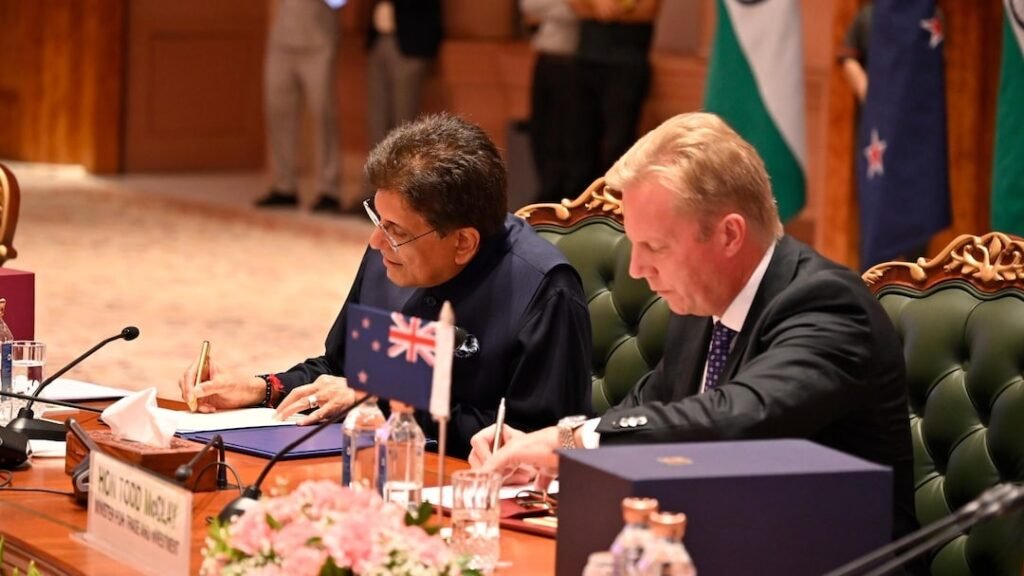
- On April 27, 2026, the landmark pact was formally signed by both nations at Bharat Mandapam in New Delhi.
- It was officially signed by India’s Union Minister of Commerce and Industry, Piyush Goyal, and New Zealand’s Minister for Trade and Investment, Todd McClay.
Highlights of India–New Zealand FTA
- Zero Duties for India: New Zealand will provide 100% duty-free access for India’s exports across all tariff lines.
- Earlier, some Indian exports faced tariffs of up to 10% in New Zealand.
- Major beneficiaries include textiles, apparel, leather, footwear, gems and jewellery, engineering goods and processed food.
- India will also receive duty-free access to important manufacturing inputs. These include wooden logs, coking coal, and metal waste and scraps.
- Calibrated Market Opening: India liberalised 70.03% of tariff lines, covering about 95% of bilateral trade value.
- Around 29.97% of tariff lines remain excluded.
- Sensitive sectors include dairy, several agricultural products, sugar, edible oils, rubber, gems and jewellery, copper and aluminium products.
- About 30% of tariff lines receive immediate duty elimination.
- Another 35.60% undergo phased tariff elimination over three, five, seven or ten years.
- Protection of Sensitive Sectors: India strategically excluded 29.97% of its tariff lines to shield local producers.
- Critically, the entire dairy sector along with staples like onions, wheat, sugar, and rice are kept out of the deal.
- Selected New Zealand products such as apples, kiwifruit and Mānuka honey will use Tariff Rate Quotas (TRQs).
- A Joint Agriculture Productivity Council will monitor relevant arrangements. The agreement also promotes agricultural productivity through Centres of Excellence.
- Broader Market Access: The agreement unlocks 118 services sectors, facilitating easier operations for IT, healthcare, education, and construction professionals.
- India also receives Most-Favoured-Nation commitments in about 139 sub-sectors.
- Eased Visas and Talent Pathways: New Zealand has introduced a special quota of 5,000 temporary employment visas for skilled Indian professionals.
- Furthermore, a dedicated Student Mobility Annex eliminates caps on Indian students while offering 3 to 4 years of post-study work rights.
- A working-holiday pathway will cover 1,000 young Indians annually.
- Globalizing AYUSH: For the first time, New Zealand officially recognizes and facilitates trade in India’s traditional medicine systems, including Ayurveda and Yoga.
- Geographical Indication (GI) Security: New Zealand has committed to updating its GI laws within 18 months.
- This ensures iconic Indian non-liquor goods, like Basmati Rice, receive the highest legal protection.
- Massive FDI Commitment: New Zealand has bound itself to invest USD 20 billion in India over 15 years.
- Potential areas include: Agriculture, Manufacturing, Infrastructure, Start-ups, Renewable energy, Digital services, and Emerging technologies.
- A built-in rebalancing clause allows India to suspend trade benefits if this investment target falls short.
- Pharmaceuticals and Medical Devices: The FTA seeks to reduce regulatory barriers for Indian pharmaceutical exports.
- New Zealand will facilitate acceptance of relevant Good Clinical Practice (GCP)/Good Manufacturing Practice (GMP) inspection reports from comparable regulators, including the US FDA, EMA, UK MHRA and Health Canada.
- This can reduce: Duplicate inspections, Compliance costs, Approval timelines.
- Rules of Origin and Trade Remedies: The agreement establishes Product-Specific Rules of Origin to ensure that preferential tariffs benefit genuine Indian and New Zealand products.
- Verification mechanisms aim to prevent: Circumvention, Falsification and Misuse of preferential tariffs.
- A bilateral safeguard mechanism can also be used when a sudden import surge causes or threatens serious injury to a domestic industry.
- Trade Facilitation and SPS Standards: The agreement seeks faster and more predictable customs procedures.
- Standard cargo clearance is targeted within 48 hours.
- Express shipments and perishables are targeted for clearance within 24 hours.
- Electronic certification and single-window systems are encouraged.
- Dedicated Sanitary and Phytosanitary (SPS) and Technical Barriers to Trade (TBT) provisions address non-tariff barriers.
India–New Zealand Economic Relations
- Foundation: India and New Zealand established diplomatic relations in 1952, while India’s Trade Commission in New Zealand had already been established in 1950 and was later upgraded to a High Commission.
- Economic ties developed around trade, education, agriculture, tourism and people-to-people links.
- Both countries also share Commonwealth membership and common-law traditions.
- Key policy include New Zealand’s “Opening Doors to India” policy (2011) and the “India-NZ 2025 – Investing in the Relationship” strategy (2020).
- Recently, ties were upgraded to a Strategic Partnership accompanied by the Roadmap to 2030.
- Institutional Mechanism:
- In 1986, India and New Zealand established the Joint Trade Committee (JTC) to address bilateral trade issues and develop economic dialogue.
- The 11th JTC meeting was held in April 2024, covering wider economic relationships.
- In August 2024, India and New Zealand signed a Customs Cooperation Arrangement to strengthen customs collaboration and facilitate legitimate trade.
- Authorised Economic Operator – Mutual Recognition Agreement (AEO MRA, 2025): Fast-tracks customs clearances for trusted traders.
- Agricultural Productivity Partnerships: Non-tariff cooperation establishing centers of excellence for horticulture, cold-chain tech, and food safety.
- Bilateral Trade: Bilateral merchandise trade reached approximately US$1.3 billion in FY 2024–25, registering nearly 49% growth over the previous year.
- India is New Zealand’s second-largest trading partner in Oceania, although the overall trade relationship remains relatively modest compared with India’s major trading partners.
- India’s principal exports to New Zealand include pharmaceuticals and medicines, machinery, textiles and made-up textile articles, and pearls, precious stones and metals.
- New Zealand’s exports to India are concentrated in wool, iron and steel, fruits and nuts, and aluminium.
- Bilateral discussions cover horticulture, agricultural technology, food safety, market access and productivity.
- Services Trade: Services are an important but often overlooked component of bilateral economic relations.
- India’s services exports to New Zealand were about US$634 million in 2024, while total bilateral goods-and-services trade was approximately US$2.4 billion.
- Travel, IT and business services are important contributors to services trade.
- Investment and FDI: New Zealand’s direct investment presence in India has historically been modest.
- DPIIT data show cumulative New Zealand FDI equity inflows of about US$87.14 million through 2024, indicating substantial scope for investment expansion.
- Indian companies such as TCS, Infosys, HCL, Tech Mahindra, Mahindra, Dr. Reddy’s Laboratories and Royal Enfield have a presence in New Zealand.
- New Zealand firms such as Gallagher, Rakon and others operate in India; notably, Rakon established a Bengaluru manufacturing facility through a joint venture with Centum Electronics, with its technology contributing to Chandrayaan-3.
- An Air Services Agreement was also signed in 2023, supporting greater connectivity and economic interaction.
- Education and Human Capital: India stands as the second-largest source of international students for New Zealand.
- New Zealand has been an important destination for Indian students, particularly in IT, engineering, science, architecture and hospitality.
- Tourism, migration and the Indian diaspora support bilateral economic relations.
- New Zealand has around 300,000 people of Indian origin or Indian diaspora, providing an important cultural and commercial bridge.
Significance of the India–New Zealand Relationship
- Geo-Political Alignment: Both democratic commonwealth nations champion a rules-based order, upholding UNCLOS to secure open sea lanes against assertive regional powers.
- New Zealand strongly endorses India’s permanent UNSC and Nuclear Suppliers Group candidatures.
- This partnership allows New Zealand to act as a natural bridge for India to expand its Act East policy into the Pacific Island nations.
- Indo-Pacific Security: New Zealand’s formal integration into India’s Indo-Pacific Oceans Initiative (IPOI) and shared command operations under Combined Task Force 150 (CTF-150) fortify counter-narcotics and maritime surveillance in critical sea-lanes.
- Macro-Economic Targets: To tap unutilized economic complementarities, both nations implemented the Roadmap to 2030, targeting a doubling of bilateral trade to NZ$7 billion (₹35,000 crore) from its current NZ$3.99 billion threshold.
- Agricultural Modernization: New Zealand’s world-class cooperative dairy models (like Fonterra) and cold-chain logistics are ideal blueprints for reducing India’s post-harvest losses.
- Workforce & Market Access: India is crucial to New Zealand’s growth, acting as its top source of skilled migrants to fill vital shortages in IT, healthcare, and engineering.
- India’s digital market of nearly one billion internet users offers massive opportunities for Kiwi tech firms in AI, fintech, and e-commerce.
Frequently Asked Questions (FAQs):
1. What is the India–New Zealand Free Trade Agreement?
The India–New Zealand FTA is a trade pact reducing tariffs and expanding market access, services, investment, and professional mobility.
2. When will India–New Zealand FTA come into force?
It will come into force after both countries complete their respective domestic procedures and formally notify implementation.
3. What are the key benefits of India–New Zealand FTA?
Benefits include duty-free exports, greater services access, investment opportunities, professional mobility, MSME support, and agricultural productivity cooperation.
4. Which Indian products will benefit from the New Zealand FTA?
Major beneficiaries include textiles, apparel, leather, footwear, gems, jewellery, engineering goods, pharmaceuticals, processed foods, machinery, and chemicals.
5. How will the India–New Zealand trade deal reduce tariffs?
New Zealand will eliminate duties on 100% of Indian exports, while India phases reductions across selected tariff lines and protects sensitive sectors.
Disclaimer: Information in this article is based on official announcements and public records. Details may evolve over time.
| Also Read: India-UK Free Trade Agreement |