



Pakistan Raises Bounty on JeM Chief Masood Azhar, Experts Calls It Diplomatic Smokescreen
| General Studies Paper II: India’s Neighbourhood, Agreements Involving India or Affecting India’s Interests |
Why in News?
Recently, Pakistan raised the bounty on Jaish-e-Mohammed chief Masood Azhar to PKR 70 lakh, listing him as a fugitive ahead of Financial Action Task Force (FATF) scrutiny.
Who is Masood Azhar?
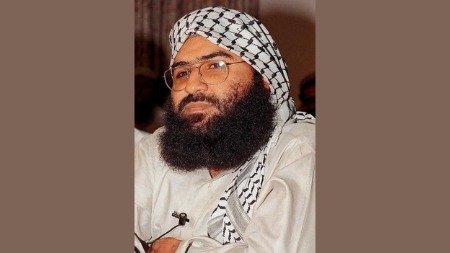
- About: Masood Azhar Alvi is a Pakistani Islamist militant and founder/chief of Jaish-e-Mohammed (JeM).
- The United Nations (UN) identifies him as a Pakistani national, born in Bahawalpur, Punjab, and designated him under its Al-Qaida sanctions regime in 2019.
- The UN Security Council listed JeM on 17 October 2001 under sanctions framework.
- He is deeply rooted in the Deobandi school of thought, having been educated at the Jamia Uloom-al-Islamia in Karachi, a known hub for the Pakistani military-madrassa nexus.
- He was associated with Harakat-ul-Ansar/Harakat-ul-Mujahidin, militant organisations active in Afghanistan and Jammu and Kashmir.
- The United Nations (UN) identifies him as a Pakistani national, born in Bahawalpur, Punjab, and designated him under its Al-Qaida sanctions regime in 2019.
- Background:
- Azhar entered India in 1994 to orchestrate operational integration between warring militant factions in Jammu & Kashmir but Indian authorities arrested him for militant activities.
- On 24 December 1999, Indian Airlines flight IC-814 was hijacked and eventually taken to Kandahar, Afghanistan. The hijackers demanded the release of Masood Azhar, Omar Sheikh and Mushtaq Zargar; India released the three prisoners to secure the hostages’ freedom.
- Following his release, Azhar founded Jaish-e-Mohammed on February 4, 2000.
- It means “Army of Mohammed” and operates primarily to separate Jammu and Kashmir from India.
- The organization relies on an extreme Deobandi jihadism and Sunni Islamist ideology.
- The group funnels money through seemingly legitimate humanitarian covers, most notably the Al-Rehmat Trust and the Al-Furqan Trust.
- The UN states that the organisation emerged with support from Osama bin Laden, the Taliban and other extremist organisations.
- Azhar entered India in 1994 to orchestrate operational integration between warring militant factions in Jammu & Kashmir but Indian authorities arrested him for militant activities.
- Terror Attacks:
- On 1 October 2001, JeM claimed responsibility for a suicide attack on the Jammu and Kashmir Legislative Assembly complex in Srinagar; the UN records that at least 31 people were killed.
- On 13 December 2001, the Indian Parliament was attacked. The UN records that JeM and Lashkar-e-Taiba were implicated; the attack killed nine people and injured 18.
- It resulted in Operation Parakram and brought India and Pakistan to the brink of a conventional war.
- It directly prompted the creation of India’s swift-retaliation Cold Start military doctrine.
- In January 2016, heavily armed Jaish-e-Mohammed operatives infiltrated the strategic Pathankot Air Force Station in Punjab, killing seven security personnel.
- India launched Operation Dhangu, a multi-day joint counter-terror operation to neutralize the attackers.
- India indefinitely suspended formal comprehensive bilateral talks with Islamabad.
- On September 18, 2016, four Jaish-e-Mohammed terrorists attacked an Indian Army brigade headquarters in Uri, Jammu and Kashmir, killing 19 soldiers.
- In response, the Indian Army carried out targeted cross-border surgical strikes on the night of September 28-29, 2016, across the Line of Control.
- In February 2019, a Jaish-e-Mohammed suicide bomber rammed an explosives-laden vehicle into a security convoy in Pulwama, killing 40 CRPF jawans.
- India countered instantly with the historic Balakot airstrikes. Indian Air Force Mirage 2000 jets crossed the border to bomb an advanced JeM terror training camp in Khyber Pakhtunkhwa, Pakistan.
- Economically, India stripped Pakistan of its Most Favoured Nation trade status and imposed a 200% customs tariff.
- In April 2025, terrorists linked to Pakistan-backed networks executed the Pahalgam massacre, killing 26 civilian tourists in Kashmir.
- India responded by launching Operation Sindoor on May 7, 2025. The Indian military executed multi-domain precision missile strikes, deploying BrahMos and SCALP missiles to destroy JeM’s main headquarters in Bahawalpur, Pakistan.
- The punitive strike decimated the group’s infrastructure and neutralized over 100 operatives, including ten close relatives of Masood Azhar.
- India’s Domestic Ban on JeM:
- India subsequently designated Jaish-e-Mohammed/Tahrik-ul-Furqan as a terrorist organisation under the Unlawful Activities (Prevention) Act, 1967 [UAPA]. The organisation remains on India’s terrorist-organisation list.
- India pursued international law-enforcement mechanisms against Azhar. India’s 2019 notification records INTERPOL Red Corner Notices A-1086/7-2004 and A-4367/5-2016, demonstrating the long-running effort to locate and prosecute him internationally.
- India repeatedly sought Azhar’s UN designation. Earlier attempts faced opposition, particularly from China, which blocked proposals.
- After the Pulwama attack and sustained diplomatic pressure, the UN Security Council’s sanctions committee finally designated him on 1 May 2019.
- The UN Security Council Al-Qaida Sanctions Committee designated Mohammed Masood Azhar Alvi under Resolution 1267-related sanctions.
- His listing subjects him to asset freeze, travel ban and arms embargo.
- The principal UN mechanism relevant to Azhar is the UN Security Council’s ISIL (Da’esh) and Al-Qaida Sanctions Committee, originating from the 1267 sanctions framework and subsequently modified through Resolutions 1989 and 2253.
- After amending the UAPA, India separately designated Masood Azhar as an individual terrorist and placed him in Schedule IV. The government cited his leadership of JeM and involvement in terrorist attacks in India.
Pakistan’s Stance and Bounty Increase Decision
- Official Stance:
- Pakistan officially banned JeM in 2002 under its Anti-Terrorism Act.
- Following Azhar’s UN listing as a global terrorist in May 2019, Pakistan issued formal orders to freeze his assets and restrict his travel.
- Pakistan, as a UN member state, is required to implement applicable Security Council sanctions.
- Pakistan officially maintains that Masood Azhar is not on its soil and has fled to Afghanistan.
- It claims that the JeM founder fled across the Durand Line in May 2019 and is actively operating from Afghan soil.
- The Taliban administration in Kabul completely rejects Pakistan’s narrative.
- Actions:
- Pakistan’s Counter-Terrorism Departments (CTD) have registered several First Information Reports (FIRs) against Azhar.
- As of September 2026, Pakistan’s Federal Investigation Agency (FIA) updated its “Red Book” of most-wanted fugitives.
- His name was included in the FIA’s Red Book of most-wanted terrorists in 2021.
- FIA included Masood Azhar in its 2026 Most Wanted/Fugitive framework and increased the reward for information leading to his capture from PKR 20 lakh to PKR 70 lakh.
- The announcement comes ahead of an upcoming October Financial Action Task Force (FATF) plenary session.
- Analysts interpret the measure partly through the lens of Pakistan’s efforts to demonstrate stronger counter-terrorist-financing and law-enforcement credentials.
FATF and Pakistan Engagement Matrix
- About FATF: The Financial Action Task Force (FATF) is the premier global inter-governmental policy-making body dedicated to establishing international standards to eliminate money laundering, terrorist financing, and the financing of weapons of mass destruction.
- It was established in 1989 during the G7 Summit in Paris to tackle the soaring threat of international money laundering.
- It was created as a “Task Force” driven by political will, administratively hosted at the OECD headquarters in Paris.
- It comprises 40 members—consisting of 38 jurisdictions (including major economies like the US, UK, India, and China) and 2 regional organizations (the European Commission and the Gulf Cooperation Council). (Note: The Russian Federation’s membership was suspended in 2023).
- Through 9 FATF-Style Regional Bodies (FSRBs)—such as the Asia/Pacific Group (APG) and MONEYVAL—over 200 jurisdictions worldwide are bound to implement FATF standards.
- Mandates:
- 1989: Combat international money laundering (AML).
- 2001: Expanded to counter terrorist financing (CFT) following the 9/11 attacks.
- 2012: Expanded to prevent proliferation financing of weapons of mass destruction (CPF).
- 2019–Present: Granted an open-ended, permanent mandate by its ministers.
- The FATF Plenary is the supreme decision-making body that meets three times a year.
- Decisions (including listing and delisting countries) are made strictly by technical consensus among members, rather than unilateral political decisions.
- The FATF actively reviews countries using stringent peer compliance metrics to ensure they adopt the “40 Recommendations”.
- The Compliance Lists:
- Grey List (Increased Monitoring): For countries with strategic gaps in their financial frameworks that have committed to a swift resolution plan.
- Black List (High-Risk Jurisdictions): For non-cooperative nations facing severe counter-measures and global financial isolation (e.g., Iran, North Korea, Myanmar).
- Pakistan Engagement:
- Pakistan is not a core member of the FATF itself but is monitored through its membership in the Asia/Pacific Group (APG).
- The country’s relationship with the watchdog has spanned multiple volatile cycles of listing and delisting:
- 2008: Pakistan was placed on the Grey List for the first time due to missing legislative frameworks regarding money laundering and basic financial oversight.
- 2010: Following the introduction of the Anti-Money Laundering Ordinance (AMLO), Pakistan was temporarily taken off the list.
- 2012: Placed on the Grey List again. The oversight shifted toward structural vulnerabilities allowing the United Nations Security Council (UNSC) banned terror organizations to access domestic funds.
- 2015: Pakistan amended its Anti-Terrorism Act to streamline asset freezing, leading to its removal from the list after fulfilling a basic action plan.
- June 2018: Pakistan was downgraded to the Grey List for a third time due to deep-seated deficiencies in tracking illicit funding paths for high-profile UN-designated terrorist groups. It was handed a grueling 27-point action plan.
- June 2021: While still completing the initial 27 points, the FATF handed Pakistan an additional 7-point action plan targeting money laundering tied to parallel systems (like Hawala/Hundi) and complex criminal networks.
- October 2022: After highly publicized regulatory overhauls, high-profile prosecutions/convictions of terror commanders, and a successful FATF on-site verification visit, Pakistan achieved full consensus for removal from the Grey List.
- Current Status: Pakistan remains under regular follow-up assessments conducted by the APG.
Frequently Asked Questions (FAQs):
1. How much has Pakistan increased the bounty on Masood Azhar?
Pakistan increased the bounty by PKR 20 lakh, raising it from PKR 50 lakh to PKR 70 lakh.
2. What is the current bounty on Masood Azhar?
The current bounty is PKR 70 lakh (7 million Pakistani rupees) for information leading to his apprehension or conviction.
3. Why has Pakistan increased the Masood Azhar bounty?
The increase comes ahead of the October 2026 FATF plenary, amid scrutiny over Pakistan’s counter-terrorism compliance.
4. Why is Masood Azhar listed in the Pakistan FIA Red Book?
He is listed as a fugitive and most-wanted terrorist, with Pakistan offering a reward for information leading to his capture.
5. Who is Jaish-e-Mohammed Chief Masood Azhar?
Masood Azhar founded Jaish-e-Mohammed, a UN-designated terrorist organisation linked to major attacks against India.
Disclaimer: Information in this article is based on official announcements and public records. Regulations and implementation details may evolve over time.
| Also Read: 17th Anniversary of Mumbai 26/11 Attacks |