



Rajya Sabha Elections 2026- ECI Announces Polls for UP, Uttarakhand, WB Seats
| General Studies Paper II: Parliament, Indian Constitution |
Why in News?
Recently, the Election Commission of India (ECI) scheduled October 16 polls for 12 Rajya Sabha seats across Uttar Pradesh, Uttarakhand, and West Bengal.
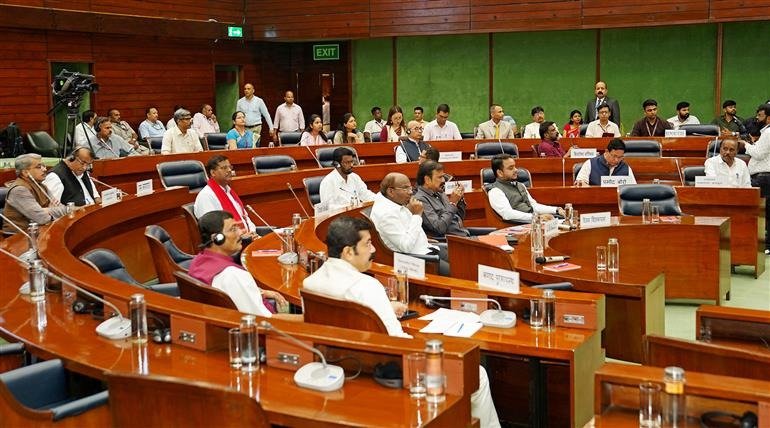
Rajya Sabha Elections 2026
- Announcement: The Election Commission of India (ECI) announced on 22 September 2026 elections covering 12 Rajya Sabha seats across Uttar Pradesh, Uttarakhand and West Bengal.
- The exercise comprises 11 biennial elections—10 from Uttar Pradesh and one from Uttarakhand—and one bye-election for a vacant West Bengal seat.
- Election Schedule: The notification will be issued on 29 September 2026, marking the formal beginning of the electoral process.
- Candidates can file nominations until 6 October, followed by scrutiny on 7 October.
- The last date for withdrawal of candidature is 9 October.
- Polling is scheduled for 16 October, from 9:00 AM to 4:00 PM, with counting at 5:00 PM the same day.
- The complete electoral process is scheduled to conclude by 19 October 2026.
- The elected member will serve the remaining term, scheduled to end on 2 April 2032.
- Seats:
- Uttar Pradesh accounts for 10 seats. Nine seats are reaching the end of their normal six-year terms on 25 November 2026, while another seat became vacant following the resignation of Dinesh Sharma after his appointment as Lieutenant Governor of the Andaman and Nicobar Islands.
- Uttarakhand has one biennial seat in the election, currently represented by Naresh Bansal, whose term ends on 25 November 2026.
- West Bengal involves a separate bye-election for a seat vacated following the resignation of Rukmini Mallik (Koel Mallick) on 16 July 2026.
What Are Rajya Sabha Elections?
- About: Rajya Sabha elections are elections for India’s Council of States, the Upper House of Parliament.
- Unlike Lok Sabha elections, Rajya Sabha members representing States are not directly elected by citizens.
- They are elected by the elected members of the concerned State Legislative Assembly through proportional representation by means of the Single Transferable Vote (STV).
- A Rajya Sabha member must satisfy the constitutional qualifications under Article 84.
- The minimum age is 30 years. Other statutory and constitutional requirements govern citizenship and qualifications.
- A Rajya Sabha member must satisfy the constitutional qualifications under Article 84.
- Permanent House: Under Article 83(1), Rajya Sabha is a permanent House and is not subject to dissolution.
- Instead, approximately one-third of its members retire every second year, with replacements elected for another term.
- Rajya Sabha provides institutional continuity even when the Lok Sabha is dissolved.
- Types: A biennial election normally replaces members whose six-year terms have expired.
- A bye-election fills a casual vacancy arising from resignation, death, disqualification or another circumstance before the normal term expires.
- Constitutional Foundation: The principal constitutional provision is Article 80, which deals with the composition of the Council of States.
- It provides for representatives of States to be elected by elected members of State Legislative Assemblies through proportional representation using STV.
- The STV system allows MLAs to indicate preferences rather than simply choosing one candidate.
- Votes can therefore transfer according to subsequent preferences when candidates are elected or eliminated.
- The STV system allows MLAs to indicate preferences rather than simply choosing one candidate.
- Article 80 also provides for 12 nominated members, chosen by the President from persons having special knowledge or practical experience in literature, science, art and social service.
- It provides for representatives of States to be elected by elected members of State Legislative Assemblies through proportional representation using STV.
- Administration: The Election Commission of India conducts and supervises these elections, while Returning Officers undertake the procedural responsibilities relating to nominations, scrutiny, polling and counting.
- The Representation of the People Act, 1951 (RPA 1951) provides the principal statutory framework for conducting parliamentary elections, including nomination and election procedures.
Rajya Sabha Election Process
- Notification: The Election Commission of India (ECI) issues an official notification announcing the election schedule at least three months before the retirement of sitting members.
- Filing of Nominations: Aspiring candidates file their official nomination papers before the appointed Returning Officer (RO) of the respective state.
- A candidate’s nomination must be proposed by at least 10% of the elected members of the state legislative assembly, or by 10 MLAs, whichever is less.
- Candidates do not need to be domiciled in the state they are contesting from (following the Representation of the People (Amendment) Act, 2003), and they must declare their party affiliation or status as an independent.
- Scrutiny and Withdrawal: The Returning Officer scrutinizes the nomination papers to verify eligibility criteria, such as a minimum age of 30 years and Indian citizenship, after which candidates are given a designated window to voluntarily withdraw their nominations.
- Voting Process: The voting body consists strictly of the elected members of the Legislative Assemblies (MLAs) of the states and specific Union Territories, while nominated MLAs are completely barred from voting.
- The election is conducted using the system of Proportional Representation by means of the Single Transferable Vote (STV).
- Rather than choosing a single candidate, each voting MLA marks their preferences (1, 2, 3, etc.) next to the candidates’ names on a single ballot paper.
- Open Ballot System: To curb cross-voting and corruption, under Open Ballot System in 2003, an open ballot system is used where every MLA belonging to a political party must show their marked ballot paper to their authorized party agent before dropping it into the ballot box.
- Independent MLAs are explicitly prohibited from showing their ballot papers to any party agent to maintain the secrecy of their individual votes.
- Vote-Value and Quota Calculation: Before counting begins, every individual MLA’s vote is assigned a fixed base value of 100 points to allow for fractional arithmetic during subsequent vote transfers.
- The total value of valid votes in the state is calculated by multiplying the number of voting MLAs by 100.
- The system applies a specific mathematical formula to determine the minimum value of votes a candidate needs to secure an immediate win.
- This is calculated using a standard formula: [(Total Valid Votes / (Seats to be filled + 1)) + 1].
- For example, If a state has 200 MLAs voting to fill 4 seats, the total vote value is 20,000, which makes the winning quota exactly 4,001 points (equivalent to 41 first-preference votes).
- Counting and Elimination: The Returning Officer first sorts and counts all the first-preference (Number 1) votes cast by the MLAs.
- Any candidate whose total accumulated vote value meets or exceeds the established quota is instantly declared elected.
- If a candidate receives more first-preference votes than the required quota, their excess value is treated as a surplus.
- This surplus value is transferred to the remaining candidates based on the second-preference (Number 2) choices marked on those specific ballot papers.
- If seats remain vacant because no candidate reaches the quota after the surplus transfer, the candidate with the lowest value of votes is eliminated from the race.
- The votes of the eliminated candidate are redistributed to the continuing candidates according to the next available preferences
- This iterative loop of elimination and transfer continues chronologically until all vacant Rajya Sabha seats are successfully filled.
Important Facts About Rajya Sabha
- Under Article 80, Rajya Sabha has a maximum sanctioned strength of 250 members: up to 238 representatives of States and Union Territories and 12 nominated members.
- The current strength is 245, comprising 233 elected representatives and 12 nominated members.
- The allocation of elected seats among States and eligible Union Territories is provided in the Fourth Schedule of the Constitution.
- Rajya Sabha is the Council of States. Their seats are allocated broadly according to population, meaning larger States have more representatives.
- The present elected membership includes representatives from States and the Union Territories of Delhi, Puducherry and Jammu & Kashmir.
- This differs from the U.S. Senate model, where every State has equal representation.
- Uttar Pradesh has 31 Rajya Sabha seats, the highest allocation among Indian States.
- Uttarakhand has three Rajya Sabha seats.
- West Bengal has 16 Rajya Sabha seats.
- Every Rajya Sabha member normally serves a six-year term. However, individual members do not all retire simultaneously because the House follows a staggered retirement system.
- The Vice-President of India serves as the ex-officio Chairman of Rajya Sabha.
- The Rajya Sabha functions as an essential revising chamber that provides a secondary review of legislation passed by the Lok Sabha to improve quality and prevent hasty laws
- Under Article 249 (Legislation on State List), it can pass a resolution by a two-thirds majority allowing Parliament to make laws on a matter listed in the State List in the national interest.
- Under Article 312 (All India Services), it can authorize the creation of new All India Services (like the IAS or IPS) common to both the Union and the States.
- If the Lok Sabha is dissolved when a Proclamation of Emergency is issued (or its dissolution takes place during the approval period), the Rajya Sabha can approve the proclamation on its own.
- This approval keeps the emergency valid until the new Lok Sabha can meet and vote on it within 30 days of its reconstitution.
- The Rajya Sabha holds zero power to reject or amend the Money Bill. It can only delay a Money Bill for up to 14 days and suggest recommendations. The Lok Sabha is completely free to accept or reject these recommendations.
Frequently Asked Questions (FAQs):
1. When will the Rajya Sabha Elections 2026 be held?
Polling is scheduled for 16 October 2026, from 9:00 AM to 4:00 PM; counting begins at 5:00 PM.
2. Which states will vote in the Rajya Sabha Elections 2026?
Uttar Pradesh, Uttarakhand and West Bengal will participate in the October 2026 Rajya Sabha electoral exercise.
3. How many Rajya Sabha seats are up for election in UP?
10 Uttar Pradesh seats are covered, including nine biennial vacancies and one existing casual vacancy.
4. How many Rajya Sabha seats are up for election in Uttarakhand?
One Uttarakhand seat is up for the biennial election, with incumbent Naresh Bansal’s term ending on 25 November 2026.
5. How many Rajya Sabha seats are up for election in West Bengal?
One West Bengal seat will be filled through a bye-election following Rukmini Mallik’s resignation.
6. Who conducts the Rajya Sabha Elections 2026?
The Election Commission of India (ECI) conducts and supervises Rajya Sabha elections under the constitutional electoral framework.
7. What is the Rajya Sabha election process?
Elected MLAs vote through proportional representation using Single Transferable Vote (STV); nominations, scrutiny, polling and counting follow ECI procedures.
Disclaimer: Information in this article is based on official announcements and public records. Details may evolve over time.
| Also Read: Rajya Sabha Elections |