Rajya Sabha Elections
|
General Studies Paper II: Indian Constitution, Parliament |
Why in News?
Recently, the Election Commission announced Rajya Sabha elections for 24 seats across 10 states to be held on June 18, following retirement of members.
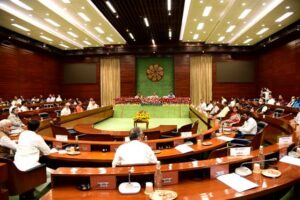
What Is Rajya Sabha?
- Constitutional Position: The Rajya Sabha is the Upper House of Parliament of India, representing the federal structure of the country.
- Composition Strength: It has a maximum strength of 250 members, of which 238 represent States and Union Territories.
- The other 12 are nominated by the President for their expertise in literature, science, art, and social service.
- The current strength is around 245 members (233 representing States and Union Territories (Delhi, Puducherry, and Jammu & Kashmir) and 12 nominated members).
- Permanent Nature: Unlike the Lok Sabha, the Rajya Sabha is a permanent body and is never dissolved completely, ensuring uninterrupted parliamentary functioning and continuity in governance and legislative review.
- To retain fresh functional insights, one-third of members retire every two years, establishing a cyclical flow of governance.
- Representation of States: It provides proportional representation to states, reflecting India’s federal character.
- Seat distribution is governed by the Fourth Schedule, scaling strictly with population size.
- Larger states have more representation, ensuring a balance between population-based influence and regional interests.
- Uttar Pradesh holds the highest presence with 31 seats, while smaller states possess just one.
- Leadership Structure: The Vice President of India serves as the ex-officio Chairman, while the Deputy Chairman is elected from among members.
- Member Tenure: Every legislator here serves a definitive six-year term.
- Casual mid-term vacancies arising from resignation or death are managed through bye-elections targeting only the remaining period of that specific seat.
- Age Threshold: To qualify for a seat, individuals must hold Indian citizenship and be at least 30 years old.
- This structural age floor preserves its institutional identity as the “House of Elders“.
- Legislative Role: Rajya Sabha acts as a revising chamber, carefully examining bills passed by Lok Sabha.
- It can suggest amendments, improving legislative quality and preventing hasty decision-making in law formation.
- Special Powers: It holds unique constitutional powers such as enabling Parliament to legislate on State List subjects under Article 249 and approving creation of All India Services under Article 312, strengthening national integration.
- If any Proclamation of Emergency is issued while the Lok Sabha is dissolved, the Rajya Sabha temporarily holds the sole legislative power to approve and maintain it, provided the lower house subsequently acts on it shortly after its reconstitution.
- Financial Limitations: In money-related legislation, Rajya Sabha has limited authority.
- The house can exercise coordinate power on ordinary bills but holds zero power to reject Money Bills.
- It can only recommend changes within 14 days, after which the Lok Sabha’s decision prevails, maintaining financial supremacy of the Lower House.
- Quorum Requirement: For the house to officially conduct meetings and vote, a minimum of 10% of total members must be physically present. This establishes a strict operational floor of 25 attendees for valid sessions.
- Role in Governance: Rajya Sabha acts as a deliberative body of experts and experienced members, contributing intellectual depth, policy scrutiny, and long-term vision in governance, strengthening India’s democratic and parliamentary framework.
How Is Rajya Sabha Election Process Conducted?
- Constitutional Basis: The Rajya Sabha election process is defined under Article 80 of the Constitution of India, which establishes indirect representation of States and Union Territories.
- Nomination Rules: The Representation of the People (Amendment) Act, 2003, permanently removed the domicile requirement.
- A candidate no longer needs to belong to the electing state. They only need to be a registered voter in any parliamentary constituency across India.
- Indirect Representation: Members of the Rajya Sabha are elected indirectly by the people.
- Rather than citizens voting directly, the Electoral College consisting exclusively of the elected Members of Legislative Assemblies (MLAs) of the States and Union Territories casts the decisive ballots.
- Core Methodology: The election utilizes the Proportional Representation method.
- This is executed specifically via the Single Transferable Vote (STV) system.
- Voters do not choose a solitary candidate but instead rank multiple contestants on a single ballot in order of personal preference.
- Mathematical Quota: To secure a seat, a candidate must hit a specific threshold called the winning quota.
- This is calculated using a standard formula: [(Total Valid Votes / (Seats to be filled + 1)) + 1].
- For instance, if 200 MLAs vote for 4 vacancies, the required quota is 41 votes.
- Vote Multiplication: During calculation, each MLA’s primary ballot holds a numerical value assigned as 100 points.
- This prevents mathematical fractions during the processing stages.
- Consequently, the total voting power of a house equals the number of MLAs multiplied by 100.
- Preference Hierarchy: An MLA marks numerical rankings like 1, 2, 3 next to candidate names.
- A ballot must feature a clear first-preference vote to remain valid.
- If a candidate secures the mathematical quota through first-preference markings alone, they are immediately declared elected.
- Surplus Distribution: If a candidate exceeds the quota, their surplus votes are transferred to remaining candidates based on the voters’ second preferences.
- This transfer occurs at a reduced fractional value, maximizing the utility of every single vote cast in the round.
- Elimination Stage: If vacant seats remain open after counting first choices, the candidate with the lowest vote count is eliminated.
- Their secured ballots are not wasted; instead, they are redistributed to remaining contenders based on subsequent preferences until all seats are filled.
- Transparency Framework: To curb corruption and institutional cross-voting, Parliament introduced the Open Ballot System in 2003.
- Every MLA representing a political party must show their marked ballot to their party’s authorized agent before dropping it into the box.
- Independent Provision: The open ballot rule does not apply to non-aligned lawmakers. Independent MLAs cannot show their marked ballot papers to any party agent.
- Their votes remain completely secret to protect their autonomous status within the legislative assembly.
- Defection Immunity: The Supreme Court ruled in Kuldip Nayar v. Union of India (2006) that voting against a party line does not trigger the Tenth Schedule (Anti-Defection Law).
- Cross-voting MLAs do not lose their assembly seats, though their parties can take separate disciplinary actions.
- The Supreme Court of India scrapped the NOTA option for Rajya Sabha elections in 2018 because it violates the system of proportional representation and encourages corruption.
- Supervisory Authority: The entire electoral exercise is strictly managed by the Election Commission of India under Article 324.
- The Commission issues notifications, appoints Returning Officers, monitors cross-voting, and signs off on final certified results.
|
4th Schedule:
10th Schedule:
|
|
Also Read: Cross-Voting in Rajya Sabha Elections |