Indigenous Vayu Astra-1 Drone
|
General Studies Paper III: Defence Technology, Indigenous Technology |
Why in News?
Recently, India successfully tested the indigenous Vayu Astra-1 loitering munition drone at Pokhran and Joshimath.
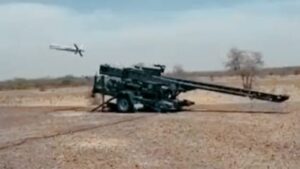
What is Vayu Astra-1 Drone?
- About: The Vayu Astra-1 is an advanced, indigenously developed loitering munition system, popularly classified as a “kamikaze” or suicide drone.
- It acts as a flying smart weapon designed to combine surveillance and precision-strike capabilities into a single aerial platform.
- It adapts a high-performing Israeli-origin platform to match stringent local operational specifications.
- Objective: The weapon system is developed to provide the Indian Army with deep tactical strike options inside enemy territory.
- Developed By: This lethal drone has been completely designed and engineered by Nibe Limited, a prominent private defence technology firm based in Pune, Maharashtra.
- Range: The system features an impressive operational range of 100 km, allowing it to cover vast distances for monitoring and tactical oversight.
- Endurance: It is engineered for extended flight endurance, remaining airborne for over 90 minutes to provide sustained situational awareness over a specific area of interest.
- Navigation: One of the core technical strengths is its high-precision guidance system, which utilizes advanced GPS and inertial navigation.
- During performance evaluations, the platform demonstrated the ability to navigate to specific coordinates with a Circular Error Probable (CEP) of less than one meter.
- Mission Flexibility: The platform is equipped with an abort-and-recovery function, allowing operators to terminate a flight path if mission parameters change.
- This capability ensures that the equipment can be safely redirected or commanded to loiter in a holding pattern until further instructions are received from the control center.
- Night Vision: For operations in low-light conditions, the system integrates a high-definition Infrared (IR) sensor suite.
- This technology enables the detection and tracking of objects based on thermal signatures, providing clear imagery during nighttime.
- Signal Handover Technology: A significant technological milestone achieved is the seamless signal handover between different control units.
- The command can be transferred from a primary Ground Control Station (GCS) to a mobile unit located up to 70 km away, ensuring continuous link stability during long-distance deployments.
- High-Altitude Performance: The structural integrity of the system allows it to operate effectively at altitudes exceeding 14,000 feet.
- It has been rigorously tested in sub-zero temperatures and thin atmospheric conditions, proving its resilience in mountainous and rugged terrains.
- Testing: The system underwent extensive No Cost No Commitment (NCNC) trials in diverse geographical locations, including the desert regions of Pokhran and the high-altitude areas of Joshimath.
- The drone successfully destroyed a distant target using a 10-kg warhead, providing deep battlefield engagement capability for frontline commanders.
- These trials validated the reusability of the platform, confirming that the unit can be recovered and redeployed for multiple missions.
Strategic Importance For India
- Border Warfare Advantage: Vayu Astra-1 significantly strengthens India’s tactical dominance along sensitive border states including Ladakh, Arunachal Pradesh, Jammu & Kashmir, Rajasthan, and Punjab.
- Operating with a 100 km tactical depth, it protects frontiers in volatile sectors like Jammu & Kashmir against cross-border infiltration without deploying human troops.
- Indigenous Defence Expansion: The drone supports India’s Make in India defence manufacturing strategy by reducing dependency on imported loitering munitions.
- Defence experts state India still imports critical UAV components, making indigenous platforms strategically essential for long-term operational sovereignty.
- Drone Warfare Transformation: Modern conflicts in Ukraine, West Asia, and South Asia have proven that low-cost kamikaze drones can reshape warfare economics.
- Indian military planners now view drone swarms and autonomous precision systems as force multipliers across infantry, artillery, and armored formations. Vayu Astra-1 fits directly into this evolving doctrine.
- Precision Strike Capability: The platform demonstrated advanced operational functions including abort mission, re-attack mode, infrared night targeting, and remote control transfer.
- Such features improve survivability, decentralized battlefield command, and coordinated strikes in complex combat theatres across multiple Indian operational sectors.
- Future Military Doctrine: Indian defence analysts increasingly consider autonomous drones central to future wars because of their cost-effectiveness, rapid deployment, and precision lethality.
- Vayu Astra-1 represents India’s transition toward AI-assisted precision warfare, where unmanned systems may increasingly supplement artillery, missiles, and conventional strike platforms.
|
India’s Indigenous Drone Fleet:
|
|
Also Read: Indigenous ULPGM-V3 Missile |