AFSPA Extension 2026, AFSPA in Manipur, Nagaland and Arunachal Pradesh
| General Studies Paper II: Center-State Relations, Emergency Provisions |
Why in News?
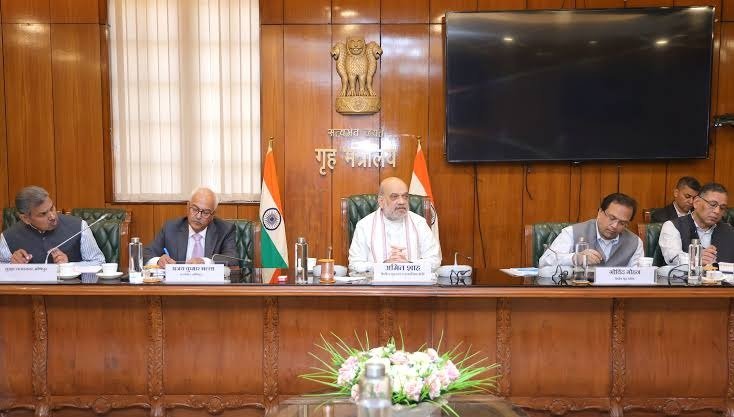
Recently, the Ministry of Home Affairs (MHA) extended Armed Forces (Special Powers) Act (AFSPA) for six months starting October 1, 2026, in parts of Manipur, Nagaland, and Arunachal Pradesh.
AFSPA Extension 2026 in Manipur, Nagaland and Arunachal Pradesh
- Announcement: The Ministry of Home Affairs extended the Armed Forces (Special Powers) Act, 1958 (AFSPA) in specified disturbed areas of Manipur, Nagaland and Arunachal Pradesh for another six months, effective 1 October 2026.
- The declarations will remain operative until 31 March 2027, unless withdrawn earlier.
- The notifications were issued after a fresh review of the law-and-order situation and exercise of powers under Section 3 of AFSPA.
- Coverage:
- In Manipur, the Centre has declared the entire State a disturbed area, excluding areas under 13 police stations across five districts.
- The excluded police stations are Imphal, Lamphel, City, Singjamei, Patsoi and Wangoi in Imphal West; Porompat, Heingang and Irilbung in Imphal East; Thoubal; Bishnupur and Nambol; and Kakching.
- In Nagaland, AFSPA covers nine complete districts: Dimapur, Niuland, Chümoukedima, Mon, Kiphire, Noklak, Phek, Peren and Meluri.
- It additionally covers specified areas under 21 police stations in five other districts—Kohima, Mokokchung, Longleng, Wokha and Zunheboto.
- In Arunachal Pradesh, AFSPA remains applicable throughout Tirap, Changlang and Longding districts, along with areas under Namsai, Mahadevpur and Chowkham police stations in Namsai district, particularly the areas bordering Assam.
- AFSPA has previously been reduced in parts of Assam, Nagaland and Manipur; in April 2022, for example, the Government reduced disturbed areas in all three States.
- In Manipur, the Centre has declared the entire State a disturbed area, excluding areas under 13 police stations across five districts.
What is AFSPA?
- About: The Armed Forces (Special Powers) Act, 1958 is a parliamentary law enabling specified special powers to be conferred upon armed forces personnel operating in areas formally declared “disturbed areas.”
- The Act presently extends statutorily to Arunachal Pradesh, Assam, Manipur, Meghalaya, Mizoram, Nagaland and Tripura, although its actual operation varies geographically.
- Objective: Its objective is to enable the military to combat internal security threats—such as insurgency, militancy, and secessionist movements—that local police forces are deemed insufficient to handle.
- Background: The act originates from the Armed Forces (Special Powers) Ordinance of 1942, enacted by the British colonial government to suppress the Quit India Movement.
- Faced with a growing Naga insurgency in the Northeast, the Indian Parliament enacted the Armed Forces (Assam and Manipur) Special Powers Act in 1958.
- As internal conflicts shifted and grew, the law was adapted for other regions:
- The Punjab and Chandigarh Act (1983): Enacted to counter the Khalistan militancy (withdrawn in 1997).
- The Jammu & Kashmir Act (1990): Enacted to address the rise of armed militancy in the state (remains in force).
- Legal Framework: AFSPA operates under a specific legal framework governed by a few critical sections of the act:
- Section 3 (Declaring a “Disturbed Area”): The Governor of a State, the Administrator of a Union Territory, or the Central Government can declare an entire state/union territory, or a specific region within it, as “disturbed.”
- This happens if they believe the area is in a dangerous condition due to differences or disputes between religious, racial, language, or regional groups.
- Section 4 (Extraordinary Powers): Once an area is declared disturbed, any commissioned officer, warrant officer, or non-commissioned officer of the armed forces is granted the power to:
- Fire upon or use force (even causing death) against any person acting in contravention of the law, after giving a due warning.
- Arrest without a warrant anyone who has committed, or is suspected of committing, a cognizable offense.
- Enter and search any premises without a warrant to make arrests or recover concealed weapons.
- Stop and search any vehicle suspected of carrying suspects or contraband.
- Section 6 (Legal Immunity/Sanction): This is the most controversial clause. It states that no prosecution, suit, or legal proceeding can be instituted against security personnel for actions taken under the act, except with the prior sanction of the Central Government.
- Section 5 requires arrested persons to be handed over to the nearest police station with the least possible delay, together with a report explaining the circumstances of arrest.
Arguments in Favour of AFSPA
- Combating Asymmetric Warfare: Insurgency, cross-border terrorism, and proxy wars (e.g., in parts of the Northeast and Jammu & Kashmir) cannot be tackled using standard law-and-order machinery. The military requires special legal frameworks to operate effectively in these hostile environments.
- Legal Protection and Morale of Forces: Soldiers operating in counter-insurgency zones face split-second, life-or-death decisions. Section 6 of AFSPA provides immunity from prosecution (except with Central Government sanction), which protects forces from malicious litigation and maintains institutional morale.
- Operational Autonomy: The power to search premises, arrest without a warrant, and use force (even causing death) after due warning ensures that tactical operations against heavily armed terrorists are not hindered by bureaucratic or procedural delays.
- Assisting Inadequate Civil Power: When local police and administration are overwhelmed by armed rebellions or ethnic violence, the state requires the armed forces as a measure of last resort to restore the authority of the constitution.
- Preserving National Integrity: Proponents argue that AFSPA has successfully contained secessionist movements over the decades, preventing the balkanization of sensitive border states.
Arguments Against AFSPA
- Violation of Fundamental Rights: The act severely restricts the Right to Life and Personal Liberty (Article 21) and protection against arbitrary arrest (Article 22). The power to shoot on mere suspicion bypasses the constitutional principle of due process.
- Culture of Impunity and Human Rights Abuses: Armed with legal immunity, the forces have faced allegations of fake encounters, torture, sexual violence, and enforced disappearances. Critics point out that the Central Government rarely grants sanction to prosecute personnel in civilian courts.
- Alienation of the Local Population: The prolonged deployment of the military under AFSPA creates a psychological gap between citizens and the Indian state. It fosters resentment, which insurgents often exploit for recruitment, thereby perpetuating the cycle of violence.
- Subversion of Civil Administration: By relying heavily on AFSPA, state governments avoid the hard work of reforming, modernizing, and strengthening the local police force. It turns a political and socio-economic problem into a permanent military issue.
- Conflict with International Law: International bodies, including the UN Human Rights Committee, have routinely questioned AFSPA, stating it violates the International Covenant to which India is a signatory.
Judicial Perspective & Safeguards:
| Key Judgment / Committee | Core Finding / Recommendation |
| Naga People’s Movement for Human Rights vs. Union of India (1997) | The SC upheld the constitutionality of AFSPA but laid down “Do’s and Don’ts” to prevent misuse. It ruled that the declaration of a “disturbed area” must be reviewed every 6 months. |
| Extra Judicial Execution Victim Families Association Case (2016) | The SC ruled that indefinite deployment of the armed forces under AFSPA mocks civic liberties and stated that even under AFSPA, the military does not enjoy absolute immunity if excessive force is used. |
| Justice Jeevan Reddy Committee (2005) | Recommended that AFSPA should be repealed and replaced with more humane provisions under the Unlawful Activities (Prevention) Act (UAPA). It famously noted that the act had become a “symbol of oppression.” |
| 2nd Administrative Reforms Commission (ARC) | Concurred with the Jeevan Reddy Committee and recommended the repeal of the act to bridge the emotional divide between the Northeast and the rest of India. |
Frequently Asked Questions (FAQs):
1. Why has AFSPA been extended in Manipur for six months?
It was extended after a further review of Manipur’s law-and-order situation, retaining disturbed-area status from October 1, 2026.
2. Which states have AFSPA extended from October 2026?
AFSPA is extended in specified areas of Manipur, Nagaland and Arunachal Pradesh from October 1, 2026.
3. When will the latest AFSPA extension end?
The latest extension will remain effective until March 31, 2027, unless withdrawn earlier by the competent authority.
4. What areas of Manipur are under AFSPA?
AFSPA covers the entire state except 13 police-station jurisdictions across five districts, including specified areas of Imphal Valley.
5. Which districts of Nagaland come under AFSPA?
Nine districts: Dimapur, Niuland, Chümoukedima, Mon, Kiphire, Noklak, Phek, Peren and Meluri; 21 police-station areas also remain covered.
Disclaimer: Information in this article is based on official announcements and public records. Details may evolve over time.
| Also Read: President Rule in India |