



India Joins Hormuz Reopening Global Effort
|
General Studies Paper II: Effect of Policies & Politics of Countries on India’s Interests |
Why in News?
Recently, India joined a UK-led global effort with over 60 nations to reopen the Strait of Hormuz, focusing on diplomatic coordination to ensure secure, uninterrupted maritime trade and energy supplies.
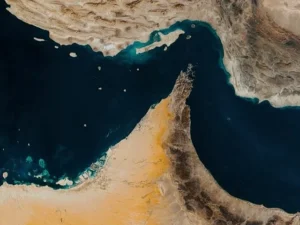
Highlights of Global Coalition Push to Reopen Strait of Hormuz
- Formation: A UK-led global coalition involving over 60 countries was formed through a high-level virtual meeting chaired by Foreign Secretary Yvette Cooper.
- The coalition includes India, France, Germany, UAE, Australia, and others, reflecting a broad multilateral response.
- The initiative aims to ensure “freedom of navigation” and the immediate reopening of the Strait of Hormuz, which is shut down by Iran, using mines and missile threats, due to US-Israel strikes on Iran.
- Nature: The coalition focuses primarily on diplomatic, political, and economic measures rather than immediate military action.
- Key objectives include restoring maritime security, ensuring safe passage of ships, clearing potential sea mines, and preventing further disruption of global trade and energy markets.
- Positions: Countries like France, Germany, Japan, UAE, Canada, and Australia supported a coordinated multilateral response, emphasizing economic pressure and diplomacy. Many nations from the Global South are being encouraged to participate.
- Notably, the United States did not participate, with its leadership suggesting that countries dependent on the Strait should take responsibility.
- India’s Stand: India, represented by Foreign Secretary Vikram Misri, strongly emphasized “unimpeded transit” and freedom of navigation under international law.
- It reiterated adherence to international maritime laws (UNCLOS principles), aligning with global demands for maintaining open sea lanes and rule-based order.
- India highlighted that the crisis directly threatens its energy security, as a significant portion of its oil and gas imports transit through Hormuz. Disruptions have already impacted fuel prices and LPG supplies, underlining India’s vulnerability.
- India raised concerns about the safety of Indian seafarers, noting casualties in recent attacks. It stressed the need for secure maritime routes and protection of commercial shipping.
How Has Hormuz Blockade Impacted World?
- Global Energy Markets: Brent crude oil prices spiked from $72 to over $120 per barrel within weeks.
- The effective closure of the Strait of Hormuz has stranded nearly 20 million barrels per day, forcing Gulf producers like Kuwait and the UAE to cut production as storage hits capacity.
- India, importing 85% of its oil, faces a burgeoning import bill, with the Indian Crude Basket reaching approximately $140 per barrel.
- The International Energy Agency (IEA) has declared this the “greatest global energy security challenge in history”.
- Maritime Trade Rerouting: Major shipping giants like Maersk and Hapag-Lloyd have suspended transits through the Persian Gulf and Red Sea.
- Vessels are rerouting around the Cape of Good Hope, adding 10–14 days to journeys and surging freight costs by up to $3,000 per container.
- In India, export-heavy sectors are bearing the brunt of these high shipping costs and schedule unreliability at ports like Mumbai and Mundra.
- Aviation and Airspace: Airspace closures across the Middle East have grounded over 4,000 daily flights, creating a global travel crisis.
- Airlines like Air India and Lufthansa have suspended regional services, forcing long-haul flights to take expensive, circular routes.
- Indian travelers face massive cancellations, while the cost of aviation turbine fuel (ATF) in India has soared, threatening domestic airline stability.
- Global Food Security: The Gulf region exports 33% of the world’s urea and nitrogen fertilizers, all currently blocked. Global fertilizer prices have doubled, threatening crop yields for the upcoming planting season.
- For India, which depends on these imports for its massive agricultural sector, this creates a direct risk of high food inflation and subsidized fertilizer shortages.
- Financial Market Volatility: Global stock indices, including the Dow Jones and Nikkei, saw sharp declines, while Gold surged above $5,400/oz as a safe-haven asset.
- The Indian Rupee hit a record low of 94.79 per US dollar due to capital outflows.
- Volatility on the Multi Commodity Exchange (MCX) in India has reached historic highs for gold and crude futures.
- Industrial Manufacturing: A shortage of Helium and Aluminum (the Gulf produces 9% of global supply) is crippling the semiconductor and automotive industries.
- Aluminum prices jumped 8% in March 2026 alone after strikes on production facilities.
- Indian auto manufacturers are facing margin compression due to the rising cost of these raw materials and crude derivatives.
- Supply Chain Shift: The “Just-in-Time” inventory model is collapsing as companies shift toward resilience and stockpiling. Delivery timelines for electronics and pharmaceuticals have become entirely unpredictable.
- Indian businesses are aggressively looking for regional suppliers to bypass the hazardous Middle Eastern corridors.
- Insurance and Risk: War-risk insurance premiums for ships have surged from 0.05% to over 0.5% of vessel value, making transit economically unviable even if routes are physically open.
- This has effectively “blocked the street” for any vessel without sovereign backing. Indian shipping firms are struggling to secure affordable coverage for cargo passing through the Gulf of Oman.
- Humanitarian and Remittances: The crisis threatens the livelihoods of 10 million Indians residing in the Gulf who send back $40 billion annually.
- An economic contraction in the GCC states due to halted oil exports directly reduces these vital remittance inflows. Indian states like Kerala and Tamil Nadu are bracing for a sharp drop in household incomes from the diaspora.
Responses to Hormuz Blockade Crisis
- India: The Indian government has operationalised an Inter-Ministerial Group (IMG) to monitor supply chains and curb hoarding through strict enforcement.
- To shield consumers, New Delhi implemented customs duty exemptions on critical industrial chemicals and capped Aviation Turbine Fuel (ATF) price hikes at 25%.
- The government has expanded its Strategic Petroleum Reserves (SPR) to provide up to 74 days of coverage.
- To mitigate the loss of Gulf supplies, India has scaled its Russian oil imports to 1.15 million barrels per day and increased domestic LPG production by 40% to 50,000 metric tons daily.
- The Reserve Bank of India intervened with $12 billion in March 2026 to stabilize the rupee, which hit a record low of 95 per USD amid $11.8 billion in capital outflows.
- European Union: The EU is focusing on strategic autonomy by coordinating a massive release from the IEA’s 1.2 billion-barrel emergency stockpile to dampen price volatility.
- The EU is accelerating a decarbonization shift to reduce reliance on Middle Eastern naphtha and LPG, which have seen price spikes of over 30%.
- The EU has signed new trade and security pacts with partners like Australia to secure alternative commodity supply lines.
- Member states like Spain and Hungary have implemented direct measures, including fuel subsidies of $0.23 per litre and retail price caps at $1.77 per litre respectively.
- The EU is accelerating its “electrified economy” transition, as renewables have already reached 48% of the electricity mix by 2025.
|
Also Read: India’s Preparedness Amid West Asia Crisis |