



India To Push RBI CBDC for BRICS Payments, Aiming to Reduce Dollar Dependence?
| General Studies Paper III: Monetary Policy, Inclusive Growth |
Why in News?
According to recent reports, India is proposing to link Central Bank Digital Currencies (CBDCs) across BRICS nations to make cross-border payments faster during the BRICS Summit 2026 in New Delhi.
What are Central Bank Digital Currencies (CBDCs)?
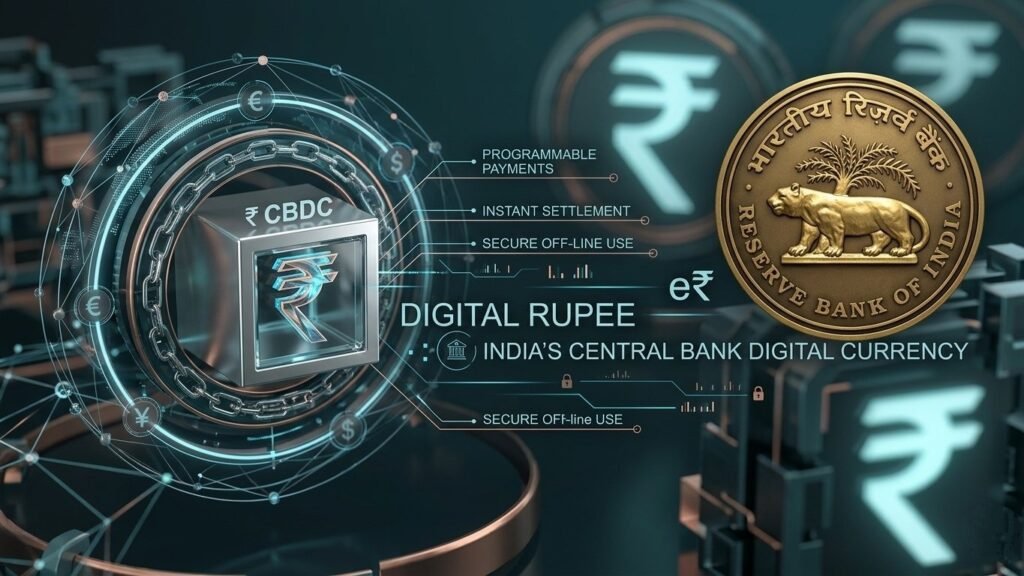
- About: Central Bank Digital Currency (CBDC) is a digital form of sovereign currency issued by a central bank.
- India’s CBDC, called the Digital Rupee (e₹), is a digital form of the Indian rupee and is a legal tender and direct liability of the RBI.
- Unlike commercial-bank deposits, its monetary claim ultimately rests on the central bank.
- Developed By: The Reserve Bank of India (RBI) developed the Digital Rupee framework and began pilots in 2022.
- RBI’s official CBDC communication uses the tagline “Cash but Digital.”
- Objective: It aims to address the decline of physical cash and the rapid rise of private digital currencies like stablecoins.
- It aims to create more efficient, secure, and inclusive financial ecosystems for everyone.
- Types: India has two principal forms: CBDC-Retail (e₹-R) and CBDC-Wholesale (e₹-W).
- Retail CBDC targets the general public and merchants, whereas wholesale CBDC serves financial institutions and other eligible participants.
- The wholesale e₹-W pilot started on 1 November 2022, initially for government-securities settlement, while the retail e₹-R pilot began on 1 December 2022 for selected customers and merchants.
- Technology: CBDC uses a centralised database or Distributed Ledger Technology (DLT).
- These currencies rely on cryptographic tools like encryption and digital signatures to secure data and authorize payments safely.
- Advanced methods like zero-knowledge proofs help protect user privacy without breaking financial rules.
- Features: RBI’s CBDC includes legal-tender status, instant settlement finality, wallet-based holding, and programmability.
- CBDC provides the advantages of cash in digital form, improves payment efficiency, resilience and settlement.
- Programmability allows CBDC funds to be restricted to predetermined purposes.
- It is issued directly by the RBI, exchangeable 1:1 at par with physical cash and bank deposits.
- It does not earn any interest, but it can be freely converted into commercial bank deposits.
- e₹ transactions can occur through P2P and P2M modes.
- It supports round-the-clock, real-time transactions and instantaneous finality of settlement without counterparty risk.
- It allows the currency to be programmed for specific use cases, such as targeted government subsidies or Direct Benefit Transfers (DBT) restricted to specific merchants or items.
- It is designed to work in low-connectivity or zero-network environments for remote or underbanked regions.
- It integrates seamlessly with existing Unified Payments Interface (UPI) QR codes.
- Working Mechanism: For retail CBDC, the RBI creates and issues e₹ electronically to participating banks and non-banks.
- These intermediaries provide wallets through which users hold and transfer e₹.
- In CBDC transactions, value can move directly between e₹ wallets, without passing through the user’s bank account for every transaction.
- Achievements: By June 2024, the retail pilot had approximately 50 lakh users and 4.2 lakh merchants.
- The pilot expanded to 15 banks and 81 locations, while UPI-CBDC interoperability was introduced.
- Wholesale CBDC was also expanded into interbank lending and borrowing.
- CBDC experimentation has moved beyond basic payments toward employee allowances, carbon-credit-linked farmer payments and government welfare transfers.
- RBI reported e₹ use as a payment channel for around 88,000 beneficiaries under Odisha’s Subhadra Yojana, demonstrating potential for programmable public finance.
- International Dimension: RBI is exploring bilateral and multilateral cross-border CBDC arrangements.
- RBI is in talks and holding pilot project discussions with partner nations like the Monetary Authority of Singapore and the Central Bank of the UAE.
- India is engaging in Bank for International Settlements (BIS) Innovation Hub projects and proposing digital currency linkage.
- Cross-border CBDC interoperability could complement its existing UPI-based international payment strategy.
BRICS Cross-Border Payments — Current Architecture, Challenges and Alternative Methods
- Existing Architecture & Challenges: BRICS cross-border payment system largely depends on correspondent banking, where banks maintain relationships and foreign-currency accounts with institutions in other jurisdictions.
- Over 90% of cross-border trade between members is still routed via the Belgium-based SWIFT messaging network.
- Transactions require a chain of global intermediary (“correspondent”) banks, using the US Dollar (USD) or Euro as a vehicle currency.
- Routing local payments through correspondent banking involves multiple currency conversions (e.g., INR to USD, then USD to South African Rand). This incurs heavy foreign exchange margins (ranging from 2.5% to 20%) and settlement delays.
- The unilateral freezing of Russia’s foreign reserves and its expulsion from SWIFT exposed the systemic risks of relying entirely on Western financial infrastructure.
- Dependence on Western-centric financial architecture exposes member states to external monetary policies, economic sanctions, and tariff threats.
- Between 2011 and 2018, global correspondent banking relationships dropped by 20%. This concentrated cross-border payments into fewer channels, intensifying structural vulnerabilities.
- Transactions require a chain of global intermediary (“correspondent”) banks, using the US Dollar (USD) or Euro as a vehicle currency.
- Over 90% of cross-border trade between members is still routed via the Belgium-based SWIFT messaging network.
- Alternative Methods & Proposals: To bypass external vulnerabilities, individual members built unilateral systems (e.g., Russia’s SPFS, China’s CIPS, India’s UPI, and Brazil’s Pix). However, these systems lack institutional cross-border interoperability on a multilateral scale.
- BRICS Pay is a specialized, independent digital payment system engineered by the BRICS Business Council to serve as an alternative financial messaging ecosystem.
- It operates as a decentralized, multi-currency messaging layer (DCMS) using a scalable fractal design and decentralized autonomous organization (DAO) governance.
- Following its prototype demonstration in Moscow, the framework is targeting expanded operational rollouts across member banks heading into late 2026.
- BRICS nations are aggressively legalizing and expanding bilateral local-currency payment corridors.
- Direct ledger-to-ledger transfers between paired countries using their domestic fiat currencies (e.g., Rupees, Dirhams, Yuan, Roubles).
- India has successfully signed standalone local-currency trade agreements with the UAE, Mauritius, the Maldives, and Indonesia.
- BRICS Clear is a proposed independent cross-border clearing, settlement, and depository infrastructure.
- Officially referenced in the Kazan Declaration during the 16th BRICS Summit in October 2024.
- It allows member states to settle securities and manage cross-border transactions using national currencies.
- BRICS Bridge is a multilateral digital settlement and payment platform utilizing central bank digital currencies. It is under active coordination by member central banks.
- At the September 2026 New Delhi BRICS Summit, India pushed an agenda to connect member states’ wholesale CBDCs.
- Wholesale CBDCs (such as India’s digital Rupee and China’s digital Yuan) would be integrated through a shared, decentralized platform.
- India has clarified it does not aim to replace the U.S. dollar, unlike previous proposals for a common BRICS currency.
- International experiments such as BIS mBridge demonstrate the technical possibility of multi-CBDC settlement.
- BRICS Pay is a specialized, independent digital payment system engineered by the BRICS Business Council to serve as an alternative financial messaging ecosystem.
How CBDC Can Benefit BRICS Cross-Border Payments?
- Faster Settlement: Linked CBDCs could enable near-real-time settlement between participating financial institutions, reducing dependence on lengthy correspondent-banking chains.
- This could make BRICS trade, investment and tourism payments faster and more predictable.
- Lower Transaction Costs: Traditional cross-border payments can involve multiple intermediaries, correspondent banks and reconciliation processes.
- CBDC interoperability could reduce some intermediary layers and associated costs.
- Direct Local-Currency Settlement: A CBDC network could facilitate settlement in national currencies, such as the digital rupee.
- This supports the BRICS objective of encouraging local-currency trade and financial transactions.
- Improved Remittance and Tourism Payments: India is a major global remittance recipient, while BRICS economies have substantial tourism and migrant-payment flows.
- Interoperable CBDCs could potentially provide cheaper and faster retail channels for such transactions, subject to regulatory and FX arrangements.
- Better Foreign-Exchange Settlement: A properly designed multi-CBDC platform could support more efficient foreign-exchange transactions and payment-versus-payment (PvP) settlement, reducing settlement risk.
Challenges in Adopting Alternative Cross-Border Payments
- Regulatory Fragmentation: Harmonizing disparate anti-money laundering (AML), counter-terrorist financing (CFT), data localization laws, and capital controls across different jurisdictions creates massive institutional roadblocks.
- Interoperability and Scaling: Linking domestic fast-payment systems or wholesale CBDC networks (like mBridge or Project Nexus) across multiple countries is technically and operationally complex.
- Geopolitical Divergence and Sanctions: Efforts to de-dollarize or bypass traditional networks like SWIFT risk secondary sanctions, trade retaliation, or severe friction with Western financial systems.
- Dominant Currency Risks: Alternative multilateral platforms often lean heavily on a single dominant alternative currency, such as China’s digital yuan, creating new dependencies and resistance from regional rivals.
- Infrastructure and Cybersecurity Costs: Upgrading legacy frameworks and securing shared cross-border rails against sophisticated cyberattacks require enormous capital investments and compatible technical standards.
- Financial and Economic Stability: Frictionless, real-time capital movements across borders can increase the risk of rapid capital flight and sudden currency volatility, particularly in smaller emerging markets.
Frequently Asked Questions (FAQs):
1. What is India’s proposal for BRICS cross-border digital currency payments?
India proposes linking BRICS members’ CBDCs and fast-payment systems to make cross-border transactions faster, cheaper and more efficient.
2. What are CBDCs and how can they support international payments?
CBDCs are central-bank-issued digital money that can enable faster, direct and potentially lower-cost cross-border settlement through interoperable systems.
3. Is India proposing a single BRICS digital currency?
No. India supports connecting existing national CBDCs, while preserving each country’s currency and monetary sovereignty.
4. What role could the RBI-backed digital rupee play in BRICS payments?
The digital rupee (e₹) could serve as India’s sovereign digital settlement instrument within interoperable BRICS cross-border payment arrangements.
5. Will BRICS create a unified payment system?
Not yet. BRICS is discussing payment-system and CBDC linkages; no unified bloc-wide payment system has been agreed.
6. How could CBDCs reduce cross-border transaction costs?
CBDCs could reduce intermediaries, reconciliation delays and settlement layers, potentially lowering costs and accelerating international payments.
Disclaimer: Information in this article is based on official announcements and public records. Regulations and implementation details may evolve over time.