India-South Korea Defence Partnership
|
General Studies Paper II: Agreements Related to or Affecting India’s Interests, Effect of Policies & Politics of Countries on India’s Interests |
Why in News?
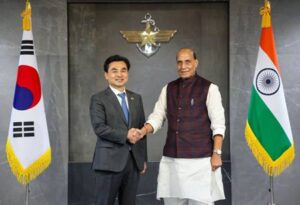
Recently, India and South Korea signed new defence pacts focusing on cyber security, military training and joint weapons development to secure the Indo-Pacific region.
Highlights of India-South Korea Recent Defence Pacts
- Cyber Security Cooperation: India and South Korea signed a landmark defence cyber security MoU in Seoul on 20 May 2026.
- The pact focuses on protecting critical military infrastructure, countering cyber threats and enhancing intelligence-sharing mechanisms amid rising digital warfare challenges in the Indo-Pacific.
- Defence Information Sharing: Both nations institutionalised real-time defence information exchange for improving strategic situational awareness.
- The agreement strengthens coordination between military establishments against emerging threats including cyber espionage, hybrid warfare and hostile digital intrusions targeting defence networks.
- Military Training Expansion: India’s National Defence College and South Korea’s Korea National Defence University signed an academic cooperation agreement.
- It will expand officer exchanges, strategic studies, defence research and joint military learning programmes for future warfare preparedness.
- Defence Industrial Cooperation: The Seoul discussions prioritised joint defence production, co-development and technology partnerships.
- India promoted its Make in India defence ecosystem while inviting Korean firms for long-term industrial collaborations and defence exports partnerships.
- Advanced Weapons Development: Both countries initiated cooperation on directed-energy weapons, laser systems and advanced air-defence technologies.
- The initiative reflects growing emphasis on next-generation warfare systems, autonomous defence technologies and integrated security architectures.
- UN Peacekeeping Collaboration: A separate MoU enhanced cooperation in United Nations peacekeeping operations.
- The partnership will improve operational coordination, humanitarian response capabilities and joint training for multinational peacekeeping missions under global security frameworks.
India-South Korea Defence Relationship
- Strategic Beginning: India and South Korea formally started defence cooperation after establishing diplomatic relations in 1973.
- Defence ties strengthened under India’s Act East Policy and South Korea’s New Southern Policy, especially after the relationship became a Special Strategic Partnership in 2015.
- Bilateral security architecture is being formalised via a 2+2 ministerial dialogue covering foreign and defence portfolios.
- Defence Agreements: The first major breakthrough came through the 2005 MoU on Defence Industry and Logistics Cooperation.
- In 2010, both countries signed agreements on military exchanges, training programmes, defence research and joint production, expanding institutional defence engagement.
- Both nations adopted the Roadmap for Defence Industries Cooperation in 2020.
- It identified cooperation in land systems, aero systems, naval systems, guided weapons, testing, certification and quality assurance, while supporting India’s defence corridors in Uttar Pradesh and Tamil Nadu.
- Logistics Pact: In 2019, India and South Korea signed a military logistics agreement allowing both navies to access each other’s naval bases for refuelling, maintenance and operational support.
- The pact improved interoperability and strengthened India’s Indo-Pacific maritime reach.
- K9 Vajra Project: The biggest defence success is the K9 Vajra-T self-propelled artillery system.
- Developed jointly by India’s L&T and South Korea’s Hanwha Aerospace, India inducted 100 K9 Vajra guns between 2017–2020 under the “Make in India” initiative.
- The K9 Vajra programme achieved over 50% indigenisation by value and involved more than 13,000 locally produced components through Indian supply chains.
- The project became one of India’s largest private-sector defence manufacturing programmes.
- Second Phase Expansion: In 2025, Hanwha Aerospace and L&T signed the K9 Vajra Phase-2 agreement for another 100 howitzers.
- The systems will be produced at L&T’s Gujarat facility over three years, strengthening India’s artillery modernisation and defence self-reliance.
- Joint Military Exercises: India and South Korea regularly conduct naval goodwill exercises, coast guard cooperation activities and military staff exchanges.
- The IN-ROKN Bilateral Exercise is the first-ever naval exercise between India and the ROK, held in October 2025. Indian Navy was represented by the indigenously built Shivalik-class stealth frigate, INS Sahyadri.
- Their navies participate in coordinated maritime engagements focused on communication drills, interoperability and Indo-Pacific maritime security cooperation.
- Innovation Partnership: India and South Korea are developing the Korea-India Defence Accelerator (KIND-X) platform connecting defence startups, industries and universities.
- The initiative supports collaboration in AI, autonomous systems, cybersecurity, semiconductors and emerging military technologies for future warfare requirements.
- Indian Partners, led primarily by the Defence Innovation Organisation (DIO) under the Ministry of Defence, which operates alongside the iDEX (Innovations for Defence Excellence) framework.
- South Korean Partners, led by the Defense Acquisition Program Administration (DAPA).
- KIND-X mirrors similar international defense startup ecosystems that India has established to foster technological self-reliance, such as INDUS-X (with the U.S.) and FRIND-X (with France).
- The 2026 defense meetings established a Joint Development, Production, and Export matrix.
India-South Korea Relations
- Historical Ties: Deep-rooted civilisational connections began with the legendary marriage of Ayodhya’s Princess Suriratna to Korean King Kim Suro in 48 AD.
- Formative modern linkages solidified through India’s deployment of the 60th Parachute Field Ambulance during the Korean War.
- India’s contribution dates back to the Korean War (1953) when India dispatched the 60 Para Field Ambulance to treat the wounded and assisted in the repatriation of over 25,000 prisoners of war as part of Custodian Forces-India.
- Diplomatic Evolution: Consular relations started in 1962, upgrading to formal diplomatic ties on 10 December 1973.
- The relationship expanded from a Strategic Partnership in 2010 to a Special Strategic Partnership by 2015, converging India’s Act East Policy.
- During President Lee Jae Myung’s landmark state visit to New Delhi from 19–21 April 2026, both nations launched a new Joint Strategic Vision (2026–2030).
- This definitive five-year roadmap features a commitment to institutionalise annual leader-level summits.
- Economic Scaling: Bilateral trade stood at USD 26.89 billion for fiscal year 2024–25.
- Under the 2026 roadmap, the leaders formally committed to double this volume, setting an ambitious USD 50 billion bilateral trade target by the end of the decade.
- Trade Refinement: To rectify India’s stark USD 15.3 billion trade deficit recorded in 2025, chief negotiators resumed intensive talks.
- The 2026 framework fast-tracks the upgrading of the Comprehensive Economic Partnership Agreement (CEPA) to ease market access.
- Industrial Integration: A new ministerial-level India-ROK Industrial Cooperation Committee was established in April 2026.
- This body focuses on advanced manufacturing across critical sectors like automobiles, semiconductors, and telecom equipment.
- Maritime Alignment: Deepening blue economy links led to the Comprehensive Framework for Partnership on Shipbuilding, Shipping, and Maritime Logistics.
- This coordinates port infrastructure development and expands joint research initiatives in crucial Arctic science corridors.
- India and South Korea deepened their strategic ties, aligning on a shared vision for a rules-based Indo-Pacific while advancing maritime collaboration through the Indo-Pacific Oceans Initiative (IPOI).
- The opening of the Korea Marine Equipment Association (KOMEA) branch in Mumbai marks a pivotal milestone in Indo-Korean maritime ties, acting as the first of its kind in the region.
- Energy Transition: The Joint Statement on Energy Resource Security signed in April 2026 forms a core economic pillar.
- Both nations are integrating supply chains for critical minerals, green hydrogen, and nuclear power plant projects.
- Cemented by a new carbon-credit framework under the Paris Agreement, South Korea joined the India-headquartered International Solar Alliance (ISA), while India joined the Seoul-headquartered Global Green Growth Institute (GGGI).
- India-Korea Digital Bridge: This initiative deepens technological cooperation by establishing joint task forces across the following core areas:
- Artificial Intelligence Guided by the inclusive principle of “AI for All,” ensuring AI technologies are developed ethically and equitably.
- MANAV, promoting collaborative research and data architectures in science and human-centric tech.
- Semiconductor Design & Fabrication, fostering joint research, talent exchange, and robust supply chain resilience.
- Data Governance, structuring standardized, open, and secure regulatory environments for digital commerce and data sharing.
- Cross-Border Financial Linkage: To facilitate secure and efficient cross-border transactions, a major Memorandum of Understanding (MoU) was signed between India’s National Payments Corporation of India Limited (NPCIL) and South Korea’s Korea Financial Telecommunications and Clearings Corporation (KFTC).
- This integration aims to interlink payment infrastructures, paving the way for seamless digital remittances, retail payments, and financial inclusion across both nations.
- Space Cooperation: India and the Republic of Korea (ROK) formalized their space partnership by establishing an ISRO-KASA Joint Working Group.
- This agreement was marked by the inaugural India–ROK Space Day, co-hosted by the Indian National Space Promotion and Authorization Centre (IN-SPACe) and KASA in Bengaluru on April 20, 2026.
- Cultural Confluence: People-to-people links are driven by the explosive popularity of the Korean Wave (Hallyu) in India and Indian yoga in Korea.
- The vibrant Indian community in South Korea is indeed estimated at approximately 18,000, composed of STEM students, researchers, and professionals.
- To institutionalise this organic goodwill, 2028–29 has been officially designated as the Year of India-Korea Friendship.
|
Also Read: India–South Korea Strategic Partnership |