Indian Army New Uniform Code
| General Studies Paper lI: Government Policies & Interventions |
Why in News?
Recently, the Indian Army unveiled the “Army Uniforms-2026” code, replacing several colonial-era traditions with indigenous elements.
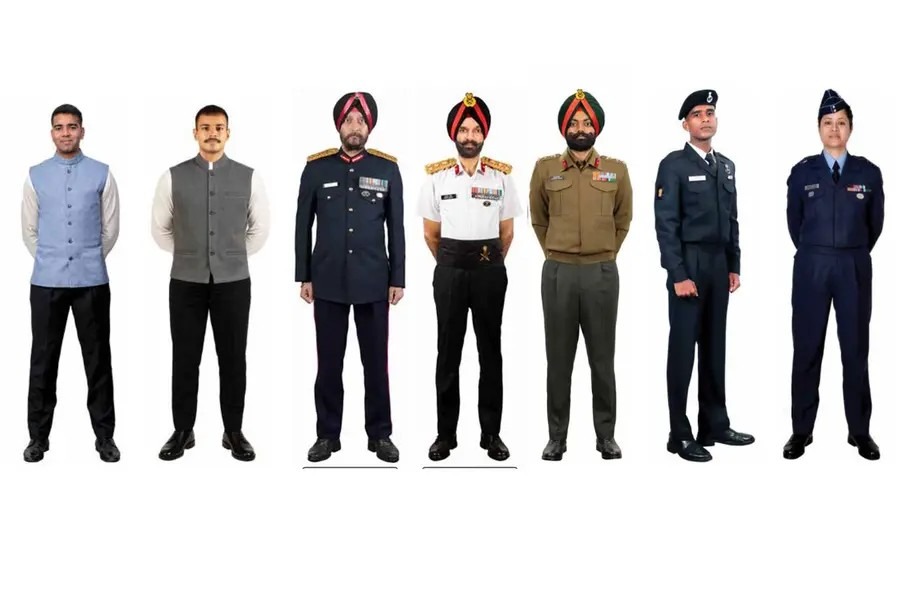
Image Credit: Mathrubhumi English
Highlights of Indian Army’s New Uniforms-2026 Code
- Manual: The Indian Army released the 174-page “Army Uniforms-2026” manual, replacing regulations issued eight years ago.
- The revision comprehensively updates dress, grooming, ceremonial practices, and formal attire.
- The reforms align military traditions more closely with India’s national identity and the broader policy of institutional decolonisation.
- It will be phased in until June 2029.
- Bandi Jacket: The manual formally authorises the closed-neck Bandi Jacket for officers in formal settings.
- It can now be worn alongside traditional formal options such as the bandhgala and lounge suit, promoting an indigenous aesthetic.
- Winter Dress: A new winter uniform, Dress 3B, has been introduced for all ranks.
- It consists of an angola shirt, battle jacket, and beret, enhancing practicality and standardisation during cold-weather duties.
- Restriction: Reviewing Officers are no longer required to carry ceremonial swords during parades.
- It will now be carried only by parade commanders, contingent commanders and designated personnel during Republic Day, Independence Day, Army Day parades and Guards of Honour.
- Removal: The Army has dropped archaic terms such as “Royal” from military usage wherever applicable, symbolising a decisive break from British-era military traditions.
- Traditional ceremonial pouch belts have been discontinued in several dress categories. This simplifies ceremonial attire and removes another colonial-era accessory.
- Updated Grooming: The manual revises grooming standards and tattoo regulations, ensuring greater uniformity, discipline, and clarity across ranks while maintaining professional military appearance.
- While in uniform, the guidelines strictly bar the following: Radical hairstyles, Unauthorised beards, Visible electronic gadgets, Tattoos, Body piercings, Cosmetic make-up.
- The regulations include clearer formal-wear provisions for women officers, permitting sober-coloured sarees, kurta-salwar sets, and ankle-length formal attire, reflecting evolving service requirements.
- Uniform Conduct: Personnel are prohibited from wearing their uniforms at events that could compromise military neutrality or dignity. This bars uniform wear without prior authorization at: Political, religious, or protest gatherings, Weddings and private parties, and Paid media appearances.
Major Decolonisation Reforms Undertaken by the Indian Army
- Renaming of 246 Military Assets: The Indian Army has renamed 246 roads, colonies, buildings and military facilities that carried colonial-era names.
- Kitchener House (named after British commander Lord Kitchener) was renamed Manekshaw House in honor of Field Marshal Sam Manekshaw.
- Mall Road in the Delhi Cantonment was renamed Arun Khetrapal Marg.
- The New Horn Line in the Mathura Cantonment is now Abdul Hamid Lines.
- Patterson Road Quarters in the Ambala Cantonment was renamed Dhan Singh Thapa Enclave.
- Malcolm Lines in the Mhow Cantonment was renamed Piru Singh Lines.
- Other prominent changes include renaming Fort William in Kolkata to Vijay Durg and Delhi Cantonment’s Kirby Place to Kenuguruse Vihar.
- At the Indian Military Academy, the Kingsway Block was renamed Kargil Block.
- The sports complex in Rangapahar Military Station has been renamed Laishram Jyotin Singh Sports Complex.
- 2023 Discontinued Practices: The specific directives issued to military units targeted three main symbolic colonial practices:
- Horse-driven Buggies phased out from routine unit and formation functions. The horses were reassigned to other formations strictly for active equestrian training purposes.
- Ceremonial Pull-Outs, the tradition where officers and troops physically pulled the vehicle of a retiring or posting-out commanding officer with ropes, was stopped to reflect modern national sentiments.
- Pipe Bands at Dinners, the practice of employing military pipers to play during formal dinner nights was ceased.
- Tri-Services Decolonisation: The Indian Navy has already dropped the colonial Cross of St. George, from its ensign, replaced Nelson’s ring on epaulettes with Chhatrapati Shivaji’s octagonal stamp, and banned the routine carrying of batons by naval personnel.
- The Beating Retreat Ceremony has systematically replaced Western hymns (like “Abide with Me”) with traditional Indian compositions such as “Ae Mere Watan Ke Logo“.
- The military is replacing colonial-era literature with Indian cultural elements, and created a unified Tri-Services Education Corps to merge the education branches of the Army, Navy, and Air Force.
- Initiatives are underway to establish Joint Military Stations across the country—with Mumbai slated to be the first common defence station—to centralize resources and reduce redundancies.
- The services are transitioning toward unified, geographical Integrated Theatre Commands (ITCs) to improve multi-domain warfare capabilities and swift operational response.
Significance of Indian Army Dress Regulations
- Strengthening India’s Sovereign Military Identity: The new code reflects a conscious shift from inherited colonial symbolism to a distinctly Indian military ethos.
- By aligning military appearance with national values, the Army reinforces its identity as an institution rooted in an independent and sovereign India.
- Advancing Institutional Decolonisation: The reforms complement India’s wider effort to decolonise institutions, laws, and symbols.
- The Army’s decision demonstrates that decolonisation is not merely symbolic but extends to organisational culture, traditions, and official practices.
- Enhancing Military Professionalism: The 174-page manual standardises dress, grooming, and ceremonial regulations across the force.
- Greater uniformity reduces ambiguity, improves discipline, and ensures consistent professional standards among personnel nationwide.
- Supporting the Atmanirbhar Bharat Vision: The emphasis on indigenous cultural elements reflects the broader Atmanirbhar Bharat philosophy.
- Symbolically, it complements the Army’s increasing focus on indigenous technologies, equipment, and self-reliance.
- Enhancing Public-Military Connect: Indigenous attire and Indian cultural symbolism make the Army appear more relatable to citizens.
- This strengthens the emotional connection between society and one of India’s most trusted institutions.
FAQs:
1. What is the Indian Army’s new uniform code?
The new Army Uniforms-2026 is a 174-page dress regulation manual covering uniforms, grooming, ceremonial practices, appearance standards and military bearing.
2. Why has the Army introduced new dress regulations?
To remove colonial-era practices, strengthen Indian military identity, standardise regulations and align traditions with contemporary Indian values and ethos.
3. Who will be affected by the new uniform code?
The regulations apply to all Indian Army personnel, including officers, junior commissioned officers, other ranks and women officers.
4. What are the key changes in the policy?
Key changes include Bandi jackets, new winter Dress 3B, restricted sword use, removal of colonial customs and revised grooming norms.
5. When will the new uniform rules take effect?
Army Uniforms-2026 was issued in June 2026, while some changes, including winter dress transition, will be phased in until June 2029.
| Also Read: Britain Forms New Gurkha Regiment |