



India’s First LNG Powered Train Flags Off, Uses Dual-Fuel System Combining Diesel-LNG
| General Studies Paper III: Indigenous Technology, Development |
Why in News?
Recently, Union Home Minister Amit Shah flagged off India’s first dual-fuel LNG-powered train from Sabarmati, advancing India’s 2030 zero-diesel decarbonization strategy.
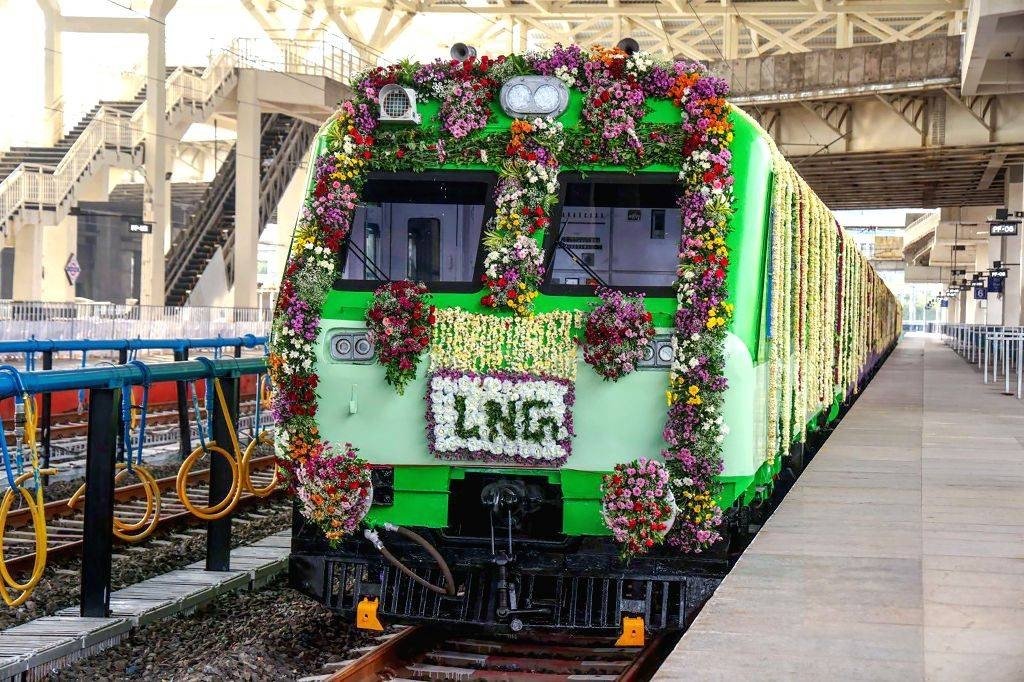
Highlights of India’s First LNG-Powered Train
- Launch: India’s first LNG-diesel dual-fuel train was successfully flagged off on September 27, 2026, from the Sabarmati Railway Station in Ahmedabad, Gujarat.
- The inaugural ceremony was led by Union Home Minister Amit Shah alongside Gujarat Chief Minister Bhupendra Patel.
- Developed By: Integral Coach Factory (ICF), Chennai developed this, while the Sabarmati Integrated Coaching Depot carried out conversion of two 1,400-HP Driving Power Cars (DPCs) into LNG-diesel dual-fuel units.
- INOX India supplied the LNG storage and regasification systems.
- The conversion programme was operationalised by January 2026. By 30 January 2026, the modified DEMU had completed more than 2,000 km of field trials and entered passenger service.
- INOX India supplied the LNG storage and regasification systems.
- Cost: The deployment of the LNG train was launched as part of a massive railway infrastructure package valued at over ₹1,472 crore.
- This mega-investment also funded a ₹700 crore WAG-12 maintenance shed and the implementation of the Kavach automatic train protection system.
- Features:
- The train comprises eight non-AC chair-car coaches and uses two 1,400-HP DPCs.
- Each DPC has approximately a 2,200-litre LNG tank, with LNG replacing up to 40% of diesel consumption under the dual-fuel configuration.
- A DPC’s 2,200-litre LNG tank can support roughly 222 km of operation on a full refill according to railway-linked reporting.
- A full fill holds up to 1,000 kg of usable LNG, providing the train an optimized operating range of roughly 444 km to 1,600 km depending on load distribution.
- The engine can switch between LNG and diesel, allowing operations to continue when LNG is unavailable.
- LNG is stored in dedicated cryogenic tanks, then supplied through a controlled system to the modified internal-combustion engine.
- Mainline trials spanning over 2,000 kilometers have been successfully completed under varying load conditions.
- For its inaugural operation, the train ran on the Sabarmati–Mahesana Junction route in Gujarat.
- The distance is approximately 62 km, with the inaugural journey taking around 1 hour 20 minutes.
- Important stations include Kalol, Jhulasan, Dangarwa, Ambliyasan and Jagudan.
- The train comprises eight non-AC chair-car coaches and uses two 1,400-HP DPCs.
What is LNG?
- About: Liquefied Natural Gas (LNG) is natural gas—predominantly methane (CH₄)—converted into liquid form by cooling it to approximately −162°C at near-atmospheric pressure.
- Liquefaction reduces its volume by roughly 600 times, making large-scale storage and transportation economically feasible.
- Discovery: The foundation of gas liquefaction began with British chemist Michael Faraday in the 19th century.
- The world’s first experimental LNG storage facility was built in 1912 in Virginia, USA, while the first commercial liquefaction plant began operating in 1941 in Cleveland, Ohio.
- The global market officially took off in 1964 with the first commercial ocean shipment from Algeria to the UK.
- Liquefaction Process: The technology follows a precise cycle: Extraction → Liquefaction → Transport → Regasification.
- First, raw natural gas is stripped of impurities like water, CO₂, and mercury to avoid freezing.
- It is then cooled using heavy refrigeration cycles.
- Once it reaches its destination in specialized insulated double-walled tankers, it passes through vaporizers to convert it back into a gaseous state for pipeline distribution or direct engine combustion.
- Advantage: LNG has relatively high energy density, enabling longer operation than compressed natural gas.
Significance of India’s First LNG Powered Train
- Railway Decarbonisation: Indian Railways aims to become a net-zero carbon emitter by 2030. LNG supports this transition by reducing diesel consumption on suitable non-electrified or operationally appropriate routes.
- Diesel Consumption Reduction: The LNG-Diesel DEMU can substitute up to 40% of diesel consumption.
- The railway diesel consumption has already declined sharply with electrification—from 293 crore litres in 2015–16 to 108 crore litres in 2024–25, according to the Ministry of Railways.
- Environmental Benefits: LNG combustion is expected to reduce CO₂, nitrogen oxides and particulate emissions compared with conventional diesel operation.
- The technology slashes toxic black smoke and particulate matter (PM) emissions, drastically improving air quality along regional railway corridors.
- Energy Security: Fuel diversification reduces excessive dependence on a single transport-energy source.
- Combining electrification, renewable electricity, LNG and hydrogen pilots creates a broader energy portfolio for Indian Railways and increases resilience against disruptions in individual fuel markets.
- Import Reduction: India imports a massive percentage of its crude oil. Scaling up domestic LNG infrastructure helps reduce reliance on expensive foreign crude oil, conserving vital foreign exchange reserves.
- The 99.6% electrification of the broad-gauge network reported in July 2026 has already substantially reduced diesel use.
- Economic Savings: Trial-based estimates suggest approximately ₹11.9 lakh annual savings per DPC and ₹23.9 lakh for an eight-coach rake.
- Scaling the technology could therefore generate recurring fuel savings.
- Indigenous Engineering: Developed locally by the Sabarmati Integrated Coaching Depot (ICD), the project showcases India’s growing capability in handling complex cryogenic engineering (storing fuel at –162°C) without external assistance.
- Scalability to Heavy Freight: The successful deployment on passenger trains lays the groundwork for applying LNG technology to heavy-haul freight locomotives, where fuel consumption is significantly higher.
Other Environment-Friendly Railway Policies
- Electrification: Electrification remains Indian Railways’ principal decarbonisation strategy. Electrification reduces diesel dependence and allows railway traction to increasingly use renewable electricity.
- By systematically retiring age-old diesel locomotives, this aggressive policy has successfully dropped carbon emissions from 3.32 million tonnes to 2.02 million tonnes annually.
- Hydrogen Fuel-Cell Train: In July 2026, Indian Railways announced its first hydrogen fuel-cell trainset, designed to generate electricity onboard using hydrogen.
- Dubbed the “NaMo Green Rail,” the 10-coach train operates on the Jind–Sonipat section in Haryana.
- This generates electricity onboard via a chemical reaction between hydrogen and oxygen, discharging only heat and water vapour as byproducts.
- Hydrogen for Heritage Initiative: Under this specialized blueprint, Indian Railways is manufacturing 35 hydrogen-powered trains.
- These trains are custom-designed for narrow-gauge hill and heritage routes, such as the Darjeeling Himalayan Railway, Kalka-Shimla Railway, and Matheran Hill Railway.
- Solar-Powered Trains: The railways have introduced multiple Solar-Panel-Roofed DEMU (Diesel Electric Multiple Unit) trains.
- These trains feature flexible solar matrices mounted on coach roofs to harvest clean energy.
- The harnessed solar energy entirely sustains internal passenger comforts like LED lighting, fans, and digital display systems.
- By June 2026, approximately 1,161 MW of solar and 103 MW of wind capacity had been commissioned, supporting the broader low-carbon electricity strategy.
- 100% Bio-Toilet Fleet: To maintain absolute track hygiene and prevent soil or groundwater contamination, Indian Railways has installed over 3.66 lakh operational bio-toilets, covering 100% of its active passenger coach fleet.
- Head-on Generation (HOG): Head-on Generation technology allows electric locomotives to supply hotel loads to coaches, reducing reliance on separate diesel generator cars.
- The Eastern and Western Dedicated Freight Corridors (DFCs) facilitate faster and more efficient freight movement.
Frequently Asked Questions (FAQs):
1. What is India’s first LNG-powered train?
India’s first LNG-diesel dual-fuel DEMU uses two 1,400-HP power cars, allowing LNG to substitute part of diesel consumption.
2. Where did Amit Shah launch the first LNG train in India?
Union Minister Amit Shah flagged it off from Sabarmati Railway Station, Ahmedabad, Gujarat, on 27 September 2026.
3. How does the LNG-powered train work?
Its modified engines use LNG and diesel together, automatically switching between fuels according to availability while maintaining operational performance.
4. What are the benefits of LNG train in India?
It can reduce diesel consumption, fuel costs and emissions, including CO₂, NOx and particulate matter, while diversifying railway fuels.
5. How much diesel can LNG replace in the new train?
The dual-fuel system allows LNG to replace up to approximately 40% of conventional diesel consumption under the current configuration.
Disclaimer: Information in this article is based on official announcements and public records. Details may evolve over time.
| Also Read: India’s First Vande Bharat Sleeper Train |