EC Rules Change 2026: Commission Announces 9 Decisions for Working Rules
| General Studies Paper I: Constitutional Bodies, Transparency, and Accountability |
Why in News?
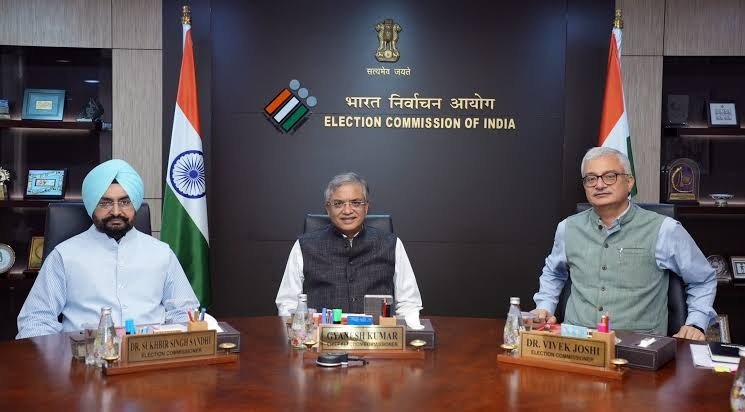
Recently, the Election Commission of India (ECI) instituted nine working rule reforms to resolve internal friction over its Special Intensive Revision (SIR) to strengthen electoral transparency.
What Are the Nine ECI New Rules 2026?
- Home Visits Instead of Routine ERO Hearings: For electors issued SIR notices because they were “unmapped” or had “logical discrepancies,” Booth Level Officers (BLOs) will visit their homes, collect necessary documents and upload them on ECINet for consideration by the Electoral Registration Officer (ERO).
- Such electors generally need not appear personally before the ERO/AERO.
- A hearing may be held only in exceptional circumstances, preferably online, and an adult family member may be authorised to represent the elector.
- Online-hearing facilities are also to be strengthened.
- Help Desks and Special Camps for Vulnerable Electors: District Election Officers (DEOs) have been directed to establish adequate help desks and conduct special camps according to local requirements.
- The measure specifically covers people living in night shelters, labourers, poor persons, homeless persons and other vulnerable groups.
- Form 6 Framework Clarified: The ECI stated that the declaration attached to Form 6 for SIR had been upheld by the Supreme Court and clarified that, outside the SIR period, the forms prescribed under the Registration of Electors Rules, 1960 would apply.
- Form 6 is fundamentally associated with applications for inclusion of a name in an electoral roll.
- ECINet Access, Independent Review and IT Oversight: Field officials have been given role-based access to ECINet according to their statutory powers.
- A committee headed by a Senior Deputy Election Commissioner, with an independent IIT/IIIT expert, will review whether ECINet conforms to relevant Acts and Rules and submit its report to the Commission.
- The ECI also said further field-level flexibility would be operationalised if required, while future major IT modules and portals must first be discussed in the Committee of Officers (COO) before Commission approval.
- Extended Claims and Objections Deadlines: Following requests from the respective Chief Electoral Officers, the ECI extended electoral-roll claims and objections timelines in Delhi and Maharashtra.
- In Delhi, filing was extended to 30 October 2026, with disposal of notices and claims/objections to 30 November 2026.
- In Maharashtra, filing was extended to 12 October 2026, while disposal was extended to 10 November 2026.
- Advance Agendas and Post-Meeting Minutes: The Commission decided that agendas of all ECI meetings will be circulated in advance, while minutes will be issued afterwards.
- This creates a clearer documentary trail of institutional deliberation and makes the formal decision-making process more structured.
- Timely Completion of APARs: The ECI decided that Annual Performance Appraisal Reports (APARs) of its officers would be completed within the stipulated timeframe, specifically by 31 December every year.
- APARs are important administrative records concerning an officer’s performance and career progression.
- Commission Approval for Foreign Travel: Foreign trips by ECI officers will require prior approval of the Election Commission. The measure places such official travel within collective institutional oversight rather than leaving it solely to individual administrative arrangements.
- Mandatory Compliance with Commissioners’ Directions: The Commission directed that all instructions issued by the Election Commissioners to Commission officers must be “meticulously complied with.”
- This establishes a clear administrative expectation regarding the implementation of directions from members of the constitutional body.
Why Were EC Rules Change 2026 Announced?
- The Election Commissioners Sukhbir Singh Sandhu and Vivek Joshi had recorded objections on multiple occasions concerning electoral-roll decisions, software systems and administrative functioning.
- The Indian Express reported at least 14 recorded objections over about 10 months.
- The ECI subsequently characterised such differences as part of institutional deliberation while maintaining that important decisions had received the full Commission’s approval.
- Several objections reportedly concerned the processes through which voter names were registered, deleted, restored and appealed.
- Because electoral rolls determine who can participate in elections, their preparation is directly connected with universal adult franchise and electoral integrity.
- During the ongoing Special Intensive Revision (SIR) of electoral rolls, massive public anxieties emerged over the potential exclusion of genuine citizens.
Constitutional and Legal Framework Governing Election Commission’s Working Rules
- Article 324 vests the ECI with the superintendence, direction and control of preparation of electoral rolls and elections to Parliament, State Legislatures, and the offices of President and Vice-President.
- Article 324(2) allows the President to appoint additional Election Commissioners.
- The current structure establishes a multi-member panel comprising the Chief Election Commissioner (CEC) and two Election Commissioners (ECs), making collective decision-making a constitutional expectation.
- Article 325 establishes the principle of one general electoral roll and prohibits exclusion from such rolls on specified grounds such as religion, race, caste or sex. Article 326 establishes elections to the Lok Sabha and State Legislative Assemblies on the basis of adult suffrage, subject to constitutional and statutory qualifications.
- Under Article 327, Parliament can make laws concerning elections, including electoral rolls, subject to the Constitution.
- The ECI’s constitutional power under Article 324 consequently operates alongside parliamentary legislation.
- The Supreme Court’s 2026 SIR judgment specifically treated Articles 324 and 327 as complementary, rather than mutually exclusive sources of electoral authority.
- The ECI’s constitutional power under Article 324 consequently operates alongside parliamentary legislation.
- The Representation of the People Act, 1950 provides the statutory framework for electoral rolls, qualifications of voters and related matters.
- Section 21 governs revision of electoral rolls, while Section 21(3) permits a special revision at any time, subject to the statutory framework.
- The 2026 Supreme Court judgment traced the Bihar SIR to Article 324 read with Section 21(3).
- Section 21 governs revision of electoral rolls, while Section 21(3) permits a special revision at any time, subject to the statutory framework.
- The Registration of Electors Rules, 1960 operationalise electoral-roll procedures, including claims, objections, notices and inquiries.
- Rules 16–20 provide mechanisms for recording claims/objections, issuing hearing notices and conducting summary inquiries.
- The statutory framework uses prescribed forms for electoral-roll transactions.
- Form 6 concerns inclusion of names, while Form 7 deals with objections to inclusion or requests for deletion.
- The Chief Election Commissioner and Other Election Commissioners Act, 2023 specifically regulates the transaction of business of the ECI.
- Section 18 provides that the Commission may unanimously regulate its procedure and allocation of business; otherwise, business should, as far as possible, be transacted unanimously, with differences decided by majority.
- The Supreme Court’s 27 May 2026 judgment in Association for Democratic Reforms v. Election Commission of India upheld the validity of the Bihar SIR, finding it traceable to Article 324 and Section 21(3), while examining proportionality and statutory safeguards.
Significance of This Change
- Enforcing Full-Bench Equality: By implementing advanced agenda sharing, the new rules dismantle top-down unilateralism.
- It solidifies the principle that the Chief Election Commissioner is merely first among equals, giving equal power to the two Election Commissioners in policy implementation.
- Ensuring Bulletproof Accountability: Mandating the immediate issuance of meeting minutes introduces a formal, permanent audit trail.
- This bureaucratic step permanently ends undocumented policy pivots and prevents the operational suppression of internal dissent.
- Neutralising Algorithmic Vulnerabilities: Subjecting the ECINet database to an independent review with an external IIT/IIIT expert radically increases systemic trust. It brings objective peer review to the centralized infrastructure, easing fears over algorithmic biases.
- Eradicating Arbitrary Voter Disenfranchisement: Replacing intimidating physical hearings at ERO offices with door-to-door verification by local field workers serves as a critical safety net. This safeguards thousands of unmapped and marginalized citizens from accidental deletion.
- Strengthening Administrative Chain of Command: Ordering that directives from the Election Commissioners must be meticulously followed by subordinate staff fixes a fractured hierarchy. It ensures that administrative wings cannot disregard or stall policies enacted by the top bench.
- Decentralising Grassroots Field Access: Granting greater system access to field executives removes technical roadblocks at the ground level. Local teams can swiftly clean up voter rolls, matching speed with absolute statutory accuracy.
- Mitigating Massive Public Backlash: Faced with political criticism over transparency, this sweeping self-reform serves as crucial damage control. It reaffirms the ECI’s constitutional neutrality and restores public faith ahead of critical state elections.
Frequently asked questions (FAQs):
1. What are the new Election Commission rules in 2026?
The ECI announced nine decisions covering SIR verification, ECINET oversight, deadlines, meeting procedures, APARs, foreign travel and official compliance.
2. What changed in the ECI SIR verification process?
For unmapped or logically discrepant electors, BLOs will collect documents at home and upload them to ECINET; routine ERO hearings are removed.
3. Can BLO collect documents from voter homes?
Yes. BLOs can visit homes, collect required documents from SIR notices and upload them on ECINET for the ERO’s decision.
4. What is the new ECINET rule for electoral roll revision?
ECINET will undergo review by a committee headed by a Senior Deputy Election Commissioner, including an independent IIT/IIIT expert.
5. What changes did the Election Commission make in the SIR process?
The ECI introduced BLO home visits, online exceptional hearings, help desks, special camps, continuous enrolment and extended claims deadlines.
6. Why will BLO visit homes for voter verification?
BLOs will visit SIR notices to collect required documents, reducing unnecessary office visits while enabling EROs to decide cases using uploaded evidence.
Disclaimer: Information in this article is based on official announcements and public records. Details may evolve over time.