


India’s First Privately Built PSLV-N1 Rocket
| General Studies Paper III: Space Technology, India’s Space Sector |
Why in News?
India’s first industry-built Polar Satellite Launch Vehicle PSLV-N1, is expected to launch in the first quarter of 2027, marking a major shift towards private-sector participation.
What is PSLV-N1?
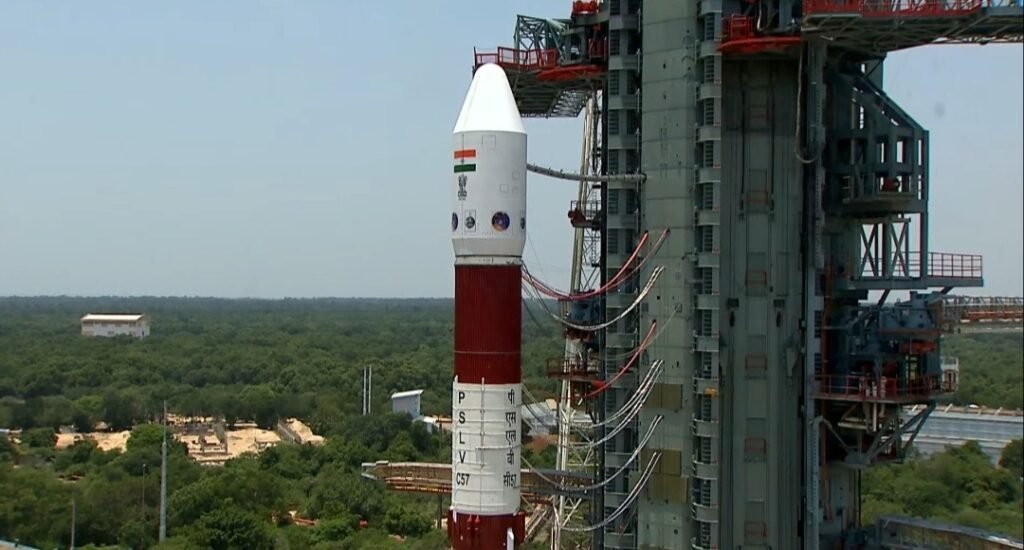
- About: The Polar Satellite Launch Vehicle (PSLV-N1) is the first PSLV rocket manufactured end-to-end by an Indian industry consortium, under Indian Space Research Organisation (ISRO)’s productionisation programme.
- It represents a transition from government-led manufacturing towards industrial-scale private-sector participation.
- It aims to boost India’s satellite launch frequency through private industrial capacity.
- Manufactured By: It is manufactured by a consortium led by Hindustan Aeronautics Limited (HAL) and Larsen & Toubro (L&T).
- NewSpace India Limited (NSIL) awarded the ₹860 crore contract in September 2022 to a consortium of HAL and L&T to build five PSLV-XL rockets.
- Features:
- PSLV is a four-stage, alternating solid-and-liquid-fuel launch vehicle. Its first and third stages use solid propellants, while its second and fourth stages use liquid propulsion.
- The rocket incorporates upgraded vendor components and third-stage refinements following recommendations from ISRO’s Failure Assessment Committeepost-PSLV-C61 and PSLV-C62 events.
- Its upper stage retains re-ignition capabilities to place multiple payloads into distinct orbits.
- The PSLV-XL configuration is approximately 44.4 metres tall, has a lift-off mass of around 320 tonnes, and uses six extended strap-on boosters.
- The standard XL configuration can carry approximately 1,750 kg to a 600-km Sun-Synchronous Polar Orbit (SSPO) and 1,425 kg into a Geosynchronous Transfer Orbit (GTO).
- It builds upon a track record that includes Chandrayaan-1, Mangalyaan, Aditya-L1, and 434 foreign payloads.
- Mission: PSLV-N1 will launch India’s Earth Observation Satellite (EOS-10) (Oceansat-3A) and secondary commercial payloads.
- Launch Schedule: As of 25 November 2026, ISRO Chairman V. Narayanan has indicated a target launch in the first quarter of 2027.
India’s Growing Private-Sector Participation in Space Activities
- Policy Reforms:
- India opened its space sector to Non-Governmental Entities in 2020.
- The government codified this shift through the Indian Space Policy 2023.
- It established a comprehensive framework for participation across the space economy.
- It encourages private investment, innovation, commercialisation and international cooperation.
- It also clearly distributes responsibilities among ISRO, IN-SPACe, NSIL and private entities.
- The Indian National Space Promotion and Authorisation Centre (IN-SPACe) was established in October 2021 as an autonomous agency under the Department of Space.
- It serves as a single-window institutional interface between ISRO and Non-Governmental Entities.
- Its central purpose is to promote, enable, authorise and supervise private-sector participation in India’s space activities.
- NewSpace INdIa LImIted (NSIL) drives commercial operations and technology transfer, and ISRO focuses on advanced R&D and human spaceflight.
- Startups:
- From a single startup in 2014, India now hosts around 440 space startups.
- Skyroot Aerospace became India’s first spacetech unicorn in May 2026 and launched its orbital Vikram-1 rocket in July 2026.
- Agnikul Cosmos operates a private launchpad at Sriharikota and flew 3D-printed engine technology, while Pixxel, Dhruva Space, Digantara, Bellatrix Aerospace, GalaxEye, and SatSure advance hyperspectral imaging, satellite buses, propulsion, surveillance, and analytics.
- NSIL had signed 118 technology-transfer agreements covering 83 ISRO/Department of Space technologies, indicating increasing industrial absorption.
- Global Reach:
- Under the Earth Observation Public-Private Partnership (EO-PPP), private consortia are building an indigenous Earth-observation constellation backed by roughly ₹1,200 crore in private commitments.
- India has signed over 300 cooperation agreements across 61 countries and five multilateral bodies.
- Investment and Market Growth:
- India’s space economy, valued at nearly $8–$9 billion, targets $40–$45 billion by 2030 and $100 billion by 2040.
- Liberalized FDI rules allow up to 100% automatic investment in satellite components and 74% in manufacturing and operations.
- It is supported by a ₹1,000-crore Venture Capital Fund, a ₹500-crore Technology Adoption Fund, and IN-SPACe seed schemes.
Significance for India
- Opening the sector for the private sector unlocks economic growth, expanding India’s space economy from roughly $8–9 billion toward a global market share of 8% by 2030.
- By delegating routine satellite manufacturing and commercial launches to private firms, ISRO can reallocate resources toward deep-space exploration and advanced research and development (R&D).
- This operational shift accelerates high-priority national missions like Gaganyaan human spaceflight, Chandrayaan-4 lunar sample return, and the Bharatiya Antariksh Station.
- Indian space startups are driving technological innovation. Such innovations have drastically lowered launch costs and production timelines, making India highly competitive in the surging global market for small-satellite deployment.
- Private enterprises are expanding downstream space applications, including satellite broadband, hyperspectral Earth observation, and geospatial analytics.
- Companies like Pixxel provide high-resolution data that optimizes precision agriculture, disaster management, climate monitoring, and infrastructure execution under the PM Gati Shakti master plan.
- Indigenous end-to-end capabilities reduce reliance on foreign providers, strengthening strategic self-reliance and space situational awareness for defense.
- IN-SPACe single-window clearances and venture fund ecosystem retains STEM talent, prevents brain drain, and generates thousands of high-skilled jobs across domestic industrial clusters.
- Space-sector manufacturing promotes technological advancements in artificial intelligence, advanced electronics, robotics and materials engineering.
- These innovations can generate applications in telecommunications, healthcare, agriculture, transportation and disaster management.
Frequently Asked Questions (FAQs):
1. What is PSLV-N1?
PSLV-N1 is the first industry-manufactured PSLV rocket, developed by the HAL–L&T consortium under ISRO’s productionisation programme.
2. Which companies are manufacturing PSLV-N1?
Hindustan Aeronautics Limited (HAL) and Larsen & Toubro (L&T) are manufacturing PSLV rockets under an NSIL contract.
3. When is PSLV-N1 expected to launch?
Its maiden launch is targeted for the first quarter of 2027, subject to mission readiness and operational clearance.
4. What is IN-SPACe’s role in India’s space sector?
IN-SPACe promotes, authorises and facilitates private-sector participation in India’s space activities, including satellite and launch-vehicle development.
5. How will PSLV-N1 benefit India’s space economy?
It will expand domestic manufacturing capacity, strengthen industrial participation, generate skilled employment and support India’s commercial launch competitiveness.
Disclaimer: Information in this article is based on official announcements and public records. Details may evolve over time.
| Also Read: ISRO’s PSLV Third Stage Successful Test |