


Shenzhou-24 Docks at Tiangong Space Station
| General Studies Paper III: Space Technology, Science & Tech |
Why in News?
Recently, China’s Shenzhou-24 spacecraft successfully docked with the Tiangong Space Station, marking a historic milestone in China’s expanding orbital ambitions.
Shenzhou-24 Mission Highlights
- Launch: China’s Shenzhou-24 spacecraft launched on 25 November 2026 at 8:18 a.m. Beijing time from the Jiuquan Satellite Launch Centre, located in northwest China’s Gansu Province.
- The spacecraft Shenzhou-24 is China’s 24th Shenzhou flight and 18th crewed spaceflight.
- Shenzhou means Divine Vessel. It is built by the China Aerospace Science and Technology Corporation.
- Mission designed to transport astronauts to the Tiangong Space Station.
- Vehicle: The mission used the Long March-2F carrier rocket, a human-rated launch vehicle developed for China’s crewed missions.
- It is built by China Academy of Launch Vehicle Technology.
- Docking: At 11:56 a.m. Beijing time on November 25, 2026, Shenzhou-24 successfully performed automated rendezvous and docking with the front docking port of the Tianhe core module.
- The operation took approximately 3 hours and 38 minutes after launch.
- Automated rendezvous involves orbital navigation, relative-position measurement, controlled approach and mechanical connection.
- Crew: It is a three-member crew mission, comprising Tang Hongbo (mission commander), Wu Yi (flight engineer) and Muhammad Zeeshan Ali (payload specialist).
- Tang Hongbo becomes the first astronaut to visit Tiangong three times.
- Ali, a former Pakistan Air Force pilot, is the first Pakistani national to enter orbit and the first foreign astronaut to visit Tiangong.
- Objectives:
- The crew will conduct approximately 90 experiments, covering space science and technological development.
- Research in microgravity helps scientists understand how the absence of normal gravitational forces affects biological systems, fluid behaviour, materials and chemical processes.
- Experiments involving biotechnology, materials science, photosynthetic microorganisms and life-support technologies will be performed.
- Key technological validations including testing a chem-electric hybrid propulsion system powered by new ionic liquid propellants to improve future spacecraft propulsion, will be conducted.
- Pakistan’s four proposed research areas include radiation-resistant hybrid composites, self-healing carbon-fibre materials, quinoa seed behaviour and microalgae/cyanobacteria-based life-support systems.
- The mission is scheduled for a 180-day duration in a 41.5-degree low Earth orbit, with a planned return to Inner Mongolia in May 2027.
- The crew will conduct approximately 90 experiments, covering space science and technological development.
China’s Tiangong Space Station
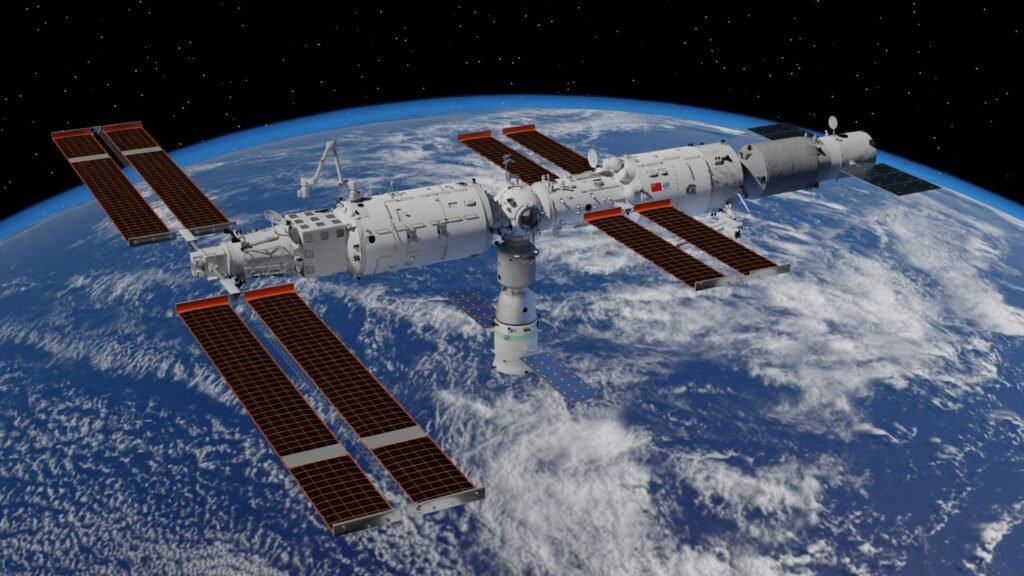
- About: The Tiangong Space Station (“Heavenly Palace”) is China’s permanently crewed, modular orbital laboratory operating in Low Earth Orbit (LEO) at an altitude of 340 to 450 kilometers.
- Operated by the China Manned Space Agency (CMSA), it is the only operational space station alongside the International Space Station (ISS).
- History: Initiated under Project 921 in 1992, China’s three-step human spaceflight strategy (China Manned Space Program).
- Following the 2011 U.S. Wolf Amendment, which barred China from joining the ISS, Beijing accelerated its autonomous path.
- China validated critical orbital rendezvous, docking, and refueling technologies using two prototype laboratories: Tiangong-1 (2011) and Tiangong-2 (2016).
- Assembly spanned three heavy-lift Long March 5B launches from Wenchang: the Tianhe core module (April 29, 2021), followed by the Wentian (July 24, 2022) and Mengtian (October 31, 2022) laboratory modules.
- Features:
- It weighs roughly 66 to 100 metric tons depending on docked spacecraft.
- It is a T-shaped outpost, serving as a sovereign platform for long-term human spaceflight.
- Designed for an operational lifespan of at least 10 to 15 years, Tiangong accommodates rotating three-astronaut (taikonaut) crews for six-month expeditions—expanding to six during handovers.
- Tiangong anchors a self-reliant orbital ecosystem supported by Shenzhou crewed spacecraft, Tianzhou automated cargo freighters, and Tianlian data-relay satellites.
- It features regenerative life-support systems, ion propulsion thrusters for efficient orbital maintenance, and advanced robotic arms capable of relocating modules and assisting spacewalks.
- It is equipped with 23 internal experiment racks and external exposure platforms.
- Future upgrades include expanding from three to six modules and launching the co-orbiting Xuntian Space Telescope in 2027, which boasts a field of view 300 times wider than Hubble.
International Space Cooperation Between China-Pakistan
- China–Pakistan space cooperation began in 1990 with the launch of Pakistan’s Badr-I satellite from China, followed by Badr-B in 2001.
- Early ties were anchored by the 1991 Cooperation Agreement on the Peaceful Utilization of Aerospace Science and Technology and the Asia-Pacific Space Cooperation Organization (APSCO), co-initiated in the 1990s and formally established in 2005.
- Pakistan became the first foreign user of China’s BeiDou Navigation Satellite System in 2014, launched PRSS-1 and PakTES-1A in 2018, and deployed PakSat-MM1 and lunar CubeSat ICUBE-Q (aboard Chang’e-6) in 2024.
- Bilateral planning later expanded through the CNSA–SUPARCO Space Cooperation Outline Program (2021–2030), the February 2025 human spaceflight agreement on astronaut selection and training, and the 2025–2029 Action Plan.
- Following PRSS-2/PRSC-S1 in 2025 and PRSC-EO3 in April 2026.
- In November 2026, Zeeshan Ali (trained alongside Khurram Daud) became the first foreign astronaut aboard Tiangong to conduct space science experiments.
- The space partnership links Pakistan’s Space & Upper Atmosphere Research Commission (SUPARCO), China National Space Administration (CNSA), and China Manned Space Agency (CMSA) with CPEC and the Space Silk Road under the Belt and Road Initiative, reinforcing their “all-weather strategic cooperative partnership” during their 75th diplomatic anniversary in 2026.
- Both nations plan to deploy a SUPARCO lunar rover near the lunar south pole aboard China’s Chang’e-8 mission in 2028.
- Assess collaboration on the International Lunar Research Station (ILRS), and establish a Pakistan Space Center.
- Islamabad has also announced an aspirational target for a Moon landing by 2035 backed by continued Chinese technical support and a 2047 lunar presence.
China’s Strategic Space Ambitions
- China treats space as a core pillar of national strategy, aiming to become a leading space superpower by 2045 and achieve space power status under its 15th five-year plan toward 2030.
- China aims to achieve its first crewed lunar landing before 2030.
- China’s Chang’e programme is a series of robotic lunar exploration missions named after a Chinese lunar deity.
- In June 2024, Chang’e-6 successfully returned the world’s first samples from the far side of the Moon. The mission landed in the South Pole–Aitken Basin and collected lunar material using a robotic arm and drilling equipment.
- The Chang’e-7 mission, planned around 2026, focuses on investigating the lunar south polar region. Chang’e-8, planned around 2028, aims to demonstrate technologies related to lunar resource utilisation and in-situ construction.
- China has proposed the International Lunar Research Station (ILRS) as a scientific research facility on and around the Moon.
- Its objectives include lunar geological research, resource exploration, scientific experiments and technological demonstrations.
- The initial facility is planned for the 2030s, with a more extensive network envisioned by 2050.
- It will complement deep-space efforts like Tianwen-1 on Mars and Tianwen-2 asteroid exploration.
India’s Human Space Programme
- The Indian Space Research Organisation (ISRO) is the principal agency responsible for developing India’s human-spaceflight programme.
- Approved in 2019, Gaganyaan is India’s indigenous human-spaceflight programme.
- Its objective is to send up to three Indian astronauts into an approximately 400-kilometre orbit for a mission lasting up to three days, followed by safe recovery on Earth.
- It involves developing human-rated launch vehicles, crew modules, environmental control systems and emergency escape mechanisms.
- ISRO plans to launch the first uncrewed Gaganyaan flight (G1) in Q4 2026, followed by the first crewed flight in 2027.
- India plans to establish its own modular space station, called the Bharatiya Antariksh Station (BAS), by 2035.
- The first module, BAS-01, is targeted for launch by 2028, with the complete five-module station planned by 2035.
- BAS is expected to support microgravity experiments, biotechnology, pharmaceuticals, materials science, space medicine and advanced manufacturing.
- India’s broader Space Vision 2047 includes achieving an Indian crewed lunar landing by 2040.
- Other important missions include Chandrayaan-4, the Venus Orbiter Mission and development of the Next Generation Launch Vehicle.
- Approved in 2019, Gaganyaan is India’s indigenous human-spaceflight programme.
- Rakesh Sharma in 1984, became the first Indian citizen to travel to space aboard the Soviet spacecraft Soyuz T-11 as part of the Interkosmos programme.
- In June 2025, Group Captain Shubhanshu Shukla travelled to the International Space Station (ISS) as the mission pilot of Axiom Mission-4 (Ax-4).
- The ISS is a multinational research laboratory operating in Low Earth Orbit. It is supported by major partners, including NASA (United States), Roscosmos (Russia), ESA (Europe), JAXA (Japan) and CSA (Canada).
- The Ax-4 mission was launched aboard a SpaceX Dragon spacecraft using a Falcon-9 rocket. He became the first Indian to visit the ISS.
- During his approximately 18-day stay, Shukla completed seven Indian research experiments. These examined muscle regeneration, algal growth, crop viability, microbial survivability, cognitive performance and cyanobacterial behaviour.
- In January 2025, India’s Space Docking Experiment (SpaDeX) demonstrated autonomous docking and undocking between two satellites.
- India became the fourth country to demonstrate this capability. Space docking is essential for future space-station assembly, and in-orbit operations.
Frequently Asked Questions (FAQs):
1. What is Shenzhou-24?
Shenzhou-24 is China’s crewed spacecraft mission transporting three astronauts, including Pakistan’s first astronaut, to the Tiangong Space Station.
2. What is the Tiangong Space Station?
Tiangong is China’s independently operated modular space station designed for scientific research, microgravity experiments and long-duration human spaceflight.
3. Who is Pakistan’s first astronaut in space?
Muhammad Zeeshan Ali became the first Pakistani national to travel into space aboard Shenzhou-24.
4. What are the major objectives of Shenzhou-24?
Its objectives include astronaut transportation, scientific experiments, microgravity research, space medicine and testing advanced space technologies.
5. What is India’s Bharatiya Antariksh Station?
It is India’s planned modular space station, with the first module targeted for 2028 and completion targeted by 2035.
Disclaimer: Information in this article is based on official announcements and public records. Details may evolve over time.