



Pakistan Names First Lunar Rover “Jinnah-1” For 2029 Moon Mission
| General Studies Paper III: Space Technology, Space Exploration |
Why in News?
Recently, Pakistan named its first lunar rover Jinnah-1, planned for China’s Chang’e-8 mission to the lunar south pole in 2029, marking Islamabad’s entry into lunar exploration.
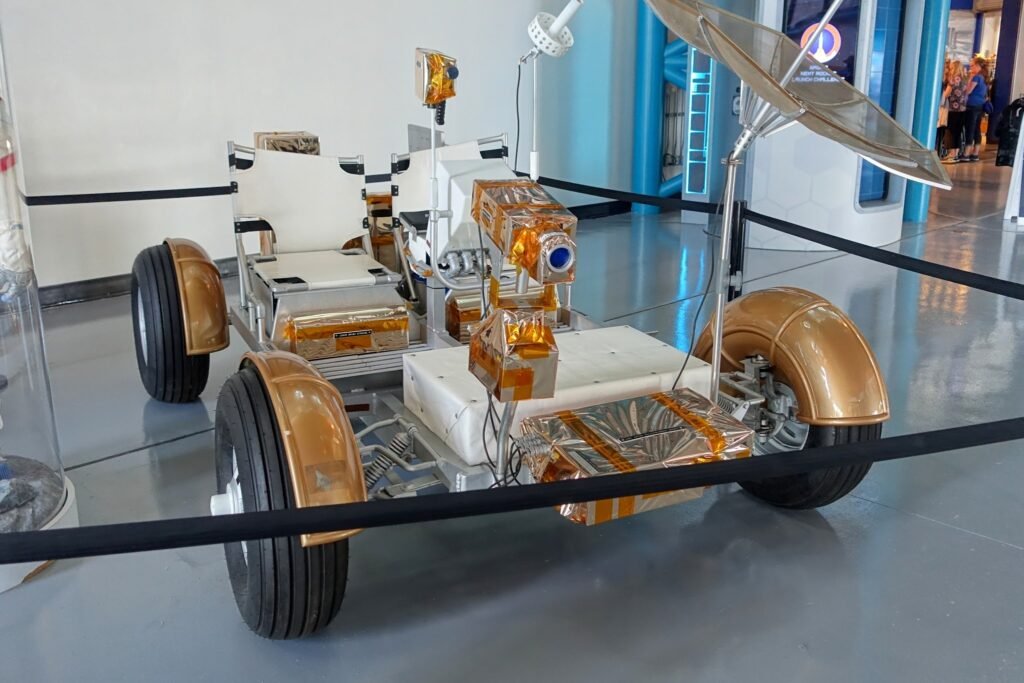
Pakistan’s Lunar Exploration Programme
- Initiative: Pakistan’s Lunar Rover Program is a national space exploration initiative to deploy the country’s first indigenous robotic rover on the Moon.
- Pakistan’s collaboration with China National Space Administration on the lunar rover was publicly announced in 2024.
- The collaboration was signed in Beijing on 5 February 2025.
- Pakistan authorities confirmed that its indigenous rover would participate in China’s Chang’e-8 mission.
- China’s Chang’e-8 will provide the lunar-mission platform for the lunar rover.
- Institutional Authority: The programme is led by SUPARCO (Space & Upper Atmosphere Research Commission).
- It is Pakistan’s national space agency and was established in 1961, SUPARCO.
- It focuses on satellite development, space science, and remote sensing.
- It manages international civil space cooperation and peaceful space research applications for the country.
- Development: On 13 August 2026, SUPARCO officially announced “Jinnah-1” as the rover’s name.
- The name was chosen from about 4,000 nationwide proposals; seven entries proposed Jinnah-1, with the final winner selected by lucky draw.
- Jinnah-1 commemorates Muhammad Ali Jinnah, Pakistan’s founder.
- SUPARCO describes the name as representing Pakistan’s resolve, progress and emergence into new space frontiers.
- It is reported to weigh about 35 kilograms and planned for the Moon’s south-polar region, an exceptionally important exploration zone.
- Jinnah-1 is expected to investigate lunar geology, plasma and radiation, while conducting experiments relevant to future lunar exploration and potential human activity on the Moon.
- Jinnah-1 is linked with the wider International Lunar Research Station (ILRS) vision.
- Jinnah-1 commemorates Muhammad Ali Jinnah, Pakistan’s founder.
- The name was chosen from about 4,000 nationwide proposals; seven entries proposed Jinnah-1, with the final winner selected by lucky draw.
- Mission Schedule: The currently announced plan places Jinnah-1 on the Moon in 2029, aboard China’s Chang’e-8 mission.
About Chang’e-8 Mission
- Chang’e-8 is China’s planned robotic lunar mission focused on south-polar exploration, and resource-utilisation experiments.
- It belongs to China’s Chang’e Lunar Exploration Programme, following Chang’e-7.
- Together, Chang’e-7 and Chang’e-8 are intended to establish technologies for sustained lunar exploration.
- The mission is led by the China National Space Administration (CNSA), with substantial opportunities for international scientific and technological participation.
- CNSA currently states that Chang’e-8 is planned for launch around 2029.
- Chang’e-8 is designed around a lander and rover, supplemented by scientific instruments and technological demonstrations.
- A heavy-lift Long March 5 rocket will execute the orbital insertion and transit maneuvers to the Moon.
- It will combine a four-legged lander, a six-wheeled rover, and a specialized utility robot.
- Private space company STAR.VISION is integrating advanced AI-controlled exploration robots designed for autonomous collaborative task operations.
- The mission will explore the lunar south-polar region, with CNSA identifying the Leibnitz-Beta Plateau as the targeted area.
- Its architecture is intended to enable detailed surface investigation and experimentation.
- Mission objectives include studying lunar geology, surface physical fields and environmental characteristics.
- Its observation is relevant to understanding the Moon and Earth–Moon system.
- It will focus on ISRU—In-Situ Resource Utilisation, including experiments examining whether lunar materials can support useful manufacturing processes such as 3D-printed construction materials.
- CNSA announced that Chang’e-8 will carry payloads from 11 countries and regions plus one international organisation.
- It will include flying instruments from Pakistan, Turkey, Italy, and Russia.
- Chang’e-8 forms the foundation of the International Lunar Research Station (ILRS), initiating full automation by 2031.
Why the Lunar South Pole Matters?
- Unique Polar Environment: The lunar south pole has an unusual combination of sunlit highlands and permanently shadowed regions (PSRs), creating conditions unlike most lunar locations.
- Potential Water-Ice Reservoirs: PSRs are extremely cold “cold traps” where water molecules can remain frozen for geological periods.
- NASA observations provide evidence of water ice, making the region scientifically valuable.
- Future Human Resource: Lunar water could become an important in-situ resource for future missions.
- It may support drinking water, life-support systems and, after processing, potentially hydrogen–oxygen propellant.
- Near-Continuous Solar Energy: Some elevated polar areas receive unusually prolonged illumination, offering opportunities for relatively reliable solar power generation compared with regions experiencing long lunar nights.
- Planetary Science Laboratory: The south pole contains ancient, heavily cratered terrain. Studying its geology, mineral composition and surface environment can improve understanding of lunar evolution and the early Solar System.
- South Pole–Aitken Basin: The nearby South Pole–Aitken (SPA) Basin is one of the Moon’s oldest and largest impact structures.
- Its exposed deep materials may provide clues about the Moon’s interior and early geological history.
- Technology Testbed: The region is ideal for testing precision landing, autonomous navigation, thermal management, power systems, drilling and resource-utilisation technologies needed for sustained lunar operations.
India’s Achievement at Lunar South Pole
- India achieved a major lunar milestone when Vikram Lander successfully soft-landed on 23 August 2023 in the Moon’s southern high latitudes.
- India became the first country to successfully land near the lunar south-polar region, and the fourth country to achieve a lunar soft landing.
- The landing site, officially named Shiv Shakti Point (Statio Shiv Shakti), lies at approximately 69.37°S, 32.32°E on the Moon’s near side.
- Chandrayaan-3 consisted of the Vikram Lander, Pragyan Rover and Propulsion Module. The mission specifically demonstrated safe landing, surface mobility and in-situ science.
- Pragyan successfully deployed onto the lunar surface and travelled approximately 101 metres, conducting scientific measurements around the landing site.
- The mission measured seismicity, thermal/thermophysical properties, plasma environment and elemental composition, providing direct observations from previously unexplored southern high latitudes.
- Pragyan’s Alpha Particle X-ray Spectrometer (APXS) measured elements at Shiv Shakti Point.
- Results supported interpretations related to the lunar magma-ocean hypothesis and primitive lunar mantle material.
- The ChaSTE instrument measured the lunar near-surface thermal environment, providing valuable information about temperature variation with depth in the landing region—important for understanding polar lunar conditions.
- Recent analysis of RAMBHA-LP observations found that the near-surface electrical/plasma environment at southern lunar latitudes is more active than previously understood.
- Chandrayaan-3 demonstrated critical technologies including autonomous landing, hazard detection, navigation and rover mobility.
- The subsequent ~50-cm Vikram hop experiment also demonstrated controlled relocation capability relevant to future sample-return missions.
- It also laid technological and scientific foundations for subsequent missions, including the India–Japan Chandrayaan-5/LUPEX mission, approved in 2025.
Frequently Asked Questions (FAQs):
1. What is Jinnah-1?
Jinnah-1 is Pakistan’s first indigenous lunar rover, designed for scientific exploration near the Moon’s south pole.
2. Why was it named Jinnah-1?
It honours Muhammad Ali Jinnah, symbolising Pakistan’s resolve, progress and emergence in space exploration.
3. When will Jinnah-1 be launched?
Jinnah-1 is scheduled for 2029, aboard China’s Chang’e-8 lunar mission.
4. What is its mission objective?
It will study lunar geology, plasma and radiation, while testing technologies relevant to future lunar exploration.
5. Which organisation is developing it?
Pakistan’s Space and Upper Atmosphere Research Commission (SUPARCO) is developing the indigenous lunar rover.
6. Will Jinnah-1 land or orbit?
Jinnah-1 is designed as a surface rover, intended to land and operate on the Moon, not merely orbit.
Disclaimer: Information in this article is based on official announcements and public records. Regulations and implementation details may evolve over time.