




Japan Extracts Deep-Sea Rare Earth Elements
|
General Studies Paper III: Mineral and Energy Resources, Environmental Pollution & Degradation |
Why in News?
Recently, Japan successfully extracted rare-earth-rich seabed mud from deep-sea at a depth of about 6,000 m near Minamitorishima, marking a world’s first technological breakthrough.
Highlights of Japan’s Deep-Sea Rare Earth Mining Achievement
-
- Project Name: Japan’s deep-sea rare earth initiative is part of the Strategic Innovation Promotion Program (SIP) led by the government with support from JAMSTEC.
- The focus of this initiative is extracting seabed mud rich in rare earth elements, which are vital for manufacturing electric vehicles and advanced electronics.
- Core Objective: The primary objective is to reduce dependence on China, which dominates global rare earth supply.
- It represents a national strategic project aimed at securing domestic critical mineral supply.
- Location: The extraction site lies near Minamitorishima Island, about 1,900 km southeast of Tokyo within Japan’s Exclusive Economic Zone. This remote Pacific zone is geopolitically significant and resource-rich.
- Operating Conditions: Mining was conducted at 6,000 meters depth, among the deepest resource extraction attempts globally.
- This depth creates challenges like high pressure, low temperature, and technical risk.
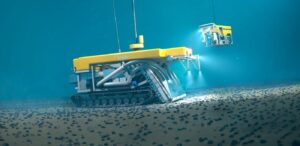
- Extraction System: Japan used the advanced drilling vessel Chikyu, deploying long pipes and seabed extraction machines to lift mud.
- The system includes remote-operated tools, pressure-resistant equipment, and real-time monitoring.
- Execution: The mission began in January 2026, with the first successful recovery on 1 February 2026. The vessel completed a continuous lifting test.
- Mineral Composition: Japan successfully extracted rare-earth-rich seabed mud from deep-sea.
- Extracted seabed mud contains valuable elements such as dysprosium, neodymium, terbium, and gadolinium.
- These are crucial for EV motors, wind turbines, semiconductors, and defence systems.
- Potential: The Minamitorishima region is estimated to hold over 16 million tonnes of rare earths, potentially one of the largest global reserves with long-term supply capacity.
- According to studies from the University of Tokyo’s Kato Laboratory, this deposit contains significant amounts of yttrium and dysprosium, capable of meeting global demand for 780 and 730 years respectively.
- Production Plan: Japan plans pilot-scale extraction by 2027, targeting around 350 tonnes of mud per day. Full-scale commercial mining may begin later depending on feasibility.
- Project Name: Japan’s deep-sea rare earth initiative is part of the Strategic Innovation Promotion Program (SIP) led by the government with support from JAMSTEC.
- Challenges: Despite success, challenges remain including high costs, environmental concerns, and technological complexity.
-
- The extraction processes raise concerns regarding the destruction of deep-sea habitats, the creation of sediment plumes, and the potential impact on fragile, uncharted ecosystems.
- Operating at 6,000m involves managing pressures exceeding 60 MPa—equivalent to 10,000 kg per square metre.
|
Deep-Sea Mining (DSM):
Rare Earth Elements (REEs):
|
Significance of Deep-Sea Rare Earth Discovery
- Diversifying Global Supply Chains: The extraction of 16 million tonnes of minerals directly challenges the geopolitically concentrated supply.
- Currently, China controls over 90% of permanent magnet production. This discovery offers a massive, alternative source for the world market.
- It reduces the risk of global price spikes caused by regional export quotas or trade wars.
- Green Energy Scalability: The global transition to Net Zero requires a 400% increase in rare-earth production by 2040.
- This find provides the raw materials for millions of EV motors and offshore wind turbines.
- It acts as a global catalyst for decarbonization, ensuring that mineral shortages do not stall the adoption of renewable energy technologies.
- Advancing Deep-Sea Engineering: Extracting sediment from 6,000 metres establishes a new technical frontier for all maritime nations.
- The successful use of riser pipes at these depths proves that “deep-sea mud” is a viable resource.
- This breakthrough shifts global mining interest from land-based pits to the vast ocean floor, which covers 70% of the planet.
- Countries like the US, EU, India, and Australia may intensify exploration efforts, leading to a multi-polar mineral order.
- Reshaping Defense Logistics: Rare earths are critical for stealth technology and satellite communications used by various nations.
- Access to these heavy rare earths ensures that international defense contractors are not reliant on a single source.
- It enhances global stability by preventing any single country from using mineral leverage to influence global military readiness.
- New Ethical Standards: Seabed mud typically contains lower levels of radioactive thorium compared to land mines.
- This offers a “cleaner” alternative for the global market, which is increasingly focused on ESG (Environmental, Social, and Governance) standards.
- It forces a global rethink on how to balance mineral needs with the preservation of sensitive marine ecosystems.
|
Related Deep-Sea Mining Initiatives:
|