Scientists Warn of Super El Niño Risk
|
General Studies Paper III: Climate Change, Environmental Pollution & Degradation |
Why in News?
Recently, scientists warn a potential “super El Niño” could emerge in 2026 as Pacific warming intensifies, with 60% probability of formation, raising risks of extreme heat and weak monsoons in India.
What is El Niño?
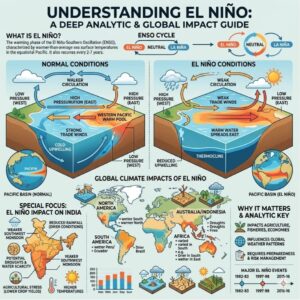
- About: El Niño is a natural climate phenomenon characterized by abnormally warm Sea Surface Temperatures (SSTs) in the central and eastern equatorial Pacific Ocean, which disrupts normal global weather systems and atmospheric circulation.
- El Niño is one phase of the El Niño–Southern Oscillation (ENSO), a coupled ocean-atmosphere system that also includes La Niña (cool phase) and neutral conditions.
-
-
- The term “El Niño”, meaning “Little Boy” or “Christ Child” in Spanish, was coined by Peruvian fishermen in the 17th century. They observed unusually warm ocean waters around December, which reduced fish catches along the South American coast.
- Super El Niño: It is an exceptionally strong, rare, and intense warm phase of the Pacific ENSO climate pattern.
- It is typically defined by central/eastern tropical Pacific sea surface temperatures in the Niño 3.4 region rising over 2°C above average.
-
- Oceanic Mechanism: During El Niño, trade winds weaken or reverse, causing warm surface water to shift eastward across the Pacific, reducing cold water upwelling near South America and leading to widespread ocean warming anomalies.
- El Niño is linked with the Southern Oscillation, a shift in air pressure patterns between the western and eastern Pacific. Typically, low pressure develops over the eastern Pacific, while high pressure dominates the western Pacific.
-
-
- The Walker Circulation, a system of east-west atmospheric circulation, weakens during El Niño. This leads to reduced rainfall in the western Pacific (Australia, Indonesia) and increased rainfall in the eastern Pacific (Peru, Ecuador).
-
- Frequency: El Niño occurs irregularly every 2–7 years and typically lasts 9–12 months, though some events can persist longer.
- Monitoring: El Niño is monitored using satellite data, buoys (like the TAO/TRITON array), and climate models.
- Agencies such as NOAA issue forecasts based on indicators like the Oceanic Niño Index (ONI).
- It is monitored using ONI, based on sea surface temperature anomalies (≥ +0.5°C) in the Niño 3.4 region, along with atmospheric indicators.
Super El Niño 2026 Projections
- Transition Phase: As of April 2026, ENSO-neutral conditions dominate (80%), marking the decline of La Niña.
- Forecast models indicate a gradual oceanic warming trend, with subsurface heat anomalies increasing in the equatorial Pacific—critical precursors for El Niño development.
- El Niño Formation: Climate models from NOAA and multi-model ensembles project a 62% probability of El Niño emergence by June–August 2026, rising further toward year-end with persistence likely into winter 2026–27.
- Model consensus indicates an 80% probability of a strong El Niño, while the likelihood of this remains lower at 20–25% (≈1-in-4 chance).
- Such intensity depends on sustained westerly wind bursts and ocean–atmosphere coupling strength.
- Duration: El Niño is expected to initiate in mid-2026, intensify through summer–autumn, and peak during November–January, consistent with historical ENSO cycles.
- Some projections indicate warming exceeding +2.5°C anomalies by late 2026 if a super event materializes.
Drivers Behind Emerging Super El Niño Risk
- Rapid Transition Creating Oceanic Instability: A key factor behind potential super El Niño risk is the rapid collapse of La Niña (2024–2026) into warming-neutral conditions. This transition often produces oceanic instability, where stored subsurface heat rapidly surfaces in the equatorial Pacific.
- Recent observations show equatorial Pacific heat content at highest levels since the last El Niño cycle, indicating strong pre-conditioning for warming amplification.
- Subsurface Heat Accumulation: One of the strongest drivers is the build-up of subsurface ocean heat (0–300 m depth) in the western Pacific warm pool. This heat is transported eastward via Kelvin waves, increasing sea surface temperature anomalies.
- Studies show that subsurface warming acts as an “energy reservoir,” enabling sudden surface temperature spikes above +2°C, a threshold linked to super El Niño formation.
- Intensification of Westerly Wind Bursts (WWBs): Frequent westerly wind bursts (WWBs) are increasingly observed due to Madden–Julian Oscillation (MJO) activity. These bursts weaken trade winds and push warm water eastward
- Advanced climate models highlight WWBs as a primary trigger for extreme El Niño events due to their role in accelerating ocean–atmosphere coupling.
- Climate Change–Driven Ocean Warming: Rising global temperatures are raising the baseline sea surface temperature (SST) across the Pacific. This reduces the threshold required to trigger El Niño conditions, meaning even moderate anomalies can escalate into extreme or “super” events.
- Atmospheric–Ocean Feedback: The Walker Circulation weakening and shifting jet streams intensify ENSO feedback loops. As warming spreads eastward, atmospheric convection shifts, reinforcing further ocean warming.
- This self-reinforcing system (Bjerknes feedback) increases the probability of extreme El Niño development, especially during strong coupling phases between ocean and atmosphere.
Global Impact of Emerging Super El Niño
- Global Temperature Surge: A potential super El Niño can raise global mean temperature by 0.1–0.2°C, intensifying already warming conditions.
- Recent studies and forecasts indicate risk of record-breaking heat in 2026–27, especially if Pacific warming exceeds +2°C SST anomaly.
- This would increase the frequency of deadly heatwaves in Asia, Europe, and North America, stressing public health systems and energy demand.
- Indian Monsoon: For India, El Niño typically weakens the southwest monsoon (Jun–Sep) by disrupting Walker Circulation.
- Forecasts for 2026 already suggest below-normal rainfall probability, threatening rice, pulses, oilseeds production and rural incomes.
- Agriculture, which supports nearly 50% of India’s workforce, faces higher risk of yield decline and inflationary pressure due to food supply shocks.
- A persistent high-pressure system can trap warm air, creating severe “heat domes” that lead to dangerous temperatures.
- Flood Risk: A strong El Niño shifts rainfall eastward, increasing flood probability in western South America (Peru, Ecuador) and parts of southern USA and China.
- These regions often experience extreme precipitation events, landslides, and infrastructure damage.
- Rainfall in northern Peru and Ecuador can exceed 15 times the long-term mean, leading to catastrophic river overflows.
- Drought Intensification: Conversely, regions like Australia, southern Africa, and parts of Southeast Asia face severe drought conditions and water stress.
- Reduced rainfall disrupts crop cycles, hydropower generation, and livestock productivity, increasing food insecurity risks in vulnerable economies.
- Countries like Indonesia, Vietnam, and Thailand are expected to experience intense dry spells, raising the risk of large-scale wildfires.
- Pakistan is expected to face a weak monsoon and severe drought this summer, potentially threatening agriculture, water resources, and food security.
- Atlantic Hurricane Suppression: A strong El Niño often strengthens upper-level wind shear in the Atlantic, which suppresses hurricane formation and intensity.
- However, it simultaneously enhances Pacific cyclone activity, shifting global tropical storm risk zones rather than reducing total storm energy.
- Economic Instability: Globally, super El Niño events disrupt food supply chains, commodity prices, and inflation patterns.
- The 1997–98 event alone caused an estimated $5.7 trillion in global income losses. The upcoming 2026 cycle is expected to strain global energy grids.
- With climate change increasing baseline ocean warmth, the economic volatility risk is now structurally higher, especially for developing nations reliant on monsoon agriculture.
|
Also Read: IMD Forecasts Below Normal Monsoon for 2026 |