




NASA $4 Billion Telescope Launch To Explore Cosmic Enigmas
| General Studies Paper III: Space Exploration, Space Technology |
Why in News?
Recently, NASA launched the $4.3-billion “Nancy Grace Roman Space Telescope” to explore cosmic enigmas and to create unprecedented wide-field maps to deepen humanity’s understanding of the universe.
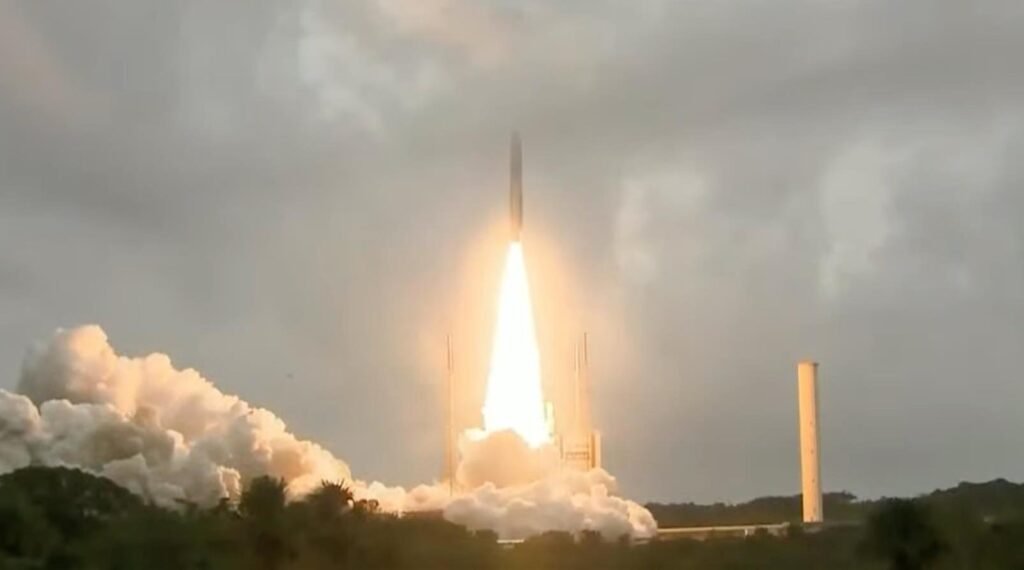
Nancy Grace Roman Space Telescope & NASA Mission
- About: The Nancy Grace Roman Space Telescope (Roman) is NASA’s next-generation flagship astrophysics observatory.
- It is designed to investigate dark energy and infrared astrophysics through exceptionally wide and deep surveys of the Universe.
- Managed By: Roman is managed by NASA’s Goddard Space Flight Center, with major participation from NASA JPL, Caltech/IPAC and the Space Telescope Science Institute.
- Industrial partners and international institutions, including ESA and JAXA, also contributed.
- Cost: Roman’s total lifecycle cost estimate is about $4.3 billion.
- Origin: The mission originated as the Wide Field Infrared Survey Telescope (WFIRST).
- NASA formally approved hardware development in March 2020 and renamed WFIRST the Nancy Grace Roman Space Telescope on May 20, 2020.
- Namesake: Nancy Grace Roman was NASA’s first Chief Astronomer and a pioneering advocate of space-based astronomy.
- She played an important role in establishing the scientific and institutional foundations that led to Hubble, earning the title “Mother of Hubble.”
- Features:
- Primary Mirror: Roman carries a 2.4-metre (7.9-foot) primary mirror, equal in diameter to Hubble’s. Roman’s mirror weighs only about 186 kg, less than one-fourth of Hubble’s mirror.
- Wide Field Instrument: Its principal instrument, the Wide Field Instrument (WFI), is a 300-megapixel near-infrared camera providing a field of view at least 100 times larger than Hubble’s.
- It can measure light from approximately one billion galaxies.
- Coronagraph Instrument: The Coronagraph Instrument is a technology demonstrator designed to suppress intense starlight, enabling direct imaging and spectroscopy of nearby exoplanets.
- Its technologies could support future missions searching for Earth-like planets.
- Mission: Roman successfully launched on 30 August 2026 at 7:26 a.m. EDT aboard a SpaceX Falcon Heavy from Launch Complex 39A, Kennedy Space Center, Florida.
- After separation, it began its approximately three-month journey toward L2.
- Roman will operate near the Sun–Earth L2 point, about 1.5 million km (930,000 miles) from Earth.
- Objectives: Its primary mission is for five years, with a 10-year operational goal, targeting the Universe, galaxies, dark components and planetary systems.
- Roman will investigate the nature of dark energy and dark matter, study galaxy evolution, map cosmic structures and examine how the Universe has changed over cosmic time.
- Its enormous surveys will generate substantial additional astrophysical discoveries.
- It will conduct a gravitational microlensing survey toward the Milky Way’s inner regions to discover more than 1,000 exoplanets, particularly planets that are difficult to detect.
- Roman will investigate the nature of dark energy and dark matter, study galaxy evolution, map cosmic structures and examine how the Universe has changed over cosmic time.
What is Dark Matter?
- About: Dark matter is an unseen form of matter inferred from its gravitational effects on visible matter, galaxies, galaxy clusters and light.
- It does not emit, absorb or reflect light, making direct observation extremely difficult.
- Discovery: The term dark matter was coined by astronomer Fritz Zwicky in 1933 while studying the unexpectedly high velocities of galaxies in the Coma Cluster.
- Later, Vera Rubin’s galaxy-rotation observations in the 1970s provided important additional evidence.
- It may have originated during the Big Bang, subsequently concentrating into primordial black holes whose immense gravitational forces continue to trap these elusive particles.
- Beyond these early cosmic origins, stellar remnants such as white dwarfs and neutron stars are also believed to harbor high concentrations of dark matter.
- Brown dwarfs—often referred to as failed stars because they lacked the mass necessary to ignite nuclear fusion within their cores—serve as another significant potential source in the universe.
- Composition: Under the standard cosmological model, dark matter constitutes roughly 27% of the Universe’s total mass-energy budget, compared with about 5% ordinary matter.
- Dark matter likely consists of heavy, invisible particles called WIMPs (weakly interacting massive particles) that rarely touch normal matter.
- Two main components are neutralinos, which are slow and heavy theoretical particles, and sterile neutrinos, which interact with our universe through gravity alone.
- Evidence: Stars far from galactic centres often orbit faster than expected from the gravity of visible matter. These flat rotation curves provide strong evidence for extended dark-matter halos surrounding galaxies.
- Dark matter bends light through gravity. By measuring distortions in the images of background galaxies, astronomers can reconstruct the otherwise invisible distribution of mass through gravitational lensing.
- The observed motions of stars and galaxies cannot be adequately explained by the gravitational pull of visible matter alone.
- The additional gravitational influence indicates the presence of substantial unseen matter.
- Dark matter provides much of the gravitational framework within which galaxies and large-scale cosmic structures developed.
- Its gravitational influence helped matter aggregate into the cosmic structures observed today.
- Projects to Study:
- Large Hadron Collider (LHC) at CERN: Smashes high-energy particles to see if unseen dark matter particles are produced in the collision debris.
- IceCube Neutrino Observatory: Searches deep Antarctic ice for invisible sterile neutrinos that might link to dark matter.
- Alpha Magnetic Spectrometer (AMS): Monitors space from the International Space Station to measure high-energy cosmic rays and antimatter excesses.
- LUX-ZEPLIN (LZ): Operates deep underground in South Dakota to spot rare interactions between dark matter candidates like WIMPs and xenon atoms.
- XENONnT: Uses liquid xenon in Italy’s Gran Sasso Laboratory to capture signals of particle collisions.
- DM-Radio: Employs superconducting devices to tune into ultra-light dark matter signals the way an AM radio tunes into frequencies.
- James Webb Space Telescope (JWST): Explores early cosmic structures and the role of dark matter in building the first galaxies.
- Vera C. Rubin Observatory: Builds a powerful time-lapse map of the southern sky to track gravitational lensing caused by invisible mass.
What is Dark Energy?
- About: Dark energy is the name given to the unknown component associated with the accelerating expansion of the Universe.
- It is a mysterious, invisible force that causes the expansion of the universe to speed up over time.
- It acts as a sort of anti-gravity, pushing galaxies apart instead of pulling them together.
- Discovery: Observations of distant Type Ia supernovae in the 1990s revealed that the Universe’s expansion was accelerating.
- This discovery fundamentally changed modern cosmology and contributed to the 2011 Nobel Prize in Physics.
- Behaviour: It smoothly distributed throughout space.
- It extremely low density (10⁻²⁷ kg/m³).
- It does not interact with the electromagnetic spectrum.
- It is undetectable through traditional telescopes.
- It does not dilute as space expands. It produces a repulsive force.
- It overpowers gravitational attraction on large scales. It pushes galaxies away from each other at an accelerating rate.
- Cosmic Share: Current cosmological estimates place dark energy at approximately 68% of the Universe’s total mass-energy budget.
- Concept: It was introduced by Albert Einstein in 1917 via his “Cosmological Constant” (Λ).
- In the standard ΛCDM model, dark energy behaves approximately as a cosmological constant.
- Study: Researchers measure cosmic expansion using Type Ia supernovae, galaxy clustering, weak gravitational lensing and other large-scale cosmological observations.
- Type Ia Supernovae is distant exploding stars appeared fainter than expected, proving acceleration (1998).
- Anisotropies mapped by WMAP and Planck satellites confirm flat universe geometry.
- Baryon Acoustic Oscillations, cosmic scale imprints in galaxy distributions confirm expansion rates.
- India:
- Astrosat: India’s first dedicated multi-wavelength space observatory.
- LIGO-India: Gravitational wave observatory aiding dark energy constraints.
- Square Kilometre Array: India is a key member mapping cosmic structures to study acceleration.
Frequently Asked Questions (FAQs):
1. What is the $4 billion NASA telescope?
The Nancy Grace Roman Space Telescope is NASA’s next-generation astrophysics observatory studying dark matter, dark energy, exoplanets and infrared astrophysics.
2. When did NASA launch the new space telescope?
NASA launched Roman on August 30, 2026, at 7:26 a.m. EDT, aboard a SpaceX Falcon Heavy from Florida.
3. How much did NASA’s new telescope cost?
Roman’s estimated lifecycle cost is approximately $4.3 billion, covering development, launch and planned mission operations.
4. What is its main purpose?
Its primary purpose is conducting wide, deep infrared surveys to investigate cosmic expansion, dark matter, dark energy and planetary systems.
5. What cosmic mysteries will it study?
Roman will investigate dark matter, dark energy, exoplanets, galaxy evolution, cosmic expansion, black holes and planetary formation.
6. How will it help scientists understand the Universe?
Roman will survey enormous sky regions, measuring galaxies, gravitational lensing and planetary systems, producing vast datasets for understanding cosmic structure and evolution.
Disclaimer: Information in this article is based on official announcements and public records. Regulations and implementation details may evolve over time.