




Pakistan Flags Indus Waters Treaty Dispute Globally
|
General Studies Paper II: India and its Neighbourhood, Groupings and Agreements involving India and/or affecting its Interests |
Why in News?
Recently, Pakistan internationalised the Indus Waters Treaty dispute by urging the UN Security Council to pressure India over suspending the treaty, escalating diplomatic tensions.
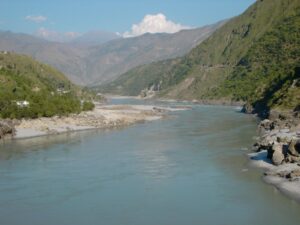
Indus Waters Treaty Between India-Pakistan
- Treaty Origin: The Indus Waters Treaty (IWT) emerged after the 1947 Partition, when Punjab’s integrated canal system was divided between India and Pakistan.
- Water disputes intensified after India temporarily stopped canal flows in April 1948, creating severe agricultural concerns in Pakistan.
- Bank Mediation: The World Bank initiated formal negotiations in 1951 under President Eugene Black.
- After nearly nine years of negotiations, the treaty was signed on 19 September 1960 in Karachi by Jawaharlal Nehru and Mohammad Ayub Khan.
- River Division: The treaty divided the six Indus Basin rivers into two groups.
- India received exclusive rights over the Eastern Rivers — Ravi, Beas and Sutlej, while Pakistan obtained rights over the Western Rivers — Indus, Jhelum and Chenab.
- Water Share: The agreement effectively allocated nearly 80% of total basin waters to Pakistan and around 20% to India.
- Pakistan received approximately 135 million acre-feet annually from western rivers, whereas India obtained nearly 33 million acre-feet from eastern rivers.
- Indian Rights: Although western rivers were assigned to Pakistan, India retained limited rights for domestic use, irrigation, navigation and hydroelectric generation.
- India is permitted Run-of-the-River (RoR) projects on Western Rivers, meaning power generation is allowed provided there is no significant diversion.
- However, Indian projects must comply with strict design and storage restrictions under treaty annexures.
- Commission Structure: The treaty established the Permanent Indus Commission (PIC) comprising one commissioner from each country.
- The PIC ensures data exchange, inspections, technical cooperation and regular communication, becoming a rare surviving institutional mechanism between both nations.
- Dispute Process: A three-level dispute mechanism was created. Minor “differences” are handled by the PIC, technical disputes go to a Neutral Expert, while legal disputes are referred to an international Court of Arbitration.
- Infrastructure Funding: The treaty enabled massive irrigation reconstruction in Pakistan through global financial assistance.
- Major projects included Mangla Dam, Tarbela Dam, barrages and link canals financed partly by World Bank member nations.
- Strategic Importance: The Indus Basin supports one of the world’s largest irrigation systems.
- Pakistan depends on it for nearly 80% of irrigated agriculture, making the treaty central to food security, hydropower and economic stability.
- Conflict Survival: The IWT survived the 1965, 1971 and 1999 wars and decades of diplomatic hostility.
- Scholars frequently describe it as one of the world’s most durable transboundary water-sharing agreements.
India–Pakistan Indus Water Treaty Disputes
- Hydroelectric Project Disputes: India–Pakistan tensions over the IWT began soon after implementation.
- Pakistan repeatedly alleged that Indian hydropower projects on western rivers violated treaty limits, while India maintained that all projects followed technical provisions under Annexure D.
- The first major conflict emerged over the 450 MW Baglihar Hydroelectric Project on the Chenab River in Jammu and Kashmir. In 2005, Pakistan approached the World Bank seeking a Neutral Expert. Swiss expert Raymond Lafitte largely upheld India’s design in 2007, though minor modifications were recommended.
- Pakistan objected to India’s 330 MW Kishanganga Project on the Jhelum tributary, claiming diversion of river flow violated downstream rights. In 2013, the Court of Arbitration (CoA) permitted India’s project but imposed minimum environmental flow requirements for Pakistan.
- The 850 MW Ratle Hydroelectric Project on the Chenab became another dispute. Pakistan challenged India’s dam design, spillway structure and water-storage capacity, arguing these could alter downstream flows during critical agricultural seasons.
- A major treaty crisis emerged in 2016–17 when Pakistan demanded a Court of Arbitration, while India insisted disputes should first go to a Neutral Expert. The World Bank temporarily paused both processes before later allowing parallel proceedings, which India strongly opposed.
- Treaty Modification: India formally sought modification and review of the treaty under Article XII(3) in 2023, arguing that Pakistan repeatedly blocked legitimate hydropower development through prolonged litigation and procedural delays. Pakistan has condemned this, claiming it violates international law.
- On August 30, 2024, India issued a formal notice to Pakistan under Article XII(3) to renegotiate the 64-year-old treaty, citing altered demographics and climate change but Pakistan refused.
- In January 2025, World Bank-appointed Neutral Expert Michel Lino upheld India’s position that disputes over Kishanganga and Ratle fell within his jurisdiction. India called the decision a validation of treaty procedures and rejected parallel arbitration mechanisms.
- Pahalgam Shift: On April 22, 2025, a terror attack in Pahalgam killed 26 people. Attributed to the Pakistan-based group The Resistance Front, this event fundamentally shifted India’s water diplomacy from restraint to “strategic utilization”.
- On April 24, 2025, New Delhi formally placed the IWT in abeyance (temporary suspension). India’s Ministry of External Affairs (MEA) declared that “blood and water cannot flow together,” linking river cooperation directly to cross-border security.
- Under the abeyance, India halted sharing hydrological data and flood warnings. This creates critical risks for Pakistan’s agriculture, which depends on the Indus system for irrigation.
- Pakistan sees this as a threat. Pakistani officials repeatedly claimed India’s decision lacked any binding legal foundation under international law.
Pakistan’s Global Campaign Over Indus Treaty Suspension
- UNSC Appeal: After that pretty suspension by India, Pakistan rapidly internationalised the dispute by approaching the United Nations Security Council (UNSC).
- Pakistan’s UN Ambassador Asim Iftikhar Ahmad described India’s move as “water warfare” and argued that unilateral suspension threatened regional peace and South Asian stability.
- PCA Strategy: Islamabad intensified legal pressure through the Permanent Court of Arbitration (PCA) at The Hague.
- In June 2025, the PCA issued a Supplemental Award observing that the treaty contains no explicit provision permitting unilateral suspension, strengthening Pakistan’s diplomatic narrative internationally.
- Bank Pressure: Pakistan also appealed to the World Bank, the treaty’s original guarantor and facilitator.
- Islamabad demanded active intervention to restore treaty operations, but World Bank President Ajay Banga maintained that the institution’s role remained limited to facilitation rather than enforcement.
- Media Outreach: Pakistan’s Foreign Ministry expanded the issue globally through diplomatic briefings, international interviews and media outreach.
- Officials warned of potential humanitarian consequences, alleging that disruption of river flows could trigger drought, agricultural collapse and food insecurity affecting nearly 240 million people.
- Global Lobbying: In 2026, Deputy Prime Minister Ishaq Dar formally wrote to the UNSC President demanding international scrutiny of India’s actions, including Operation Sindoor and treaty suspension.
- Pakistan sought diplomatic isolation of India through calls for global intervention and sanctions.
India’s Stand on Indus Treaty Suspension
- Legal Doctrine: India justifies its stance using Article 62 of the Vienna Convention (VCLT), invoking the principle of rebus sic stantibus (fundamental change of circumstances).
- New Delhi argues that Pakistan’s state-sponsored terrorism has destroyed the “spirit of goodwill” essential for the treaty’s survival.
- Expansion Rights: By suspending the treaty, India has removed self-imposed restrictions on the Western Rivers.
- It is now fast-tracking 850 MW Ratle and 330 MW Kishanganga projects, ignoring Pakistani design objections.
- Diplomatic Strategy: Internationally, India frames the suspension as a national security necessity rather than a treaty violation.
- India briefed major partners including the United States, France and Gulf countries, stressing that treaty measures were linked to terrorism concerns.
- Mediation Withdrawal: India has formally withdrawn from World Bank-led mediation and Neutral Expert proceedings, stating it will no longer participate in interim processes while the treaty is suspended.
- UNSC Standoff: In April 2026, Pakistan approached the UN Security Council, calling the move “water coercion”. India countered by asserting its sovereign right to respond to cross-border threats.
- Officials argued that international agreements operate on principles of good faith and reciprocity, both allegedly undermined by continued Pakistan-backed terrorism.
- India maintains that the IWT will remain in abeyance until Pakistan takes “credible and irreversible” steps against terror groups.
|
International Framework for Transboundary River Conflicts:
|