Jet-Powered Kamikaze Drone
| General Studies Paper III: Defence Technology, Indigenous Technology |
Why in News?
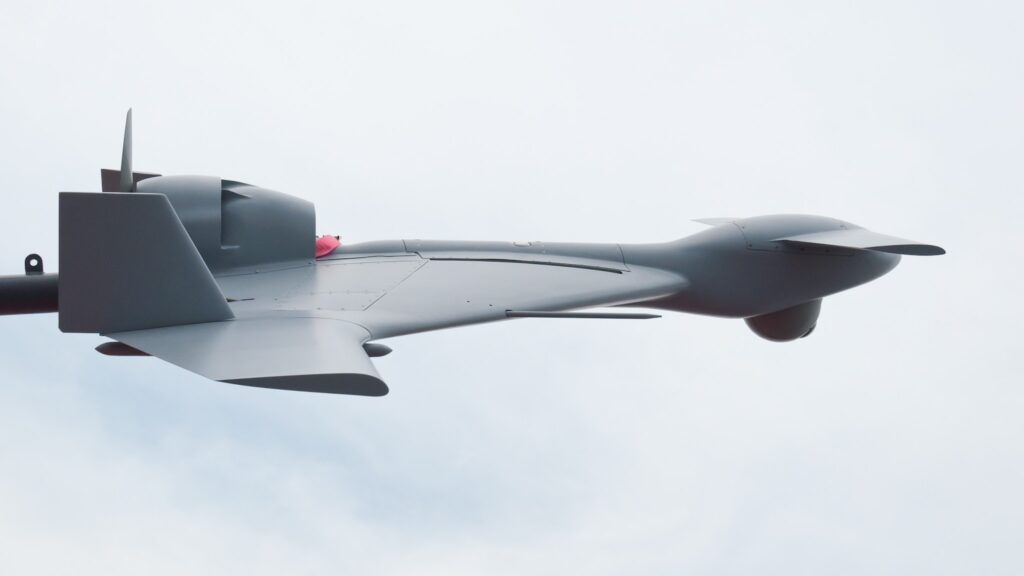
Recently, the Indian Army received 106 indigenous jet-powered Peacekeeper (Agniveg) kamikaze drones, consisting of 100 strike drones and 6 training UAVs.
What are Jet-Powered Kamikaze Drones?
- About: Jet-Powered Kamikaze Drones (one-way attack drones) are unmanned aerial vehicles (UAVs) equipped with a turbojet engine and an explosive warhead.
- It is designed to loiter over a target area and crash directly into a target to detonate.
- The Indian Army received these types of drones called Peacekeeper (Agniveg).
- Developed By: The drones are manufactured by Delhi-based defence firm SMPP in partnership with the Belarusian firm KB Indela.
- The development was accelerated under emergency procurement protocols following Operation Sindoor.
- Propulsion: Agniveg uses a turbojet engine, making it significantly faster than propeller-driven loitering munitions.
- The jet-powered configuration enables rapid penetration of defended airspace and quick engagement of time-sensitive targets.
- Range and Speed: The drone has an operational range of approximately 180 km and can achieve speeds of up to 450 km/h.
- These specifications place it among India’s notable long-range tactical strike drones capable of attacking targets deep behind enemy lines.
- Electronic Warfare Resilience: It is able to operate in heavily jammed and spoofed electromagnetic environments.
- It maintains stable mission execution even in GPS-denied environments.
- Minimal Collateral Damage: The lethal payload is optimized to feature a concentrated blast radius of under 5 meters.
- Autonomous Precision Targeting: Operating with advanced onboard algorithm matrices, the system executes fully autonomous precision-strike missions.
- Once a military objective is locked, the drone requires zero human-in-the-loop intervention, tracking and steering itself directly into the target asset.
- User Trials: During stringent user trials conducted at the Pokhran testing range in Rajasthan, the drone demonstrated a Circular Error Probable (CEP) of less than 5 meters.
Significance of Agniveg Kamikaze Drones
- Strengthening India’s Deep-Strike Architecture: The induction of Peacekeeper (Agniveg) fills a critical capability gap between conventional artillery and long-range missile systems.
- It provides commanders with a rapid-response precision weapon for engaging strategic targets deep inside adversary territory.
- Transformation of Battlefield Economics: Modern warfare increasingly favours low-cost precision effects over high-cost platforms.
- Agniveg offers a comparatively economical option for neutralising high-value targets, improving the Army’s cost-to-impact ratio.
- Enhancing Deterrence in Two-Front Scenarios: India faces potential simultaneous challenges along multiple borders.
- The Line of Actual Control (LAC) is the contested 3,488 km boundary with China. Tensions have remained highly volatile since the 2020 border clashes.
- The Line of Control (LoC) with Pakistan, spanning 3,323 km, involves long-standing territorial disputes and ongoing cross-border proxy warfare.
- These types of long-range loitering munitions capable of striking critical infrastructure enhance deterrence.
- Acceleration of Indigenous Defence Manufacturing: The delivery demonstrates growing domestic capability in advanced unmanned systems.
- It supports Aatmanirbhar Bharat, reduces dependence on foreign suppliers, and strengthens India’s defence-industrial ecosystem in a technology segment.
- Alignment with Global Warfare Trends: Conflicts in recent years have demonstrated the decisive role of loitering munitions in shaping battlefield outcomes.
- Systems like the Iranian-designed Shahed-136, used extensively in the Russia-Ukraine war, cost a fraction of traditional cruise missiles or air defense interceptors.
- During the 2020 Nagorno-Karabakh conflict, Israeli-made loitering munitions (like the IAI Harop) were instrumental in systematically dismantling Armenian air defense systems.
- Agniveg places India within the emerging global trend of integrating drones and network-centric operations into a unified combat framework.
India’s Indigenous Kamikaze Drone Arsenal
- Nagastra-1: Developed by Economic Explosives Ltd (EEL)/Solar Defence & Aerospace Ltd (SDAL), Nagastra-1 is India’s first indigenous loitering munition inducted in the Indian Army.
- The Indian Army completed procurement of 480 units under emergency procurement.
- It carries a high-explosive warhead, has 15 km man-in-loop range, up to 30 km autonomous range, around 60 minutes endurance, and 2-metre CEP accuracy.
- Nagastra-1R: The upgraded Nagastra-1R is manufactured by SDAL and incorporates a 360-degree gimbal camera, optional thermal imaging, encrypted communications, and enhanced night-strike capability.
- Following operational success, the Army placed an order for 450 additional units, indicating transition from experimental capability to sustained deployment.
- Solar Defence is developing Nagastra-2 and Nagastra-3, featuring greater range and enhanced strike capability.
- ALS Series: Developed by Tata Advanced Systems Limited (TASL), ALS-50 combines vertical take-off and landing (VTOL) capability with fixed-wing endurance. It can strike targets up to 50 km away, carry approximately 5–6 kg warheads, and is already operational with the Indian Air Force.
- TASL’s ALS-50 Mk II improves endurance, precision, payload, avionics, and performance in GPS-denied environments. Extensive flight testing has been completed.
- The ALS-250, also developed by TASL, is designed for a 250-km operational envelope, substantially extending India’s indigenous loitering strike reach.
- Vayu Astra-1: Developed by Nibe Limited, Vayu Astra-1 recently completed successful demonstrations in Pokhran and Joshimath.
- It can carry a 10-kg warhead, engage targets at 100 km range, supports anti-personnel and anti-armour missions, and has demonstrated high-altitude operations.
- AGNIKAA VTOL-1: Manufactured by ZUPPA Geo Navigation Technologies, AGNIKAA VTOL-1 is a first-person-view (FPV) kamikaze drone recently inducted under the Army’s EP-6 emergency procurement framework.
India’s Unmanned Military Drone Development Strategy
- Multi-Layered Strategy: India is developing a layered drone architecture to maintain situational awareness over the high-altitude Himalayas and porous borders.
- Aggressive Acquisitions: India approved a ₹32,350 crore acquisition of 87 Medium Altitude Long Endurance (MALE) drones, combining foreign purchases like the MQ-9B Predator with indigenous systems like the DRDO Rustom.
- Indigenous Development (DRDO & HAL): The focus is shifting toward self-reliance. DRDO is developing the Rustom series, TAPAS-BH-201, and loitering munitions like Nagastra-1 and ALS-50.
- Autonomous Swarms & “Loyal Wingman”: The Indian Air Force is testing ALFA-S swarm drones and the “Loyal Wingman” concept, allowing uncrewed platforms to act as decoys or conduct strikes ahead of crewed fighter jets.
- AI and Automatic Target Recognition (ATR): Artificial Intelligence is being embedded into drone swarms to ensure autonomous target recognition and shorten the kill chain, especially in harsh conditions.
- Counter-UAS (Anti-Drone) Grids: To neutralize enemy drones, India deploys systems like Akashteer, Bhargavastra, Indrajaal, and DRDO’s anti-drone technologies, utilizing soft-kill (jammers) and hard-kill (lasers, micro-rockets) capabilities.
- IACCS Integration: All military and civilian radar inputs are fed into the Integrated Air Command and Control System (IACCS) to preempt and track drone threats in real-time.
- Startup and MSME Support: Initiatives like Innovations for Defence Excellence (iDEX) and the ADITI scheme fund private startups like Idea Forge to mass-produce modular, scalable, and dual-use uncrewed platforms.
- Regulatory Frameworks: Stricter import bans on fully built drones and progressive production-linked incentive (PLI) schemes drive domestic manufacturing under the “Drone Superpower by 2030” vision.
FAQs:
1. What are kamikaze drones?
Kamikaze drones (loitering munitions) are one-way attack drones that search for, identify, and destroy targets by crashing into them with an onboard warhead.
2. How many drones were delivered to the Indian Army?
A total of 106 Peacekeeper (Agniveg) drones were delivered, comprising 100 operational drones and 6 training variants.
3. What role will these drones play in warfare?
They enable deep precision strikes against command centres, radar sites, logistics hubs, and other high-value military targets.
4. Which Indian company developed the drones?
The drones were delivered and integrated by Indian defence technology company SMPP, strengthening indigenous unmanned warfare capabilities.
5. How do loitering munitions work?
They loiter over an area, identify targets using onboard sensors, then autonomously or operator-guided crash into targets, detonating their warhead.
| Also Read: Indigenous Vayu Astra-1 Dronev |