




Trump India Voter ID System – Trump Praises India’s Voter ID System to Push US Reforms
| General Studies Paper II: Federalism, Election Commission, Constitutional Institutes |
Why in News?
Recently, Donald Trump praised India’s voter-identification framework, citing its scale and mandatory photo-ID practices to strengthen his push for the Safeguard American Voter Eligibility (SAVE) America Act.
Trump’s Voter ID Push and Remarks
- Donald Trump cited India’s election system while renewing support for the SAVE America Act, linking voter identification with electoral integrity.
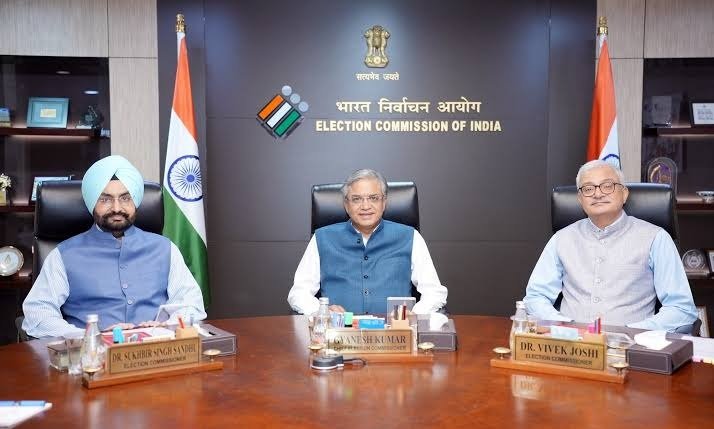
- The remarks followed Chief Election Commissioner Gyanesh Kumar’s reported question about U.S. elections without universal photo-ID requirements.
- Trump highlighted that India uses photo identification for voters and said less than 1% of voters used postal ballots in the recent general election.
- The 2024 Lok Sabha election covered 543 constituencies, with 97.98 crore registered electors. A total of 64.64 crore votes were polled, including 42.82 lakh postal votes.
- Every voter had a valid photo identity document. His comparison is intended to strengthen the argument for stricter U.S. identification rules.
- Citing the massive scale of India’s 2024 general election as a global benchmark for voter authentication.
- He argued that implementing robust, universal photo identification—similar to India’s system—is essential for maintaining American election integrity and revamping its voting procedures.
India’s Voter Identification System: Institutions and Legal Framework
- Main Authority: The Election Commission of India (ECI) is an autonomous constitutional authority administering elections to the Lok Sabha, Rajya Sabha, State Assemblies, President and Vice-President.
- It manages the registration of voters and the issuance of Voter ID to enforce clean, free, and fair elections.
- Its constitutional position gives voter identification an institutional foundation independent of ordinary executive administration.
- Constitutional Foundation: India’s electoral framework is mentioned in Part XV of the Constitution:
- Article 324: Vests the complete superintendence, direction, and control of elections—including the preparation of electoral rolls—exclusively in the ECI.
- Article 325: Mandates a single, unified general electoral roll for every territorial constituency. It explicitly prohibits discrimination or exclusion from voter registration based on religion, race, caste, or sex.
- Article 326: Establishes universal adult suffrage as the bedrock of Indian democracy. Every Indian citizen who is at least 18 years old on the qualifying date, and not otherwise disqualified, has the right to be registered.
- Article 327: Empowers Parliament to enact laws concerning all matters related to elections, providing the constitutional basis for statutory legislation.
- Legal Framework:
- The Representation of the People Act, 1950 governs electoral-roll preparation, voter qualifications and related matters.
- Section 16 outlines legal grounds for disqualifying an individual from the electoral roll.
- Under Section 20, a person can only register in the constituency where they are an “ordinarily resident“.
- It provides unique conditions for service voters (e.g., Armed Forces personnel, government officials posted overseas).
- Representation of the People Act (RPA), 1951 regulates electoral offenses, illegal voting practices, and defines corrupt activities.
- Its framework is supplemented by the Registration of Electors Rules, 1960, creating the legal foundation for electoral registration and roll revision.
- The ECI currently provides four qualifying dates—1 January, 1 April, 1 July and 1 October—for determining eligibility.
- The Representation of the People Act, 1950 governs electoral-roll preparation, voter qualifications and related matters.
- Principal Identification: The Electors Photo Identity Card (EPIC) is the principal polling identification document.
- It is a 10-digit alphanumeric voter ID number issued by the ECI to each registered voter.
- It also contains the voter’s full name, photograph, date of birth or age, gender, relative’s name (father/mother/husband), residential address, a signature or thumb impression, and a bar code or QR code.
- It is not the exclusive identification route: ECI instructions permit specified alternative documents where an elector does not produce EPIC.
- Depending on ECI notification, alternatives can include Aadhaar, passport, driving licence, PAN, MGNREGA job card and pension documents, among others.
- Voter ID does not itself confer voting rights.
- A person can vote only when their name appears in the electoral roll.
- Administrative Structure:
- Electoral Registration Officer (ERO): Appointed by the ECI in consultation with State Governments, the ERO is statutory head responsible for preparing and correcting the electoral roll for a specific Assembly Constituency.
- Booth Level Officer (BLO): A grassroots public official (typically a local teacher or government employee) assigned to a specific polling booth area. BLOs conduct physical field verifications, manage house-to-house surveys, and serve as the direct link between citizens and the ERO.
- Transformation: India has progressively digitised voter services through e-EPIC, online registration, electoral-roll search, application tracking and correction facilities.
- The ECI also provides a mechanism for submitting Aadhaar information for electoral-roll authentication.
- ERONET acts as the internal web platform automating voter registration, de-duplication, and cross-state migration tracking.
- This links directly into ECINET, a comprehensive digital portal uniting over 40 distinct election-related applications for voters, parties, and administrators.
- Special Intensive Revision (SIR), authorized under Section 21 of the RPA 1950.
- It is an exercise undertaken by the ECI to verify and revise electoral rolls through house-to-house.
- It is a cleanup cycle launched to overhaul outdated rolls.
What is the SAVE America Act?
- About: The SAVE America Act—the Safeguard American Voter Eligibility Act—is a proposed U.S. federal election-reform law aimed at ensuring that only U.S. citizens register and vote in federal elections. It substantially expands the earlier SAVE Act.
- Provisions:
- Proof of U.S. Citizenship: Its central provision requires applicants to provide documentary proof of U.S. citizenship when registering to vote federally.
- Acceptable evidence includes a qualifying REAL ID, U.S. passport, birth certificate plus government photo ID, naturalization certificate, Certificate of Citizenship, or specified military documentation.
- Mandatory Voter Identification: The legislation additionally introduces photo-ID requirements for voting in federal elections, making identification at the ballot stage a separate safeguard from citizenship verification during registration.
- Restrictions on Mail Voting: The proposal would significantly restrict mail-in voting, generally permitting it only for specified circumstances such as illness, disability, military service or travel.
- Voter-Roll Verification: The Act seeks stronger citizenship verification and voter-roll maintenance, including mechanisms for states to identify and remove non-citizens from federal voter rolls.
- Registration Procedures: The proposed framework would substantially alter how registration is conducted, including stricter documentary verification and in-person presentation requirements.
- Proof of U.S. Citizenship: Its central provision requires applicants to provide documentary proof of U.S. citizenship when registering to vote federally.
- Status: The House passed the SAVE America Act in February 2026.
- It has faced difficulty in the Senate, where Republicans hold 53 seats and legislation generally requires 60 votes to overcome a filibuster.
- Criticism: The proposal provides no dedicated federal implementation funding, potentially shifting costs to states.
- Critics argue that the rules create unnecessary barriers that disproportionately disenfranchise eligible, low-income, or minority voters.
India–US Electoral Systems: Key Structural Differences
- Executive Selection:
- India (Parliamentary Model): Citizens do not vote directly for the Prime Minister. They elect Members of Parliament (MPs) to the lower house (Lok Sabha) using the First-Past-The-Post (FPTP) system. The political party or coalition holding the majority in parliament then forms the government and selects the Prime Minister.
- United States (Presidential Model): The President is elected independently of the legislature via the Electoral College system. Citizens vote for state electors pledged to a candidate.
- A candidate must secure a majority of 270 out of 538 electoral votes to win. Most states apply a “winner-takes-all” rule, meaning a candidate can win the national popular vote but still lose the presidency.
- Election Management:
- India (Highly Centralized): A single autonomous constitutional body, the Election Commission of India (ECI), independently manages all federal and state legislative elections. It is based on the Westminster model. It maintains absolute control over election schedules, voter registration, and strict code-of-conduct enforcement across all states.
- United States (Highly Decentralized): There is no single central agency running elections. Power is decentralized across 50 states and over 10,000 local county jurisdictions, which set their own rules for ballot designs, registration requirements, and voting options. The Federal Election Commission (FEC) only regulates campaign finance, not election administration.
- Voter Registration:
- India: India maintains constituency-based electoral rolls, with eligibility and registration governed principally by election law.
- United States: In the U.S., registration is generally a prerequisite, with North Dakota the exception, and systems differ considerably by state.
- Voter Identification:
- India: India uses EPIC/photo identification as a major polling safeguard, while allowing specified alternative documents.
- United States: In the U.S., identification requirements vary: as of 2024, 36 states requested or required some identification for in-person voting, while 14 states and Washington, D.C. used other verification methods.
- Election Calendars:
- India: The timing of general elections is flexible within a mandatory 5-year maximum window. The ECI determines and announces the exact dates a few weeks in advance. Elections can happen early if the government loses its majority and parliament dissolves.
- United States: Election dates are fixed by federal law. Congressional and presidential elections occur strictly every two and four years respectively, held precisely on the first Tuesday after the first Monday in November.
- Voting Method:
- India: Mandates uniform use of standalone Electronic Voting Machines (EVMs) coupled with a Voter Verifiable Paper Audit Trail (VVPAT) nationwide. Voting is conducted strictly in person at designated booths on a single scheduled polling day.
- India’s postal ballot system primarily serves specified categories such as service voters, election-duty personnel and other notified electors.
- United States: Voting technology varies heavily by state, ranging from hand-marked paper ballots and optical scanners to digital touchscreens. The system heavily features flexible voting alternatives, including multi-week early in-person voting and widespread mail-in or absentee ballots.
- India: Mandates uniform use of standalone Electronic Voting Machines (EVMs) coupled with a Voter Verifiable Paper Audit Trail (VVPAT) nationwide. Voting is conducted strictly in person at designated booths on a single scheduled polling day.
- Political Parties:
- India (Multi-Party System): Dozens of national and regional parties compete. Candidate selection is entirely top-down, determined internally by high-level party leadership committees rather than general party voters.
- United States (Two-Party System): Power is consolidated between the Democratic and Republican parties. Candidates are chosen through an open, public process of state-level primaries and caucuses, allowing registered citizens to vote directly on who will represent a party in the general election.
| India–US Electoral Systems Structural Differences | ||
| Feature | India 🇮🇳 | United States 🇺🇸 |
| Form of Government | Parliamentary Democracy | Presidential Republic |
| Executive Selection | Chosen by the majority party in Parliament | Elected via the Electoral College |
| Oversight Body | Centralized, powerful Election Commission (ECI) | Decentralized across 50 individual states |
| Election Date | Flexible; determined by the ECI within 5 years | Fixed by federal law (First Tuesday of November) |
| Party Framework | Multi-party with top-down nomination | Two-party with public primary elections |
| Primary Ballot Style | Uniform Electronic Voting Machines (EVMs) | Varies (Paper, digital, mail-in, early voting) |
Frequently Asked Questions (FAQs):
1. Why did Trump cite India’s electoral system while pushing for US voter ID?
Trump cited India as an example of large-scale elections using photo identification, supporting his argument for stricter U.S. voter-ID rules.
2. What did Trump say about India’s voter identification system?
Trump said Indian voters had valid photo identification and noted that fewer than 1% used postal ballots in recent elections.
3. Why is Donald Trump pushing for mandatory voter ID in the US?
Trump argues mandatory photo ID would strengthen electoral integrity and help curb what he describes as electoral fraud.
4. What is the SAVE America Act?
The Safeguard American Voter Eligibility Act proposes documentary citizenship verification, voter photo ID and tighter federal election safeguards.
5. What would the SAVE America Act change in US elections?
It would require citizenship proof for registration, photo ID for voting, tighter mail-voting rules, and removal of non-citizens from rolls.
6. Does India require voters to show photo identification?
Yes. India generally requires EPIC or an ECI-approved alternative photo ID for polling-station identification; EPIC is not the sole accepted document.
Disclaimer: Information in this article is based on official announcements and public records. Regulations and implementation details may evolve over time.