




Devastating Nepal Flash Floods Strike Bhote Koshi and Trishuli Rivers
| General Studies Paper III: Disaster Management, Environmental Pollution & Degradation |
Why in News?
Recently, a catastrophic glacial collapse triggered flash floods along Nepal’s Bhote Koshi and Trishuli rivers, destroying critical hydropower infrastructure.
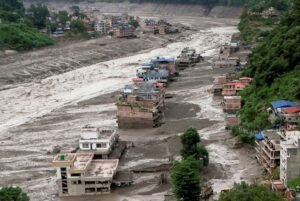
Nepal Flash Floods 2026: Himalayan Glacial Collapse and Its Wider Implications
- Event: On 26 August 2026, a catastrophic flash flood struck the Nepal–China (Tibet) border region, devastating communities along the Bhote Koshi–Trishuli river corridor.
- The event began at approximately 8:40 a.m. local time, when an enormous mass of ice, rock and sediment collapsed in the high Himalayas.
- Satellite analysis indicated that the lower section of a glacier collapsed from around 5,200 metres, falling roughly 1,200 metres into a valley and generating a powerful ice-rock avalanche.
- The disaster originated near the Lhende Khola, a tributary of the Bhote Koshi, in the Himalayan region north-east of the Rasuwagadhi border crossing.
- The avalanche temporarily obstructed the river, effectively creating a natural debris dam.
- Its subsequent failure released a sudden torrent of water, ice, mud and boulders downstream.
- The flood then travelled through the Bhote Koshi and Trishuli systems, affecting Rasuwa, Nuwakot and Dhading districts.
- The Trishuli eventually became part of the Gandak river system in India, making the event significant beyond Nepal’s borders.
- Impact: Preliminary assessments indicate that at least 19 bridges and approximately 40 kilometres of roads were damaged or washed away, severely disrupting transportation and emergency access.
- Several settlements, including Timure and areas around Syapru Besi, suffered extensive destruction.
- Rasuwa (north-central Nepal, bordering China) was the epicenter, with subsequent devastation spreading to Nuwakot, Dhading, Gorkha, and Chitwan districts.
- Over 350 people were confirmed dead, and hundreds went missing. Among those missing were over 130 Indian workers and Hindu pilgrims undertaking the Kailash-Mansarovar Yatra.
- Nepalese authorities reported 826 missing people, while Chinese authorities separately reported large numbers missing in Tibet.
- Major arterial routes like the Pasang Lhamu Highway completely washed out.
- Nepal’s clean energy grid suffered a massive blow. Major facilities like Rasuwagadhi, Chilime, and Upper Trishuli 3A were heavily damaged.
- This event knocked out roughly 430 MW of power (nearly 12.5% of Nepal’s total national installed capacity), worsening grid vulnerabilities left behind by a similar Glacial Lake Outburst Flood (GLOF) the prior year.
- Triggers:
- Initially misidentified as a 4.4 magnitude earthquake due to the massive seismic energy generated, the US Geological Survey (USGS) confirmed the primary trigger was an exceptionally powerful glacial collapse and landslide (equivalent to a 5.2 magnitude event).
- The region is increasingly exposed to Glacial Lake Outburst Floods (GLOFs), ice-rock avalanches, landslides and sudden river surges.
- A GLOF occurs when water stored behind a glacial or moraine dam is suddenly released.
- A massive chunk of rock and ice broke off a destabilized Himalayan glacier. This avalanche rushed down the valley, picking up water-logged monsoon sediment.
- Geologically, the Himalayas are the world’s youngest and most active mountain range.
- Due to the constant movement of tectonic plates, the region is highly earthquake-prone, easily triggering landslides.
- It has active thrust faults (Main Central Thrust (MCT), Main Boundary Thrust (MBT) and Himalayan Frontal Thrust (HFT)).
- The debris temporarily dammed the narrow Lhende River channel. As water rapidly accumulated behind this unstable, natural dam, it suddenly breached, releasing a “glacier-inclusive flood“.
- Moving like liquid concrete due to high sediment density, it bypassed all conventional hydrological early-warning systems.
- While local rainfall at the headquarters was low, the area had experienced persistent upstream rainfall in the preceding days, enhanced by a combination of the standard Monsoon Depression and an unseasonal Western Disturbance.
- Rescue Operation: Nepal’s Prime Minister’s Office (PMO) deployed troops from the Army, Armed Police Force (APF) and Nepal Police on the ground.
- More than 17 military and private helicopters have been deployed for search and relief operations (Nepal Flood Rescue Operation).
- The Government of India immediately sent relief materials and financial and technical assistance to Nepal.
- Ten tonnes of emergency relief material was flown to Kathmandu from Hindon Airbase by a special C-130J Super Hercules aircraft of the Indian Air Force (IAF). This included temporary tents, shelters, blankets, hygiene kits, solar lamps and life-saving medicines.
- India also responded swiftly and sent 37.5 tonnes of additional relief material, including rations, medical kits and food packets.
- Medicines, water purifiers (chlorine tablets) and tarpaulins are being sent to affected areas like Nepalganj via the Uttar Pradesh and Bihar border.
- Indian National Disaster Response Force (NDRF) teams have been put on high alert in areas along the Gandak river in Bihar.
- The Indian Embassy in Kathmandu, in collaboration with the Ministry of Home Affairs of Nepal, has set up a dedicated helpline and coordination centre to trace missing Indian nationals and pilgrims.
Frequently Asked Questions (FAQs):
1. What caused the flash floods in Nepal’s Bhote Koshi and Trishuli rivers?
A massive ice-rock avalanche from a glacier blocked the Lhende Khola, causing a sudden debris-laden flood downstream.
2. Which areas of Nepal were affected by the flash floods?
Rasuwa, Nuwakot, Dhading, Gorkha and Chitwan were among affected areas as floodwaters travelled downstream through the Bhote Koshi-Trishuli system.
3. What happened along the Bhote Koshi River?
A powerful flood surge entered the Bhote Koshi from Tibet, devastating settlements, bridges and infrastructure, particularly around Timure and Syabrubesi.
4. What happened along the Trishuli River?
The flood surged downstream into the Trishuli, rapidly raising water levels, destroying bridges and structures, and threatening settlements along the river corridor.
5. How severe were the Nepal flash floods?
The disaster killed hundreds, left more than 1,000 people missing, and destroyed villages, roads, bridges and critical infrastructure.
6. Were people evacuated from flood-affected areas?
Yes. Authorities warned residents along the Trishuli to move to safer, higher areas as the flood surge travelled downstream.
Disclaimer: Information in this article is based on official announcements and public records. Regulations and implementation details may evolve over time.
| Also Read: Floods in Rajasthan |