Russia S-400 Deal India 5 More Squadrons Proposal
| General Studies Paper III: Defence Partnership, Defence Technology |
Why in News?
Recently, Russia submitted a ₹50,000 crore proposal for five more S-400 squadrons to India, strategically expanding India’s air defense network following its proven combat efficacy during Operation Sindoor.
- The proposal responds to India’s tender and is currently under government processing.
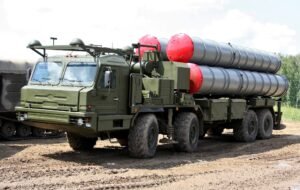
What is S-400?
- About: The S-400 (S-400 Triumf) is a Russian mobile, long-range surface-to-air missile (SAM) system designed to detect, track and engage aircraft, cruise missiles and certain ballistic-missile threats.
- Development: The system originated in Russia and evolved from the S-300 family.
- Development was undertaken by Almaz-Antey, with substantial S-300 technology adapted into the newer architecture.
- The S-400 entered Russian service in 2007, with the first operational systems assigned to the air-defence forces protecting the Moscow region.
- Missile Family: The S-400 is essentially a system family. Its major interceptor families include 9M96, 48N6 and 40N6, providing different engagement ranges.
- Features:
- Its key strength is the ability to employ different missiles from the same air-defence system, allowing short-, medium- and long-range interception and improving flexibility against diverse aerial threats.
- It can detect targets up to 600 kilometers (373 miles) away using advanced multi-frequency radar arrays.
- The system’s 40N6-family missile is associated with a maximum range of about 400 km, while other interceptors provide shorter engagement envelopes.
- S-400 is designed to counter fighter aircraft, drones, cruise missiles and ballistic-missile threats, making it substantially broader than a conventional aircraft-only SAM.
- It can track up to 300 targets at the same time. It employs sensor fusion and low-frequency VHF radar to spot stealth aircraft.
- Its mobile launchers, surveillance radars, engagement radars and command elements allow deployment around strategically important areas and integration into broader air-defence networks.
- It operates at heights from 10 meters up to 30 kilometers to handle low drones and high-altitude jets.
- Its interceptor missiles reach extreme speeds of up to Mach 14 (17,000 km/h) and engage up to 36 targets simultaneously with up to 72 guided missiles.
- It can deploy and prepare for firing in just 5 to 10 minutes.
- Global Users: Beyond Russia, publicly identified operators include China, Turkey, India, Belarus and Algeria.
- India signed the S-400 contract with Russia on 5 October 2018 for five squadrons.
- The deal is widely reported at approximately US$5.43 billion. India received its first S-400 squadron in December 2021.
- Four have been received, while the fifth and final squadron is expected by November 2026.
- During Operation Sindoor (2025), the S-400 became a major component of India’s integrated air-defence architecture.
- IAF Chief Air Chief Marshal A.P. Singh described an S-400 engagement as India’s largest-ever surface-to-air kill, while reports linked the system to an engagement at approximately 314 km.
- India has decided to acquire around 280 additional S-400 missiles, aimed at replenishing stocks following Operation Sindoor.
Significance of Additional S-400 Squadrons for India
- Stronger Strategic Air Defence: Five additional S-400 squadrons, if contracted, would substantially expand India’s long-range air-defence layer, improving the ability to protect critical military and strategic assets.
- The proposed systems are expected to strengthen coverage along both western and eastern/northern fronts, giving India greater flexibility in responding to simultaneous security pressures involving Pakistan and China.
- Additional S-400s can increase the cost and risk of hostile air operations near Indian airspace.
- Growing Importance of Integrated Air Defence: Modern warfare increasingly combines drones, cruise missiles, aircraft, electronic warfare and precision weapons.
- Therefore, S-400s are most valuable when networked with other sensors and systems rather than operating independently.
- Operation Sindoor demonstrated the importance of such joint and integrated capabilities.
- Mission Sudarshan Chakra: The acquisition fits into the broader Mission Sudarshan Chakra vision for a multi-level missile-defence architecture.
- S-400 can provide an important long-range layer while indigenous systems progressively expand the overall shield.
- The additional S-400s can provide near-to-medium-term capability while India develops indigenous long-range systems under Project Kusha.
- India-Russia Defence Partnership: The proposal demonstrates the continuing importance of India-Russia defence cooperation, particularly in sophisticated missile and air-defence technology.
- Russia extended an exclusive proposal to India for the joint production and technology transfer of the advanced S-500 Prometheus air-defense system.
- Both nations reaffirmed industrial and military collaboration during high-level forums like the India-Russia Army Land System Sub-Group conference in New Delhi.
Important Facts:
- Mission Sudarshan Chakra:
- It is India’s proposed modern, multi-level national security and missile-defence architecture, announced by Prime Minister Narendra Modi on 15 August 2025.
- The mission draws its name and strategic symbolism from Lord Krishna’s Sudarshan Chakra, representing speed, precision and decisive action.
- A central objective is to establish an expanded nationwide security shield by 2035, covering public spaces and critical national locations.
- It is spearheaded primarily by the Defence Research and Development Organisation (DRDO) to promote defense self-reliance under the Atmanirbhar Bharat framework.
- It will integrate long-range radars, early-warning satellites, surface-to-air missiles, anti-drone systems, and directed-energy laser weapons.
- The architecture of Mission Sudarshan Chakra is built as a three-tier:
- Multi-Tiered Interception Layer: Outer Layer (Long-Range) uses Project Kusha (India’s equivalent to Israel’s Iron Dome / S-400), Medium Layer relies on the MRSAM (Medium Range Surface-to-Air Missile) and Akash-NG systems to neutralize threats between 30–80 km and Inner Layer (Close-In Defense) employs VSHORADS (Very Short Range Air Defense), anti-drone swarms, and Directed-Energy Weapons (DEWs).
- Surveillance and Early Warning Grid: Military satellites monitor regional airspace and provide early launch warnings for ballistic missiles, Radars utilizes indigenous Long-Range Tracking Radars (LRTR) and Arudhra radars to scan borders and Airborne Systems like Netra and Phalcon AWACS (Airborne Warning and Control Systems) act as flying command posts to detect low-flying threats hidden from ground radar.
- Digital “Brain” (C4I): An automated Command, Control, Communications, Computers, and Intelligence (C4I) system will process massive data from all radars and satellites instantly, AI algorithms will assess incoming threats, calculate speed, and predict impact points within milliseconds. The system will automatically select and task the optimal weapon to neutralize the threat.
- Project Kusha:
- Project Kusha [Extended Range Air Defence System (ERADS)] is India’s indigenous Long-Range Surface-to-Air Missile (LR-SAM) system, designed to provide a sophisticated long-range air-defence capability.
- It is being developed indigenously by DRDO laboratories with Indian industry partners.
- The project features three interceptor classes. The M1 variant spans a 150 km range, the M2 variant extends to 250 km, and the M3 variant targets deep threats at 350–400 km.
- It neutralizes diverse threats, including stealth fighters, drones, cruise missiles, and precision munitions.
- The system maintains a high interception success rate exceeding 80%. The system integrates with the Indian Air Force’s Integrated Air Command and Control System (IACCS).
- DRDO conducted Kusha’s maiden flight test from APJ Abdul Kalam Island, Odisha. The test used an electronic target simulating a high-speed, high-altitude aerial threat, which was successfully intercepted.
- Following successful initial trials, phased induction is scheduled between 2028 and 2030.
Frequently Asked Questions (FAQs):
1. What is Russia’s new S-400 proposal to India?
Russia has submitted a detailed proposal responding to India’s tender for five additional S-400 Triumf long-range air-defence squadrons.
2. How many additional S-400 squadrons has Russia proposed?
Russia has proposed five additional S-400 squadrons, potentially increasing India’s planned inventory to 10 squadrons.
3. What is the reported value of the new S-400 deal?
The proposed five-squadron acquisition is estimated to cost over ₹50,000 crore, though final value remains subject to negotiations.
4. What is the S-400 Sudarshan air-defence system?
The S-400 Triumf, called Sudarshan in Indian service, is a mobile, long-range surface-to-air missile system designed against diverse aerial threats.
5. Why does India need five more S-400 squadrons?
Additional squadrons would strengthen layered air defence across India’s western and eastern fronts and improve protection against diverse aerial threats.
6. How many S-400 squadrons does India currently operate?
India has received four of its five originally contracted squadrons; the fifth is expected by November 2026, according to current defence reporting.
Disclaimer: Information in this article is based on official announcements and public records. Regulations and implementation details may evolve over time.
| Also Read: DRDO Tests Kusha LRSAM Missile |