Gollala Gudi Temple Declared Monument of National Importance, Added to India’s National Monuments List
| General Studies Paper I: Heritage Conservation, Government Policies |
Why in News?
Recently, Archaeological Survey of India (ASI) declared Telangana’s Gollala Gudi Temple a Monument of National Importance and added it to India’s National Monuments List, strengthening legal protection.
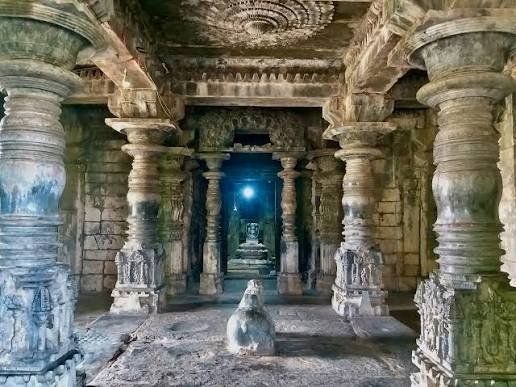
About Gollala Gudi Temple
- Location: Gollala Gudi is a historic Kakatiya-period temple situated at Palampet village in Mulugu district, Telangana.
- It lies to the south-west of the UNESCO World Heritage Site Kakatiya Rudreshwara (Ramappa) Temple.
- History: This temple is an ancient temple dating back to around 12th to 13th century AD, which was built during the reign of the famous Kakatiya Dynasty.
- Architecture: Gollala Gudi follows the Trikutalaya plan, meaning a temple complex with three sanctums.
- An east-facing mandapa forms the principal hall and is surrounded by three garbhagrihas.
- The central sanctum contains a Shiva lingam.
- The main structure has a portico leading into a central hall, while the three shrines have associated antechambers.
- Features: The temple is particularly significant for its stone craftsmanship, sculptural richness and architectural planning.
- The temple is especially notable for its intricate carvings. Its parapet contains sculptural decoration, while the entablature and doorways feature carved hamsas and jali work.
- Two detached shrines stand in front of the main temple and contain finely carved dvarapalas. Their antechambers display decorated cornices and screens.
- Sculptural niches on the walls contain representations of Vishnu, Lakshmi, Ganesha and Mahishasuramardini.
- The temple also stands on a high plinth decorated with animal figures and floral motifs.
- Its construction utilized engineering techniques, which included joining stones together without any binding mortar.
- National Importance: Gollala Gudi was formally declared a Monument of National Importance by the Central Government.
- The preliminary notification was issued on 6 March 2026. The Government subsequently issued the final declaration under Section 4(3).
- The final notification, S.O. 4802(E), was issued on 31 August 2026 under Section 4(3) of the AMASR Act.
- It formally declared Gollala Gudi, a Monument of National Importance. The notified monument covers approximately 0.25 acres.
- Significance: National-level recognition can increase awareness of Palampet and Mulugu’s heritage landscape.
- If tourism is developed sustainably, the site can support local employment, guides, handicrafts, hospitality and cultural interpretation.
- Now ASI Hyderabad Circle will allocate a budget under Annual Conservation Plan for its restoration, and construction of pathways for tourists.
- As per the conditions of UNESCO, after this status, a large Heritage Corridor can be developed by including Ramappa Temple, Shiva Temple and Gollala Gudi on 16 acres of land handed over by the state government.
What are Monuments of National Importance (MNI)?
- About: A Monument of National Importance (MNI) is an ancient or historical monument, archaeological site or remains considered sufficiently significant to warrant protection and preservation by the Union Government.
- Act: Such monuments receive statutory protection under the Ancient Monuments and Archaeological Sites and Remains Act, 1958 (AMASR Act).
- It is administered by the Ministry of Culture. A monument or site must be at least 100 years old to be considered for this status.
- The Act seeks to preserve monuments and archaeological remains of national importance and also regulates archaeological excavations and protects sculptures, carvings and similar objects.
- Heritage protection has both constitutional and statutory dimensions.
- Article 49 directs the State to protect monuments and objects of national importance from destruction, disfigurement, removal or export.
- Article 51A(f) makes it a fundamental duty of citizens to value and preserve India’s rich composite cultural heritage.
- Declaration: The Central Government has the statutory power to declare an ancient monument to be of national importance under Section 4 of the AMASR Act.
- Under Section 4(1), the Central Government issues a notice stating its intention to declare the site, allowing the public two months to submit objections.
- After reviewing these objections, the government may finalize the decision by issuing an official gazette notification.
- Protection: Once protected under the AMASR framework, the monument and its surrounding protected areas become subject to statutory controls.
- The Act establishes prohibited and regulated areas around protected monuments and regulates construction and other activities.
- The Archaeological Survey of India (ASI) manages protected monuments.
- It operates under the Ministry of Culture to conserve and maintain nationally important monuments (MNIs).
- The first 100 meters around a monument has a complete construction ban.
- The next 200 meters have strict construction restrictions.
- Under Section 35 of the AMASR Act, 1958, the ASI can delist monuments that lose national importance.
- Delisted sites lose ASI protection, and nearby urban development or construction can begin.
- The National Monuments Authority (NMA) has an important role concerning heritage bye-laws.
- It was created under the AMASR Act (amended in 2010).
- It reviews and grants permissions for approved construction work inside the regulated and prohibited zones near these protected sites.
- Current Status: The Ministry of Culture information has reported approximately 3,689 monuments/sites of national importance.
- Examples include major heritage complexes such as the Taj Mahal, Qutb Minar, Red Fort, Sanchi monuments and Ajanta Caves.
- Their statutory protection should not be confused with UNESCO World Heritage status.
- Monument of National Importance is a statutory Indian protection category, while UNESCO World Heritage Site is an international designation.
Government Initiatives for Heritage Conservation
- Adarsh Smarak: It was launched on 26th December 2014 by the Ministry of Culture to upgrade and develop 100 selected centrally protected monuments into “model monuments”.
- These may include toilets, drinking water, signage, pathways, interpretation facilities, security and other amenities.
- The objective is to combine conservation with a better visitor experience without compromising heritage values.
- National Mission on Monuments and Antiquities: The National Mission on Monuments and Antiquities (NMMA) was established in 2007 to strengthen documentation of India’s built heritage and antiquities.
- It supports systematic documentation, inventory creation and digital dissemination.
- Ministry data reported more than 17 lakh antiquities documented and about 1.84 lakh built heritage sites documented, with a substantial portion published through the NMMA platform.
- National Cultural Fund: The National Cultural Fund (NCF) facilitates partnerships between government and other stakeholders for heritage conservation and visitor amenities.
- It has supported conservation projects at selected protected monuments through contributions from organisations and corporate partners.
- Adopt a Heritage: The Adopt a Heritage programme seeks participation from public and private organisations in improving visitor amenities and heritage-site experience.
- Adoption is intended to support facilities and interpretation while ownership and statutory protection remain with the government.
- HRIDAY: The Heritage City Development and Augmentation Yojana (HRIDAY) focused on improving the infrastructure and heritage-sensitive development of selected heritage cities.
- It sought to connect conservation with urban planning, sanitation, infrastructure and tourism.
- PRASAD: The Pilgrimage Rejuvenation and Spiritual Heritage Augmentation Drive (PRASAD) scheme focuses on pilgrimage and spiritual tourism infrastructure at identified destinations.
- The scheme provides 100% central funding to State Governments and Union Territory Administrations to enrich the religious tourism experience.
- Project Mausam: It is a cultural initiative that explores the historical maritime interactions across the Indian Ocean.
- It seeks to highlight shared cultural routes, knowledge systems and historical connections.
- It demonstrates India’s broader approach of preserving and promoting heritage through transnational cultural landscapes and historical networks.
- Digital Documentation and Scientific Preservation: The Government increasingly combines conventional conservation with digital mapping, photogrammetry, documentation and scientific techniques.
- Digital records can help create baseline information for monitoring, research, disaster management and future restoration.
Frequently Asked Questions (FAQs):
1. What is the Gollala Gudi Temple and where is it located?
Gollala Gudi is a Kakatiya-period Trikutalaya temple located at Palampet, Mulugu district, Telangana, near Ramappa Temple.
2. Why was the Gollala Gudi Temple added to India’s national monuments list?
It was recognised for its exquisite stone carvings, architectural heritage and Kakatiya-era significance, warranting statutory central protection.
3. What makes Gollala Gudi Temple a monument of national importance?
Its Trikutalaya design, intricate sculptures and distinctive Kakatiya craftsmanship provide important evidence of medieval Deccan architectural traditions.
4. What is the historical significance of Gollala Gudi Temple?
The temple represents Kakatiya architectural and artistic traditions, contributing to understanding the historical cultural landscape surrounding Palampet and Ramappa Temple.
5. What is the role of the Archaeological Survey of India (ASI) in protecting national monuments?
ASI undertakes conservation, maintenance, scientific preservation and regulated public access for centrally protected monuments under applicable heritage laws.
6. How does national monument status help preserve India’s cultural heritage?
It provides statutory protection, conservation oversight and restrictions on damaging activities, helping preserve monuments, architecture and archaeological evidence for future generations.
Disclaimer: Information in this article is based on official announcements and public records. Regulations and implementation details may evolve over time.