Tata Secures L1 Bid for Zorawar Light Tank Project, Company Will Build 2 Operational Prototypes
| General Studies Paper III: Defence Technology, Defence Agreements |
Why in News?
Recently, Tata Advanced Systems Ltd. (TASL) secured the L1 bid for the ₹20,000-crore Zorawar Light Tank Project, accelerating cIndia’s high-altitude military indigenization.
Tata’s L1 Bid: Defence Procurement and Make-I Framework
- Tata Advanced Systems Ltd. (TASL) has emerged as the L1 bidder for the Army’s next-generation Armoured Fighting Vehicle–Indian Light Tank (AFV-ILT) programme under Project Zorawar.
- The project is currently reported at approximately ₹20,000 crore, with the selection following a roughly three-year evaluation of technical and commercial bids from five contenders.
- Under the present process, TASL is expected to develop and demonstrate two prototypes within 130 weeks.
- The company will build 2 operational prototypes.
- Mahindra Defence Systems, reported as the L2 bidder, is also being invited to develop a prototype.
- The programme falls under Make-I of Defence Acquisition Procedure (DAP) 2020.
- Make-I is specifically designed for industry-led design and development with government financial support.
- The government can fund up to 70% of prototype-development cost, subject to the applicable ceiling of ₹250 crore per Development Agency, while the framework requires minimum 50% Indigenous Content.
- This makes Make-I fundamentally different from conventional import procurement.
- The broader framework places the Ministry of Defence at the procurement-policy level, the Indian Army as the user and operational authority, and industry as the development agency.
Note: L1 is the lowest responsive bidder in a government tender, and L2 is the second-lowest responsive bidder.
What is Project Zorawar?
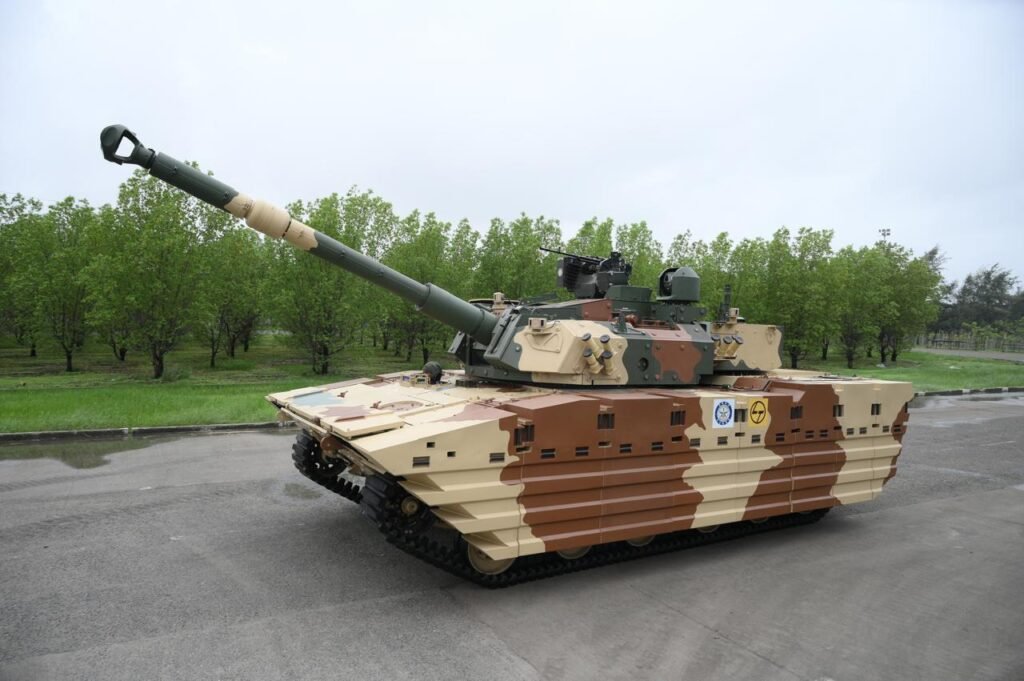
- About: Project Zorawar is India’s programme for developing a next-generation light tank, formally associated with the Armoured Fighting Vehicle–Indian Light Tank (AFV-ILT) requirement.
- It is intended primarily for demanding environments such as high-altitude Himalayan areas, while also providing versatility in deserts and marshy terrain.
- Its central design philosophy is to combine mobility, firepower and protection without the weight burden of a conventional main battle tank.
- Institutional Framework: The programme sits within the Ministry of Defence’s procurement architecture and the Army’s operational requirement.
- The earlier indigenous Zorawar prototype was developed by DRDO’s Combat Vehicles Research & Development Establishment (CVRDE) in partnership with Larsen & Toubro, with participation from Indian MSMEs in subsystems.
- Need: The requirement gained urgency after the 2020 India-China military confrontation in eastern Ladakh.
- Development Approval: The light-tank initiative was placed under the Make-I framework.
- In 2022, the Ministry identified the Light Weight Tank among major platforms for industry-led design and development.
- The Army’s requirement has been reported as 354 light tanks.
- Earlier planning envisaged 59 tanks associated with the DRDO-developed design and the remaining 295 tanks under competitive Make-I procurement.
- Features of Tank:
- Namesake: It is named after General Zorawar Singh Kahluria (or Kahlon), a legendary 19th-century Dogra military commander.
- Known as the “Conqueror of Ladakh” and the “Napoleon of India,” he famously extended territories into Ladakh, Baltistan, and Western Tibet.
- Weight and Mobility: The Zorawar concept is built around a 25-tonne-class armoured fighting vehicle.
- This is substantially lighter than India’s conventional T-72/T-90 main battle tanks, allowing better mobility across difficult mountain terrain.
- Crew: Operated by a 3-person crew (commander, gunner, and driver).
- Engine: Powered by a robust diesel engine (such as the Cummins 760hp platform) paired with advanced transmission systems.
- Firepower: The prototype configuration is associated with a 105-mm high-pressure gun, providing substantial direct-fire capability while keeping the platform lightweight.
- DRDO-linked material has also highlighted the possibility of active protection, UAV integration and advanced situational awareness.
- High-Altitude Validation: The developmental prototype successfully fired multiple rounds at different ranges at an altitude above 4,200 metres.
- This followed successful preliminary trials in desert terrain in September 2024.
- The tank’s airlift capability was also demonstrated, addressing the logistical challenges of rapidly deploying heavy combat equipment.
- Missile Integration: Fitted with dual launchers for Nag Mk2 anti-tank guided missiles (ATGMs) and options for precision-guided or loitering munitions.
- Secondary Armament: Includes a 7.62mm coaxial machine gun and a 12.7mm remote-controlled weapon station (RCWS).
- Digital & AI Integration: Features artificial intelligence-enabled situational awareness, drone integration, active protection systems, and thermal night-fighting optics.
- Namesake: It is named after General Zorawar Singh Kahluria (or Kahlon), a legendary 19th-century Dogra military commander.
Why India Needs Light Tanks for High-Altitude Warfare?
- Strategic Symmetry: China has proactively deployed its nimble Type 15 (ZTQ-15) light tanks across the Tibetan plateau. India requires matching armored capabilities to deter asymmetric tactical advantages.
- Terrain and Maneuverability: Heavy Main Battle Tanks (MBTs) like the T-72 and T-90 (weighing 40–50 tonnes) struggle on narrow Himalayan roads, fragile bridges, and steep mountain passes. Light tanks navigate these restricted spatial environments with ease.
- Strategic Airlift and Rapid Deployment: Heavy MBTs stretch the constraints of strategic airlifters. In contrast, the Indian Air Force’s C-17 Globemaster III can transport two 25-tonne light tanks simultaneously, enabling rapid inter-valley redeployment.
- High Power-to-Weight Ratio: Rarefied mountain air drastically degrades standard internal combustion engines. Light tanks offer a superior power-to-weight ratio, ensuring operational agility even in low-oxygen environments.
- Amphibious Operations: The high-altitude border features critical riverine networks and lakes like Pangong Tso. Light tanks feature organic water-jet propulsion to effortlessly cross deep water obstacles.
- High-Angle Fire Support: Mountain warfare requires specialized high-angle fire capabilities to target entrenched enemy positions atop mountain crests, a task standard flat-trajectory MBTs cannot achieve efficiently.
- Indigenous Modernization: Native development under Atmanirbhar Bharat ensures the platform integrates modern tactical drones, loitering munitions, and artificial intelligence, transforming it into a network-centric warfare asset.
Frequently Asked Questions (FAQs):
1. What is the Tata Zorawar Light Tank Project?
Project Zorawar is the Indian Army’s 25-tonne-class light tank programme, with Tata Advanced Systems emerging L1 for development under Make-I.
2. Why did Tata emerge as the lowest bidder?
Tata Advanced Systems Ltd. (TASL) emerged L1 after a three-year technical and commercial evaluation involving five competing entities.
3. What is the value of the ₹20,000 Crore Zorawar Tank Project?
The Project Zorawar programme is estimated at approximately ₹20,000 crore, covering development and planned procurement of 354 light tanks.
4. What is the Zorawar Light Tank?
Zorawar is a 25-tonne indigenous light tank, designed for high-altitude warfare, with mobility, firepower, protection and air-transportability as key priorities.
5. Why does the Indian Army need the Zorawar Light Tank?
The Army requires a highly mobile armoured platform suited to challenging Ladakh and Himalayan terrain, where heavier tanks face greater mobility and transport constraints.
6. Who will manufacture the Zorawar Tank for the Indian Army?
Tata Advanced Systems is the current L1 bidder; Mahindra Defence Systems will also develop a prototype, with final production following evaluation and approval.
Disclaimer: Information in this article is based on official announcements and public records. Regulations and implementation details may evolve over time.
| Also Read: Indian Army T-72 Tanks Upgradation Plan |