



Made in India Mobile Phone 2028: India To Design Own Designed-Manufactured-Branded Smartphones
| General Studies Paper III: Economic Development, Infrastructure |
Why in News?
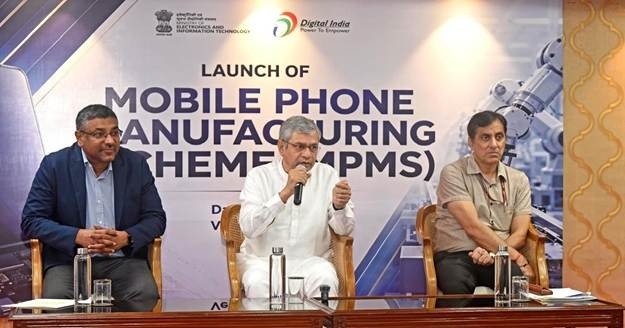
Recently, the Union Government announced an ambitious target to launch fully indigenous, Indian-designed, manufactured, and branded smartphones by October 23, 2028.
Policy Vision of Made in India Mobile Phone By 2028
- Target Date: Union Minister for Electronics and Information Technology, Ashwini Vaishnaw, announced that the first completely homegrown smartphones will debut by October 23, 2028.
- Need: Achieving complete self-reliance in mobile phone production requires full control over three interconnected pillars:
- domestic design, localized manufacturing, and homegrown intellectual property (IP).
- To achieve this government:
- Support genuine Indian ownership where design, intellectual property (IP), and branding originate in India.
- Deepen the domestic supply chain and increase Domestic Value Addition (DVA).
- Reduce heavy reliance on imported components and foreign tech stacks.
- Eligibility Rules for Brands: Requires a minimum turnover threshold (₹1,000 crore for TS2), Indian-owned IP/trademark, and over 51% Indian citizen shareholding or management control.
India’s Design & Manufacturing Capabilities
- India has successfully consolidated its position as the world’s second-largest mobile phone manufacturer by volume.
- Mobile phone production escalated dramatically from ₹18,000 crore in 2014 to ₹5.45 lakh crore in FY2024-25, serving 99.2% of domestic demand.
- Mobile phones have emerged as one of India’s leading export engines, surging past ₹2.05 lakh crore.
- The sector is executing a crucial transition from “Low-Value Assembly (Screw-driver technology)” to “High-Value Design-led Manufacturing”.
- Indian engineers have developed the competency to design and route multi-layered Printed Circuit Board Assemblies (PCBAs).
- Domestic engineering firms have advanced from basic board stuffing to complex motherboard engineering.
- An Indian design house successfully engineered, manufactured, and delivered a high-end 5G-plus smartphone architecture that passed strict compliance protocols for a major US telecommunications carrier
- India possesses a world-class pool of VLSI (Very Large Scale Integration) design engineers. Nearly 20% of the world’s semiconductor design engineers work out of India, primarily inside global R&D captives.
- Through joint ventures (such as Tata Electronics, Micron, and Kaynes Technology), India is translating this raw talent into physical Outsourced Semiconductor Assembly and Test (OSAT) and Fab infrastructure.
- This bridges the gap between software-based chip design and physical hardware integration.
- Indian software ecosystem players have high competencies in customizing Android Open Source Project (AOSP) skins, writing low-level device drivers, optimizing power management algorithms, and implementing local cybersecurity protocols.
- Through joint ventures (such as Tata Electronics, Micron, and Kaynes Technology), India is translating this raw talent into physical Outsourced Semiconductor Assembly and Test (OSAT) and Fab infrastructure.
- Precision engineering companies (e.g., Tata Electronics) have developed high-precision CNC machining capabilities to manufacture premium smartphone enclosures (aluminum/titanium bodies) matching global standards.
Why Does India Need Indigenous Smartphone Manufacturing?
- Smiling Curve Paradox: In the electronics value chain, the lowest profits lie in physical assembly, which India currently dominates.
- The highest profit margins are trapped at either end of the curve—Pre-production (R&D, patent creation, component design) and Post-production (Branding, marketing, software ecosystems).
- Displays (OLED/AMOLED) account for nearly 20–25% of a smartphone’s Bill of Materials (BoM) cost.
- Without indigenous brands, India remains vulnerable to foreign MNCs capturing the lion’s share of financial wealth generated by domestic consumers.
- Domestic Value Addition: Despite massive volume growth, India’s local value addition in smartphones hovers at only 23%–25%.
- The rest is composed of imported completely-knocked-down (CKD) kits. Indigenous manufacturing forces vertical integration.
- Mitigating Electronics Import Strain: Electronics represent a monumental chunk of India’s import bills, largely causing bilateral trade deficits with nations like China.
- Indigenous production serves as an import substitution mechanism, conserving foreign exchange reserves.
- Supply Chain Contamination (Hardware Trojans): Smartphones are ubiquitous data endpoints. Relying on foreign-designed components introduces the critical threat of embedded malware, firmware vulnerabilities, and hardware backdoors.
- Data Sovereignty and Privacy: Operating systems (OS) and critical firmware designed abroad frequently route metadata through offshore servers.
- An indigenous ecosystem ensures data localization and absolute legal compliance with frameworks like the Digital Personal Data Protection (DPDP) Act.
- Weaponization of Global Supply Chains: Geopolitical friction (e.g., Taiwan Strait tensions, US-China trade disputes) exposes India to abrupt choke points in semiconductor or critical component supplies. Technological self-reliance isolates the Indian state from such external leverage.
- Employment Multiplier Effect: While low-tier assembly creates blue-collar jobs, indigenous brand ownership expands the high-skilled job ecosystem. It demands a pipeline of chip architects, software developers, UI/UX engineers, and industrial designers.
- Catalyzing Semiconductor Ecosystem: For India’s semiconductor ambitions to yield results, there must be captive domestic demand.
- Indigenous smartphone brands create a direct, predictable domestic buyer base for home-grown fabrications and assembly testing units (ATMP).
- Overcoming Low R&D Trap: India’s Gross Expenditure on R&D (GERD) sits low at 0.65% to 0.84% of GDP. Indigenous smartphone giants (mirroring the trajectories of Samsung in South Korea or Huawei in China) inherently drive private sector R&D spending, fostering university-industry technology transfer.
Government Initiatives Related to Electronics and Components Manufacturing
- Mobile Phone Manufacturing Scheme (MPMS): The Union Cabinet approved MPMS with a budgetary outlay of ₹62,500 crore to succeed the Production Linked Incentive Scheme for Large Scale Electronics Manufacturing (PLI-LSEM).
- Tenure: 5 years, running from FY 2026-27 to FY 2030-31 (effective April 1, 2026).
- Segments:
- Target Segment 1 (TS1 – Large-Scale Manufacturing): Provides differentiated production-linked incentives ranging from 2.25% to 5% on eligible incremental sales.
- Target Segment 2 (TS2 – Indian Brand Empowerment): Provides a 5% incentive for Indian-owned brands, plus an additional 3% incentive for indigenous design and R&D, alongside non-fiscal support.
- Domestic Sourcing Incentive: An additional incentive of up to 1.5% is provided for sourcing key components and sub-assemblies locally.
- Electronics Components Manufacturing Scheme (ECMS): Notified in 2025 by MeitY, its outlay was scaled to ₹40,000 crore in the 2026–27 budget.
- It targets passive components, sub-assemblies (like camera modules), and capital equipment through capex, turnover-linked, and hybrid incentives.
- Semicon India Programme: Aimed at developing a robust semiconductor and display ecosystem, its funding has expanded (Semicon 2.0 at ₹1,27,500 crore) to provide fiscal support for silicon fabs and packaging units.
- National Policy on Electronics (NPE) 2019: Acts as the overarching policy vision to position India as a global hub for Electronics System Design and Manufacturing (ESDM), targeting a $500 billion ecosystem by 2030.
- Scheme for Promotion of Manufacturing of Electronic Components and Semiconductors (SPECS): Provides a 25% financial incentive on capital expenditure for setting up new units or modernizing facilities producing specialized components.
- Modified Electronics Manufacturing Clusters (EMC 2.0): Offers financial assistance to set up world-class infrastructure and common facility centers to attract global supply chains.
- Phased Manufacturing Programme (PMP): Employs a structured, progressive tariff framework on imports to incentivize domestic component assembly and localized sourcing over time.
- Electronics Development Fund (EDF): Operates as a “Fund of Funds” to foster innovation, R&D, and commercialization in technology product start-ups across the ESDM sector.
- Public Procurement Order (Make in India): Mandates preference for domestically manufactured electronic products in government procurement to generate stable domestic demand.
Way Forward
- India must leverage its massive pool of chip design engineers to create indigenous SoCs (like the IIT-Madras ‘Shakti’ processor ecosystem but scaled for commercial mobile use).
- Operationalizing domestic commercial foundries (fabs) under the India Semiconductor Mission (ISM) is non-negotiable to secure supply chains.
- The government needs to introduce a targeted PLI scheme specifically for Display Fabs to attract massive capital investments required for Generation 6 (or higher) AMOLED manufacturing units.
- India must build domestic capabilities in precision optoelectronics and sensor design. Partnering with global leaders for technology transfer in digital imaging processing algorithms will be critical.
- Scale and commercialize BharOS (India’s indigenous free and open-source operating system developed by IIT Madras).
- It must be optimized to support local languages, offer tight cybersecurity features, and foster an indigenous app ecosystem (like the Mobile Seva AppStore).
- India needs to fast-track cell manufacturing by securing bilateral access to critical minerals (Lithium, Cobalt, Graphite) through KABIL(Khanij Bidesh India Ltd).
- Research into next-generation solid-state batteries and sodium-ion alternatives must be commercialized to leapfrog current technology.
- Establish state-backed Design Houses and provide R&D tax credits to domestic firms to create proprietary industrial designs, mechanical engineering frameworks, and internal antenna layouts.
Frequently Asked Questions (FAQs):
1. When will India launch its own designed, manufactured, and branded mobile phone?
India aims to launch an indigenous designed, manufactured, and branded smartphone by October 2028.
2. What is the objective of developing an entirely Indian mobile phone?
The objective is to strengthen technological sovereignty, Indian intellectual property, domestic innovation and global competitiveness.
3. Which companies or organisations are expected to participate in this initiative?
Indian electronics manufacturers, smartphone brands, semiconductor firms, research institutions and technology startups are potential participants.
4. How will an indigenous mobile phone benefit India’s electronics manufacturing industry?
It could boost domestic value addition, skilled employment, component manufacturing, research investment and smartphone exports.
Disclaimer: Information in this article is based on official announcements and public records. Details may evolve over time.