Indian Army Sets Up AASHVAST Lab, Capable to Detect Chinese Components in Drones
| General Studies Paper III: Defence, Drone Warfare |
Why in News?
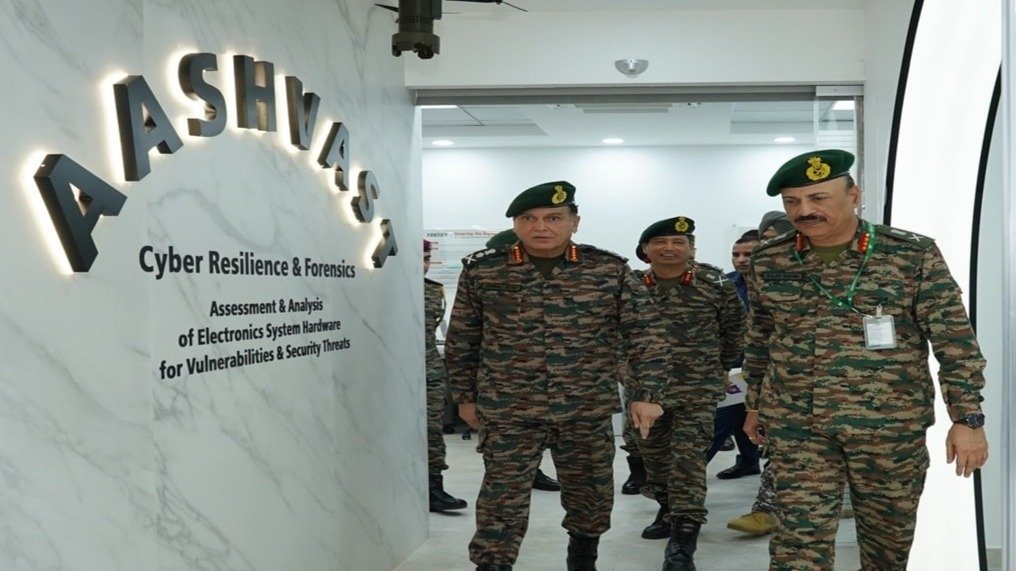
Recently, the Indian Army operationalized the air-gapped AASHVAST laboratory in New Delhi, systematically screening military drones to neutralize structural supply-chain threats and unauthorized Chinese hardware components.
What is AASHVAST Lab?
- About: AASHVAST is a specialised Indian Army facility for assessing the electronic, hardware and software security of military unmanned systems.
- It is located at the Directorate General of Electronics and Mechanical Engineering (DG EME) Headquarters, Delhi Cantonment.
- The facility was inaugurated by Chief of Army Staff General Dhiraj Seth on 14 August 2026.
- Full Form: AASHVAST stands for Assessment and Analysis of Electronic Systems Hardware for Vulnerabilities and Security Threats.
- Purpose: Its principal purpose is to verify the integrity, authenticity and cyber-security of military drones and other mission-critical electronic systems.
- Developed By: It was developed as an analysis and validation suite for DG EME, with QuickPay Tech establishing the suite.
- Functions:
- It can examine firmware, embedded software and electronic components for hidden credentials, encryption keys, undisclosed command pathways, remote-access mechanisms and altered operational restrictions.
- It can also assess whether systems accept only authorised software updates.
- The laboratory is intended to identify foreign-origin components.
- It can identify potentially risky Chinese-origin hardware and software inside military drones.
- The facility can also examine how drones respond when their navigation signals are spoofed or jammed.
- The laboratory can examine whether firmware contains undisclosed command pathways.
- The system’s response to GPS spoofing and jamming is also assessed.
- It is an air-gapped, read-only facility. Analysis can be conducted offline while avoiding writing information back into the equipment being examined.
Need for AASHVAST Facility
- Changing Nature of Drone Warfare: Drones have transformed modern warfare by providing surveillance, reconnaissance, targeting, logistics and strike capabilities at comparatively lower cost.
- Consequently, compromising a drone’s electronics can potentially undermine an entire operational mission.
- Risk of Hardware Backdoors: A hardware backdoor refers to an undocumented mechanism that may provide unauthorised access or functionality. If present in a mission-critical component, it could potentially compromise communications, data or control.
- Risk of Software Backdoors: A software backdoor could create an undisclosed route for remote access, information extraction or command manipulation.
- Hidden credentials and command pathways are specifically among the vulnerabilities reported as being examined by AASHVAST.
- Supply-Chain Vulnerability: The danger extends beyond deliberate sabotage. Opaque supply chains, counterfeit components, compromised firmware and dependence on foreign suppliers can create vulnerabilities even without an obvious backdoor.
- Operation Sindoor: The need became particularly relevant during Operation Sindoor in May 2025.
- India reported large-scale drone attempts against military targets, while approximately 300–400 drone intrusions were attempted across multiple locations.
- Indian forces used kinetic and non-kinetic methods to counter them.
- Global Evidence: The Russia-Ukraine war has demonstrated the growing importance of electronic warfare against drones. GPS interference and spoofing have been widely reported around the Black Sea and Russian-controlled areas, illustrating that navigation systems can themselves become contested battlefields.
Strategic Significance
- Technological Sovereignty: AASHVAST represents an important change in India’s defence approach. Domestic assembly alone is insufficient if critical processors, sensors, navigation systems or software remain dependent on external suppliers.
- Strategic Autonomy: Secure indigenous technology reduces the possibility that foreign suppliers can influence India’s operational availability, upgrades or wartime sustainability. This is especially important for long-duration conflicts.
- Strengthening Atmanirbhar Bharat: The initiative supports Atmanirbhar Bharat in defence by encouraging indigenous development, testing and validation.
- The government’s Defence Acquisition Procedure has explicitly promoted higher indigenous content and indigenous design in procurement categories.
- Cyber Resilience: Modern military platforms are increasingly cyber-physical systems. Their security depends simultaneously on hardware, software, networks, sensors and communication links. AASHVAST strengthens resilience by examining vulnerabilities.
- Boost to Domestic Industry: AASHVAST can create demand not only for complete drones but also for indigenous flight controllers, sensors, navigation systems, communication modules and secure software.
- This supports development of a deeper defence-industrial ecosystem.
- Civil-Military Technology Linkages: Its association with iHUB DivyaSampark, IIT Roorkee demonstrates the importance of linking the Army, academia, startups and technology developers.
- Such partnerships can accelerate conversion of research into deployable military capabilities.
Key Developments in India’s Counter-Drone & Cybersecurity Preparedness
- In 2022, the Indian Army’s Army Design Bureau signed an MoU with the Drone Federation of India to promote research, development, testing and manufacturing of drones, counter-drone systems and associated technologies.
- The Army Design Bureau (ADB) functions as a facilitator between the Army and industry, academia, DRDO and DPSUs.
- Its purpose includes communicating military requirements and supporting indigenous technology development.
- In July 2025, the Ministry of Defence organised a workshop focused on indigenising critical UAV and Counter-UAS components currently imported from foreign original-equipment manufacturers.
- During the May 2025 attacks, India employed an Integrated Counter-UAS Grid and air-defence systems to detect and neutralise incoming drones and missiles.
- Defence Acquisition Procedure 2020 increased emphasis on indigenous content and indigenous design.
- The Buy Indian-IDDM category requires minimum indigenous content of 50%, supporting domestic defence manufacturing.
- India established North and South Defence Industrial Corridors to encourage domestic defence manufacturing and build supporting industrial capabilities.
- The Defence Research and Development Organisation (DRDO) developed a ground-based directed-energy weapon named SHIELD to disable hostile drone swarms by frying their electronics at ranges up to one kilometer, with plans to expand the kill range to five kilometers.
- India launched Project Pragyashakti: tri-service, AI-driven electronic warfare backbone in 2025 to unify the Army, Navy, and Air Force electronic warfare systems under a single operational framework.
- Project Sudarshan Chakra, India plans to deploy this comprehensive terrestrial and space-based counter-drone network by 2035, integrating radar grids, electromagnetic jammers, kinetic interceptors, and satellite tracking to secure vital zones.
- The Indian Army conducted Exercise Vayu Samanvay-II, a major joint drone and counter-drone exercise in October 2025 under the Southern Command in the desert sector to test command-and-control fusion in contested electronic warfare scenarios.
- India signed a ₹1,577 crore contract with Tata Advanced Systems and NIBE in August 2026 for loitering munitions.
- It is backed by a broader push via iDEX and domestic defense startups to manufacture indigenous counter-measure systems.
Frequently Asked Questions (FAQs):
1. Why did the Indian Army establish AASHVAST Lab?
To strengthen military-drone security by detecting foreign components, hidden vulnerabilities, unauthorised access mechanisms and cyber threats.
2. What is the full form of AASHVAST?
Assessment and Analysis of Electronic Systems Hardware for Vulnerabilities and Security Threats.
3. What does AASHVAST Lab examine in military drones?
It examines hardware, software and firmware, including hidden passwords, embedded keys, remote-access tools and software-update controls.
4. Can AASHVAST detect Chinese components?
Yes. It is designed to identify Chinese-origin hardware and software components and associated security vulnerabilities in military drones.
5. How will AASHVAST strengthen drone security?
It verifies drone integrity and tests vulnerabilities against remote access, unauthorised modifications, GPS spoofing, jamming and compromised software updates.
6. Where is the AASHVAST facility established?
The facility is established at DG EME Headquarters, Delhi Cantonment, New Delhi, under the Army’s technical organisation.
Disclaimer: Information in this article is based on official announcements and public records. Regulations and implementation details may evolve over time.
| Also Read: Jet-Powered Kamikaze Drone |