Indigenous ASW-SWC INS Malvan
| General Studies Paper III: Indigenization of Technology, Defence Technology |
Why in News?
The Indian Navy will commission indigenous INS Malvan on 22 July 2026 strengthening India’s coastal anti-submarine warfare.
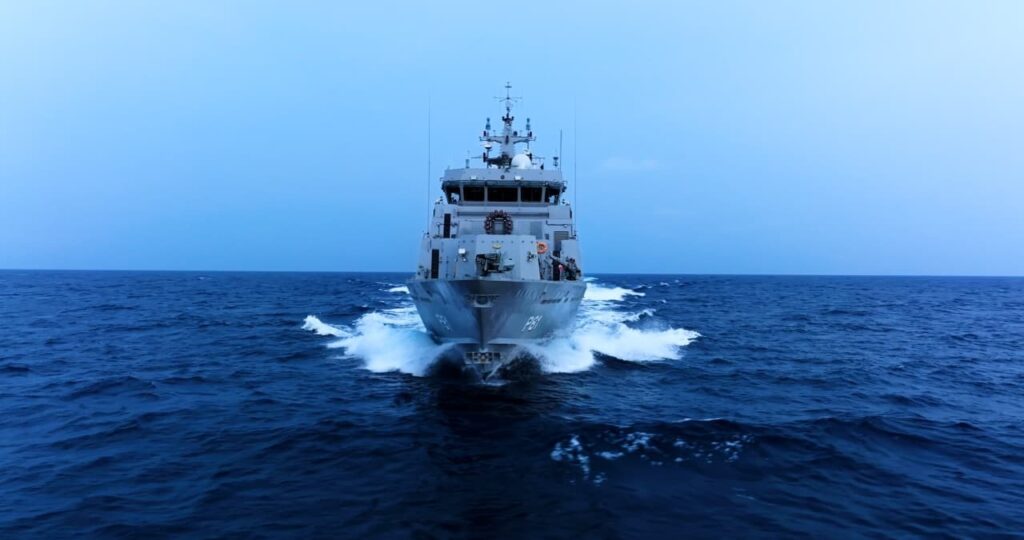
What is INS Malvan?
- About: INS Malvan is an indigenous Anti-Submarine Warfare Shallow Water Craft (ASW-SWC) of the Indian Navy.
- Ship Class: The vessel belongs to the Mahe-class ASW-SWC programme.
- It is the second vessel of this class.
- These ships are specially designed for operations in shallow coastal waters.
- Naming: The vessel is named after Malvan, a coastal town in Maharashtra.
- It continues the legacy of an earlier Indian Navy minesweeper that served from 1983 to 2003.
- Builder: INS Malvan has been designed and built by Cochin Shipyard Limited (CSL), Kochi for the Indian Navy.
- Commissioning: The ship will be commissioned on 22 July 2026 at Kochi.
- The ceremony will be presided over by Air Chief Marshal A. P. Singh, Chief of the Air Staff.
- Construction Milestones: The ship’s keel was laid in February 2023, it was launched in November 2023, and delivered to the Indian Navy on 31 March 2026 before its commissioning.
- Primary Role: Its principal role is Anti-Submarine Warfare (ASW) in shallow waters.
- The vessel is also capable of underwater surveillance, Low Intensity Maritime Operations (LIMO) and mine warfare tasks.
- Dimensions: The ship is approximately 80 metres long and has a displacement of about 1,100 tonnes, making it suitable for agile coastal operations.
- Naval Crest: Its official crest is inspired by Chhatrapati Shivaji Maharaj‘s legendary Bagh Nakha (tiger claw), symbolizing courage and vigilance.
- Propulsion: INS Malvan uses water-jet propulsion, providing improved manoeuvrability and operational efficiency in littoral and shallow-water environments.
- Speed and Capacity: The vessel can attain a maximum speed of 25 knots (about 46 km/h) and has an endurance of 14 days.
- Weapons & Sensors: The vessel carries torpedoes, multifunctional RBU-6000 anti-submarine rockets, and advanced radars.
- It is equipped with the indigenous Abhay Sonar system for underwater reconnaissance.
Indian Navy’s ASW Shallow Water Craft Programme
- About: The Anti-Submarine Warfare Shallow Water Craft (ASW-SWC) Programme is an Indian Navy warship acquisition programme to build 16 indigenous shallow-water anti-submarine vessels.
- These ships are specially designed for coastal and littoral operations.
- Project Approval: The project was approved by the Cabinet Committee on Security (CCS) in April 2019 for the construction of eight ASW-SWC vessels under the Buy (Indian–IDDM) category.
- Shipbuilders: Construction is shared between Garden Reach Shipbuilders & Engineers (GRSE), Kolkata and Cochin Shipyard Limited (CSL), Kochi.
- Both shipyards are delivering eight ships each.
- Classes: The programme has two classes.
- The Arnala-class is being built by GRSE, while the Mahe-class is being built by CSL.
- Both belong to the ASW-SWC family.
- Features: The ships are approximately 77–80 metres long, displace around 1,100 tonnes, and use water-jet propulsion for high manoeuvrability in shallow coastal waters.
- Each vessel carries lightweight torpedoes, anti-submarine rockets, advanced radars, hull-mounted sonar, and low-frequency variable depth sonar.
- Induction Status: INS Arnala (Arnala-class) – Commissioned on 18 June 2025. First ASW-SWC inducted into the Indian Navy.
- INS Androth (Arnala-class) – Commissioned on 6 October 2025.
- INS Mahe (Mahe-class) – Commissioned on 24 November 2025. Lead ship of the Mahe class.
- INS Anjadip (Arnala-class) – Commissioned on 27 February 2026. Fourth ASW-SWC inducted overall.
- INS Agray (Arnala-class) – Delivered to the Indian Navy on 30 March 2026; commissioning pending.
- INS Malvan (Mahe-class) – Scheduled for commissioning on 22 July 2026.
- Remaining ships under construction:
- Arnala-class: Kadmat, Karusa, Kavaratti, Ajay – at various stages of construction, trials or fitting-out.
- Mahe-class: Mangrol, Malpe, Mulki, Mangalore, Minicoy, Murdeshwar – under phased construction.
Strategic Significance for India’s Defence
- Strengthening Coastal Defence: The ASW-SWC programme enhances the Indian Navy’s capability to protect coastal waters, harbours, and strategic sea approaches.
- These vessels are optimized for operations where larger warships have operational limitations.
- Enhancing Anti-Submarine Capability: The ships improve India’s ability to detect, track, and neutralise hostile submarines operating in shallow and littoral water.
- Promoting Aatmanirbhar Bharat: The vessels incorporate over 80% indigenous content, including major systems, equipment, and combat integration, reducing dependence on imported defence platforms.
- Supporting Domestic Defence Industry: The programme strengthens India’s defence manufacturing ecosystem by involving public sector shipyards, private industries, MSMEs, and indigenous technology developers.
- Improving Maritime Domain Awareness: The ASW-SWC fleet strengthens underwater surveillance, subsurface monitoring, and continuous maritime awareness in India’s coastal security architecture.
- Replacing Ageing Naval Platforms: These vessels are progressively replacing the Abhay-class corvettes, ensuring continuity of specialised shallow-water anti-submarine operations with modern technology.
- Generating Industrial and Technical Capacity: The programme develops long-term expertise in warship design, systems integration, shipbuilding, and skilled manpower, expanding India’s naval industrial base.
FAQs:
1. What is INS Malvan?
INS Malvan is the second indigenous Mahe-class ASW-SWC built for the Indian Navy.
2. When will INS Malvan join the Indian Navy?
INS Malvan will be commissioned on 22 July 2026 at Kochi.
3. What does ASW-SWC stand for?
ASW-SWC stands for Anti-Submarine Warfare Shallow Water Craft.
4. What are the key features of INS Malvan?
It features water-jet propulsion, torpedoes, ASW rockets, advanced radar, and sonar systems.
5. Why is INS Malvan important for the Indian Navy?
It strengthens coastal anti-submarine warfare, underwater surveillance, and mine warfare capabilities.
Disclaimer: Information in this article is based on official announcements and public records. Regulations and implementation details may evolve over time.