52nd G7 Summit 2026
| General Studies Paper II: Groupings & Agreements Involving India and/or Affecting India’s Interests |
Why in News?
Recently, the 52nd G7 Summit 2026 commenced in Évian, France, shifting deep analytical focus toward resolving global economic imbalances.

52nd G7 Summit 2026 Highlights
- Venue: The summit is being held from 15–17 June 2026 in Évian-les-Bains, Haute-Savoie, France, a lakeside town on Lake Geneva.
- Évian previously hosted the 2003 G8 Summit, making it a symbolically significant venue for global diplomacy.
- Host: The summit is hosted by Emmanuel Macron under France’s rotating G7 presidency.
- Macron has positioned the gathering as a forum for “convergence and action” on global crises and long-term systemic challenges.
- Theme: The central theme for the 2026 French presidency is “Solidarity, Sustainable Growth, and Resilience.”
- The framework was divided into three core pillars: Forging New International Partnerships, Reviving Balanced and Sustainable Economic Growth, and Ensuring Safe Global Implementations of AI.
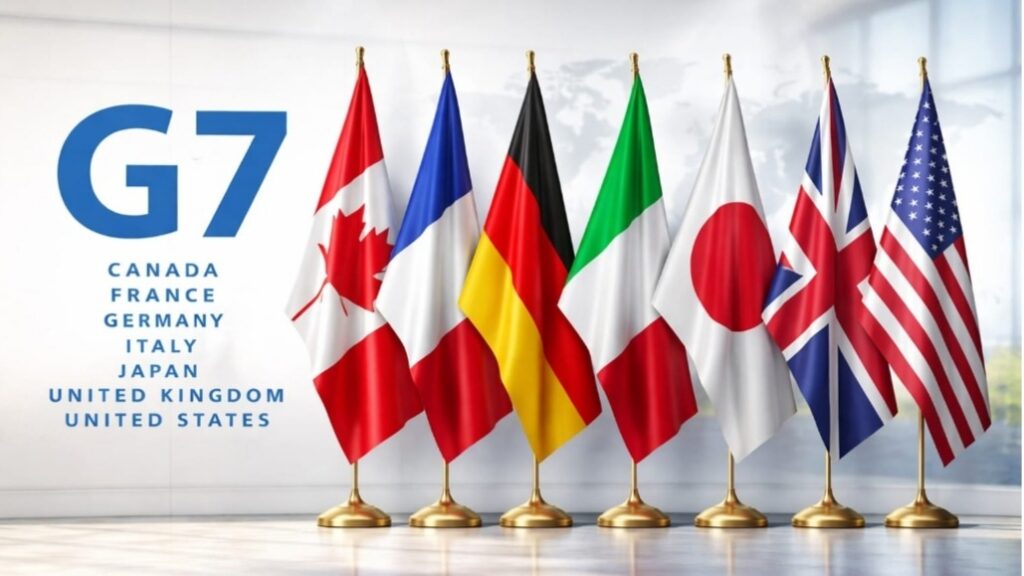
- Participation: The G7 comprises the world’s seven advanced democracies: Canada, France, Germany, Italy, Japan, the United Kingdom, and the United States.
- The European Union (EU) also participated fully in all discussions, represented by the President of the European Council and the President of the European Commission.
- Invitees: France invited several vital outreach and partner nations including India, Brazil, Egypt, Kenya, South Korea, Qatar, and the United Arab Emirates.
- Additionally, Ukrainian President Volodymyr Zelenskyy is invited to discuss ongoing war diplomacy.
- Key Agendas:
- Global Economic Imbalances & Trade: Leaders are addressing systemic financial imbalances (e.g., European underinvestment, U.S. over-consumption, and Chinese overproduction) and striving to reduce dependencies on China for rare earth and critical minerals.
- Geopolitics and Security: A major focus is placed on maintaining unified G7 backing for Ukraine’s energy infrastructure and war effort, as well as managing the geopolitical and maritime impacts of the U.S.-Iran conflict in the Middle East.
- Artificial Intelligence & Digital Safety: Leaders are engaging with major tech executives to shape the governance of safe, ethical AI, while also pushing for stronger digital infrastructure and the online protection of minors.
- Development & Health Sovereignty: Discussions are tackling the rising debt burdens of developing nations, overhauling international solidarity finance models, and prioritizing global public health, with cancer prevention and research emerging as a new focus.
- Outreach to the Global South: Guest nations (including India, Brazil, Kenya, and South Korea) are participating in expanded sessions to advocate for inclusive growth, technology transfers, and food and fertilizer security.
- India: Prime Minister Narendra Modi attended the summit as a special invitee for the seventh consecutive G7 appearance, reflecting India’s growing importance in global governance.
- India and France concluded 19 agreements and cooperation frameworks spanning defence, clean energy, digital technology, education, infrastructure, space cooperation, and innovation.
- Both leaders agreed to deepen cooperation in critical technologies, economic security, artificial intelligence, defence manufacturing, civil nuclear energy, and innovation ecosystems. They also launched a structured dialogue on emerging technologies and AI governance.
- India and France announced a significant economic objective: doubling bilateral trade within the next five years. This commitment is aimed at strengthening supply-chain resilience and advanced manufacturing.
- Indian and Frence jointly inaugurated “Bharat Innovates 2026” at the Palais des Expositions in Nice, France, right on the sidelines of the ongoing G7 Summit engagements.
- It features 120 breakthrough Indian deep-tech startups and more than 15 premier Higher Education Institutions (including various IITs).
- Prime Minister Narendra Modi has officially announced that India will establish its first-ever India Chair on Artificial Intelligence (AI) at the Technical University of Košice in Slovakia.
What is G7 Group?
- About: The Group of Seven (G7) is an informal bloc of advanced industrialized democracies that coordinates global economic governance, international security, and energy policies.
- It functions without a permanent headquarters, charter, or legal status.
- It relays entirely on political consensus and joint declarations to influence global standards.
- Objective: The primary objective of the G7 is to maintain macroeconomic stability, manage geopolitical crises, and drive multilateral cooperation.
- It aims to foster a shared consensus on pressing global challenges, ranging from trade barriers and international security to environmental sustainability and public health.
- Origin: The G7 originated during the 1973 oil crisis and subsequent global recession, beginning as an informal gathering of finance ministers in the White House library.
- Officially founded as the G6 in 1975 by France, West Germany, Italy, Japan, the UK, and the USA, its history expanded to the G7 when Canada joined in 1976.
- Russia was admitted in 1998, forming the G8, but was indefinitely suspended in 2014 following its annexation of Crimea.
- Nature: The nature of the G7 is informal and non-binding, meaning its decisions carry no legal enforcement power but hold immense geopolitical weight.
- Presidency: Hosting and presidency rotate annually among member states in a fixed order.
- The presiding country holds the presidency for that calendar year, sets the policy agenda, funds the administrative logistics, and hosts the ministerial meetings culminating in the annual leaders’ summit.
- Mechanism: The mechanism function through a continuous stream of ministerial meetings, where sherpas (diplomatic envoys) conduct year-round negotiations to draft joint communiqués.
- These preparatory tracks lead to the annual leaders’ summit, where heads of state formally ratify joint agreements.
- Significance: Economically, the G7 is a massive global powerhouse, currently representing roughly 30% to 44% of global GDP depending on nominal versus purchasing power parity (PPP) metrics.
- G7 nations dominate key institutions like the IMF, World Bank, and global capital markets, influencing monetary policies.
- G7 countries contribute about 25% of global energy-related CO₂ emissions, placing them at the forefront of climate negotiations.
- Initiatives: Key G7 initiatives include the Partnership for Global Infrastructure and Investment (PGII), aimed at narrowing the infrastructure gap in developing nations.
- The bloc has also pioneered the Climate Club for carbon leakage prevention.
- The G7 supported the creation of the Global Fund (2002), mobilizing billions of dollars to combat HIV/AIDS, TB, and malaria.
- L’Aquila Food Security Initiative (AFSI) was launched during the 2009 Italy Summit, pledged $20+ billion to address global hunger and food security.
- India’s Participation: India is not a permanent member of the G7 but participates as an “invited guest country”.
- India has been invited 13 times in total, participating consecutively.
- First invited in 2003 (France Summit) under PM Atal Bihari Vajpayee.
- Former PM Manmohan Singh subsequently attended 5 summits between 2005 and 2013.
- Since 2019 (France), Prime Minister Narendra Modi has attended multiple consecutive summits, reinforcing India’s strategic relevance to the West.
- Acting as a link between advanced G7 economies and developing G20 nations, India promotes balanced global governance.
FAQs:
1. What is the 52nd G7 Summit?
The 52nd G7 Summit is the annual meeting of G7 leaders held from 15–17 June 2026 to discuss major global economic, security, technology, and geopolitical challenges.
2. Which country hosted the summit?
France hosted the 52nd G7 Summit under its rotating presidency at Évian-les-Bains, Haute-Savoie, on the shores of Lake Geneva.
Q3. What were the key issues discussed?
Key issues included Ukraine, Middle East security, AI governance, global economic imbalances, critical minerals, debt challenges, international partnerships, and multilateral cooperation.
4. Did India participate in the summit?
Yes. India participated as an invited partner country, with Prime Minister Narendra Modi attending at the invitation of French President Emmanuel Macron.
5. Why is the G7 Summit important?
The summit helps coordinate responses to global crises, influences economic and security policies, promotes international cooperation, and shapes discussions on emerging issues like AI and supply chains.
| Also Read: 51st G7 Summit 2025 |