


PM Modi Commissions Three Indigenous Naval Ships
| General Studies Paper III: Indigenization of Technology, Defence |
Why in News?
Recently, Prime Minister Narendra Modi commissioned three indigenously built naval platforms—INS Dunagiri, INS Sanshodhak, and INS Agray—in Kolkata, strengthening India’s maritime surveillance.
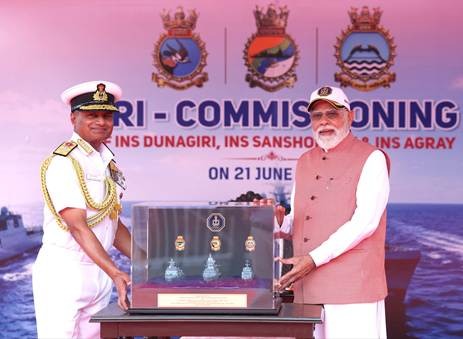
Overview of the Three Indigenous Naval Ships Commissioned by PM Modi
- INS Dunagiri: It is a frontline stealth guided-missile frigate of the Indian Navy and the fifth warship of the Nilgiri-class (Project 17A).
- It was officially commissioned on 21 June 2026 into the Indian Navy.
- It represents India’s next-generation indigenous surface combat capability.
- The vessel is designed for simultaneous operations in surface, air and underwater warfare environments.
- It carries the historical legacy of the original INS Dunagiri (F36), an erstwhile Leander-class frigate.
- The original vessel served the Indian Navy with distinction for 33 years (1977 to 2010).
- The frigate was designed by the Indian Navy’s Warship Design Bureau (WDB) and constructed by Garden Reach Shipbuilders & Engineers (GRSE), Kolkata.
- It reflects India’s growing shipbuilding expertise, with approximately 75% indigenous content and participation from over 200 MSMEs.
- The ship measures about 149 metres in length and displaces roughly 6,670 tonnes, making it one of the heaviest and most capable frontline surface combatants in the modern Indian fleet.
- It uses a Combined Diesel or Gas (CODOG) propulsion system with controllable-pitch propellers, enabling speeds exceeding 28 knots.
- It incorporates a state-of-the-art Integrated Platform Management System (IPMS), allowing the ship to cruise efficiently on diesel engines.
- The frigate incorporates low-observability features, radar-signature reduction techniques, advanced hull shaping and stealth coatings. These technologies make detection more difficult.
- INS Dunagiri carries a potent combat suite including BrahMos supersonic cruise missiles, MRSAM/Barak-8 air-defence systems, advanced guns, torpedoes and anti-submarine rockets.
- The warship is equipped with sophisticated sensors including the MF-STAR multifunction radar, integrated combat-management systems and advanced electronic warfare capabilities.
- INS Dunagiri strengthens India’s maritime deterrence in the Indian Ocean Region (IOR).
- It supports sea-lane security, power projection and anti-submarine operations amid increasing geopolitical competition.
- INS Sanshodhak: It is the fourth and final Survey Vessel (Large) (SVL) of the Indian Navy.
- Commissioned on 21 June 2026, it is a specialized hydrographic survey ship designed to map the seabed, support navigation, and generate critical maritime data for defence and civilian use.
- The vessel was designed by the Indian Navy’s Warship Design Bureau (WDB) and built by Garden Reach Shipbuilders & Engineers in Kolkata.
- The hull is built from DMR 249-A steel developed by the Steel Authority of India Limited (SAIL).
- It represents India’s growing shipbuilding capability and contains over 80% indigenous content by cost, supporting the Aatmanirbhar Bharat initiative.
- INS Sanshodhak completes the Navy’s four-ship SVL programme, contracted in October 2018.
- Its sister ships are INS Sandhayak, INS Nirdeshak, and INS Ikshak.
- The programme significantly expands India’s hydrographic and oceanographic survey capacity.
- The ship has a displacement of approximately 3,400 tonnes, a length of 110 metres, and a beam of around 16 metres.
- Powered by twin diesel engines, it can achieve speeds exceeding 18 knots and undertake extended missions across the Indian Ocean Region.
- It boasts an impressive operating range of 6,500 nautical miles at cruising speeds, allowing for long-duration deployments.
- It carries sophisticated hydrographic equipment, including Autonomous Underwater Vehicles (AUVs), Remotely Operated Vehicles (ROVs), digital side-scan sonar, DGPS positioning systems, and advanced data-processing suites.
- Often described as a “floating ocean laboratory,” the vessel collects oceanographic, hydrographic, and geophysical data. Such information supports naval operations and climate studies.
- The ship acts as a hospital ship during medical emergencies, supports Humanitarian Assistance and Disaster Relief (HADR), and is capable of launching Advanced Light Helicopters (ALH) from its onboard hangar.
- Its accurate seabed mapping improves submarine operations, mine warfare planning, and amphibious missions help safe naval navigation.
- It strengthens India’s Maritime Domain Awareness (MDA) by providing detailed underwater intelligence across strategic waters.
- The vessel enhances India’s influence in the Indian Ocean Region (IOR) by supporting navigation safety, charting sea routes, and hydrographic cooperation with friendly countries.
- INS Agray: It is an Anti-Submarine Warfare Shallow Water Craft (ASW-SWC) commissioned into the Indian Navy on 21 June 2026.
- It is designed specifically to detect, track, and neutralize hostile submarines in coastal and shallow waters.
- The vessel proudly carries forward the name of the erstwhile INS Agray, which was the fourth of the 1241 PE class of Patrol Vessels.
- This older Abhay-class vessel served the Indian Navy with distinction before being officially decommissioned in early 2017.
- INS Agray is the fourth vessel delivered under the Navy’s indigenous ASW-SWC programme. It belongs to the Arnala-class.
- The vessel was designed and built by Garden Reach Shipbuilders & Engineers (GRSE), Kolkata.
- It contains more than 80% indigenous content, reflecting India’s commitment to Aatmanirbhar Bharat.
- It is approximately 77 metres long and is among the largest Indian naval warships propelled by waterjets.
- Waterjet propulsion provides superior manoeuvrability, lower acoustic signatures, and better performance in shallow coastal environments.
- The warship is propelled by three advanced marine diesel engines, each coupled with a dedicated waterjet system.
- It generates a combined power output of 6 MW. The ship can achieve a maximum speed of 25 knots.
- The vessel’s primary mission is anti-submarine warfare. It is equipped with shallow-water sonar systems.
- It allows effective detection of submarines operating in complex littoral waters where conventional detection is often difficult.
- The INS Agray boasts an endurance of over 1,800 nautical miles at a cruising speed of 14 knots.
- INS Agray carries lightweight torpedoes, indigenous anti-submarine rocket launchers, and advanced underwater combat systems. These weapons enable rapid engagement of submarine threats.
- For self-defense and anti-surface roles, it is equipped with a 30 mm close-in weapon system (CIWS) and 16.7 stabilized remote-controlled guns.
- The vessel supports mine warfare, coastal surveillance, patrol missions, and Low Intensity Maritime Operations (LIMO).
- It is specifically built to detect and track adversary submarines in the Indian Ocean Region, particularly around crucial ports, sea lanes, and strategic maritime approaches.
IMPORTANT POINTS TO KNOW
- Project 17A: Project 17A is the Indian Navy’s programme to build seven advanced stealth guided-missile frigates.
- Approved in 2015 at a cost exceeding ₹45,000 crore, it is a major naval modernization initiative.
- It is an upgraded version of the Shivalik-class (Project 17) frigates.
- It is also known as the Nilgiri-class.
- It incorporates improved stealth, automation, survivability, and advanced sensor integration.
- Of the seven frigates, four (Nilgiri, Udaygiri, Taragiri, Mahendragiri) are being built by Mazagon Dock Shipbuilders Ltd (MDL), and three (Himgiri, Dunagiri, Vindhyagiri) by Garden Reach Shipbuilders & Engineers Ltd.
- ASW-SWC Programme: The Anti-Submarine Warfare Shallow Water Craft (ASW-SWC) programme is an Indian Navy initiative to build 16 specialized warships for detecting and neutralizing submarines operating in coastal and shallow waters.
- It involves building a fleet of advanced, indigenous vessels to replace the aging Abhay-class corvettes.
- The Ministry of Defence signed contracts in 2019 with Garden Reach Shipbuilders & Engineers and Cochin Shipyard Limited to construct eight vessels each.
- Cochin Shipyard Limited (CSL) in Kochi is building the Mahe-class fleets.
- Garden Reach Shipbuilders & Engineers (GRSE) in Kolkata is building the Arnala-class fleets.
- These vessels align with the Aatmanirbhar Bharat initiative, with over 80% of their components, sensors, and weapons sourced domestically.
FAQs:
1. What are INS Dunagiri, INS Sanshodhak and INS Agray?
INS Dunagiri is a stealth frigate, INS Sanshodhak a survey vessel, and INS Agray an anti-submarine warfare craft.
2. Why are these naval vessels significant for India?
They enhance maritime security, surveillance, anti-submarine warfare, and operational readiness, strengthening India’s naval capabilities.
3. Where were the ships commissioned?
The three indigenous naval platforms were commissioned in Kolkata, West Bengal, on 21 June 2026.
4. How do these ships strengthen the Indian Navy?
Together they provide battlefield mapping, submarine hunting, and multi-role combat capabilities, creating an integrated maritime warfare network.
5. What is the importance of indigenous shipbuilding?
Indigenous shipbuilding promotes self-reliance, defence manufacturing growth, technology development, and reduced dependence on foreign suppliers.
Disclaimer: Information in this article is based on official announcements and public records. Regulations and implementation details may evolve over time.
| Also Read: INSV Koundinya, Indigenous ASW Ship Mahe |