



Indian Railways Allocates ₹170 Crore to Deploy Kavach 4.0
| General Studies Paper II: Government Policies and Interventions, Indigenous Technology |
Why in News?
Recently, Indian Railways approved ₹170 crore for Kavach 4.0 across 712 Rkm in Moradabad Division, strengthening indigenous automatic train protection against collisions.
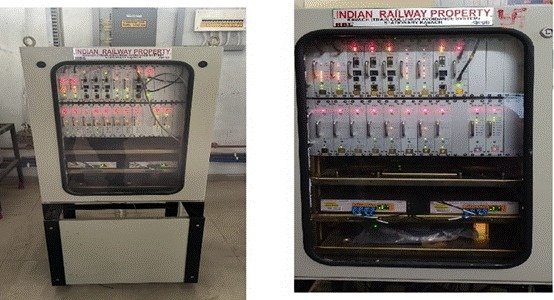
What is India’s Train Protection System “Kavach”?
- About: Kavach is India’s indigenous Automatic Train Protection (ATP) system, developed by the Research Designs and Standards Organisation (RDSO) in collaboration with the Indian railway industry.
- It was earlier associated with the name Train Collision Avoidance System (TCAS) and was adopted as the National ATP System in July 2020.
- Kavach continuously processes information about the train’s location, speed, signal aspect, movement authority and permissible speed.
- Kavach prevents trains from overspeeding and averts catastrophic collisions even when human operators fail to react in time.
- Kavach is certified to Safety Integrity Level-4 (SIL-4), the highest safety-integrity level.
- It represents the highest level of safety certification globally, indicating an error probability of just once in 10,000 years.
- Objective: Its objective of Kavach is to achieve zero accidents on the vast Indian rail network by eliminating human errors made.
- Its basic purpose is to create an additional technological safety layer between human error and a railway accident.
- It specifically aims to prevent Signal Passing at Danger (SPAD), a high-risk situation where a train overshoots a red signal and enters a restricted section.
- It seeks to provide fail-safe train protection that ensures safe operations during dense fog, heavy rain, and low visibility.
- Developed By: Kavach was designed and conceptualized by RDSO, the premier research and development wing of Indian Railways.
- The development process was conducted in close collaboration with Medha Servo Drives Pvt Ltd, HBL Power Systems Ltd, and Kernex Microsystems.
- This joint initiative emphasizes the government’s vision of self-reliance under the Atmanirbhar Bharat.
- It was conceptualized and manufactured locally, it costs approximately ₹50 lakh per kilometer to operate, which is nearly one-fourth of the ₹2 crore per kilometer cost of similar international systems like the European Train Control System (ETCS).
- Need: Indian Railways operates one of the world’s largest railway networks, with enormous traffic density and increasingly higher train speeds.
- The implementation of an automated safety framework like Kavach is highlighted by several catastrophic train accidents in India caused primarily by signaling failures or human oversight.
- The Indore–Patna Express derailment in 2016, Khatauli derailment in 2017, and Amritsar train tragedy in 2018 highlighted different dimensions of railway safety.
- The Balasore triple-train accident in Odisha in June 2023 was particularly significant because failures associated with signalling and electronic interlocking were central to the accident investigation.
- The Kanchanjunga Express accident in West Bengal in June 2024 again highlighted the importance of protection against train-to-train collisions.
- The implementation of an automated safety framework like Kavach is highlighted by several catastrophic train accidents in India caused primarily by signaling failures or human oversight.
- Components: It comprises five key integrated components distributed across the tracks, stations, and locomotives.
- The first component is the Radio Frequency Identification (RFID) Tags, which are durable chips fitted directly into the track sleepers at regular intervals to determine exact train location and direction.
- The second is the Loco Kavach Unit, an onboard computer installed in the locomotive cabin that features RFID readers, a Driver Machine Interface (DMI) display screen, and an electronic brake interface equipment.
- The third component is the Station Kavach, an edge data center and stationary electronic system set up at every railway station to fetch real-time signaling data.
- The fourth and fifth components consist of Telecom Towers with radio modems for wireless communication and a continuous network of Optical Fibre Cables (OFC) laid along the tracks to ensure ultra-fast data transfer between stations.
- Working Mechanism: It relies on continuous, real-time situational awareness and instant machine-to-machine communication.
- As a train travels, its onboard RFID reader scans the track-mounted RFID tags to determine its precise position, speed, and track ID.
- Simultaneously, the Station Kavach reads the layout from the station’s interlocking system to find out the status of upcoming signals and route occupancy.
- The station unit calculates the Movement Authority—the exact safe distance the train is permitted to travel—and transmits it wirelessly to the locomotive.
- The onboard computer compares the train’s actual speed against a dynamically generated braking curve; if the driver overspeeds or approaches a red signal without slowing down, Kavach sounds visual and audible alerts.
- If the loco pilot fails to lower the speed below 15 km/h within a specific timeline, the system automatically takes control of the pneumatic brakes to bring the train to a complete stop before the hazard point.
- Development: The development of Kavach began around 2015, followed by extensive testing and field validation.
- The first passenger-train field trials began in February 2016. An operational certificate was subsequently obtained, and experience from deployments on South Central Railway helped improve the system.
- Versions:
- The first commercially scalable version of this technology was Kavach Version 3.2, approved for manufacturing and deployment in the 2018-19 financial year.
- Passenger-train field trials began in February 2016, and after extensive testing and independent safety assessment.
- This version utilized Ultra High Frequency (UHF) radio channels for data communication between trains and trackside stations.
- It included fundamental ATP attributes such as automated braking during SPAD incidents, overspeed protection, and live signal duplication on the cab’s DMI screen.
- It also integrated basic Loco-to-Loco communication, enabling two approaching trains on the exact same track to sense each other’s presence.
- Kavach 4.0 is the latest version. RDSO approved the Version 4.0 specification on 16 July 2024.
- This major upgrade replaced the legacy UHF radio setup with a modern, high-bandwidth 4G LTE-based communication backbone.
- It brought significant safety features, including drastically increased location accuracy for precise train tracking and enhanced processing of complex signal aspects within large, multi-track station yards.
- It introduced a standardized Station-to-Station Kavach interface over Optical Fibre Cables and provided a direct, seamless electronic linkage to existing Electronic Interlocking (EI) systems.
- The first commercially scalable version of this technology was Kavach Version 3.2, approved for manufacturing and deployment in the 2018-19 financial year.
- Coverage: Kavach deployment has accelerated substantially.
- Version 3.2 was successfully commissioned and thoroughly tested across 1,465 route kilometers and 144 locomotives, primarily under the South Central Railway zone.
- By 31 July 2026, Kavach Version 4.0 had been commissioned on 2,633 route kilometres, covering important high-density corridors including the Delhi–Mumbai and Delhi–Howrah routes.
- It had been commissioned on 738 Rkm, comprising 633 Rkm on Palwal–Mathura–Nagda and 105 Rkm on Howrah–Bardhaman.
- Vadodara–Virar section (344 km), Tughlakabad–Palwal section (35 km), and Manpur–Sarmatanr section (93.3 km).
- On 1 September 2026, Indian Railways approved ₹170 crore for deploying Kavach Version 4.0 across the remaining 712 Rkm of Moradabad Division.
- The Railways planned to expand the Kavach network by approximately 9,000 Route Km over the following two years, with an eventual target of around 10,000 Route Km annually.
- Alongside physical deployment, the Railways is developing a Universal Braking Algorithm to facilitate faster implementation and Suraksha, an AI-based centralised monitoring platform intended to alert traffic monitors about unusual events.
- Significance:
- It strengthens passenger safety and infrastructure resilience.
- The implementation of automated systems has contributed to a 90% reduction in consequential train accidents, dropping from 135 incidents in 2014 to just 11.
- Its low operational cost allows Indian Railways to protect its entire network without facing the massive financial burden of foreign technology.
- It serves as the technological foundation for high-speed rail corridors like Mission Raftar, enabling trains to run safely at 160 kmph.
- This success also opens doors for India to enter the global railway systems export market as a major provider of affordable, certified safety technology.
- It supports modernisation of signalling and telecommunications, which is essential for higher-speed and higher-density rail operations.
- Its integration with electronic interlocking and digital communication contributes to the broader digitalisation of infrastructure.
Frequently Asked Questions (FAQs):
1. What is Kavach 4.0?
Kavach 4.0 is India’s latest indigenous Automatic Train Protection system, specified by RDSO on 16 July 2024.
2. Why has Indian Railways approved ₹170 crore for Kavach 4.0?
Indian Railways approved ₹170 crore to deploy Kavach 4.0 across the remaining 712 Rkm of Moradabad Division.
3. What does Kavach 4.0 do?
It provides automatic speed supervision, SPAD protection, collision prevention, and enhanced signalling information through improved railway-system integration.
4. How does Kavach prevent train collisions?
Kavach monitors train speed, location and movement authority, warning the pilot and automatically applying brakes when dangerous conditions require intervention.
5. Is Kavach an Automatic Train Protection system?
Yes. Kavach is India’s indigenous Automatic Train Protection (ATP) system, designed to prevent accidents caused by unsafe train movements.
6. What is the difference between Kavach 4.0 and earlier versions?
Version 4.0 improves location accuracy, yard-signal information, OFC interfaces and electronic-interlocking integration over earlier Kavach versions.
Disclaimer: Information in this article is based on official announcements and public records. Regulations and implementation details may evolve over time.
| Also Read: India’s First Vande Bharat Sleeper Train |