ISRO GSLV-F17 EOS-05 Launch Success, Satellite Deployed in Sub-GTO
| General Studies Paper III: Space Technology, ISRO Achievements |
Why in News?
Recently, ISRO’s GSLV-F17 successfully placed EOS-05 into Sub-Geosynchronous Transfer Orbit, marking India’s first imaging satellite mission from geosynchronous orbit.
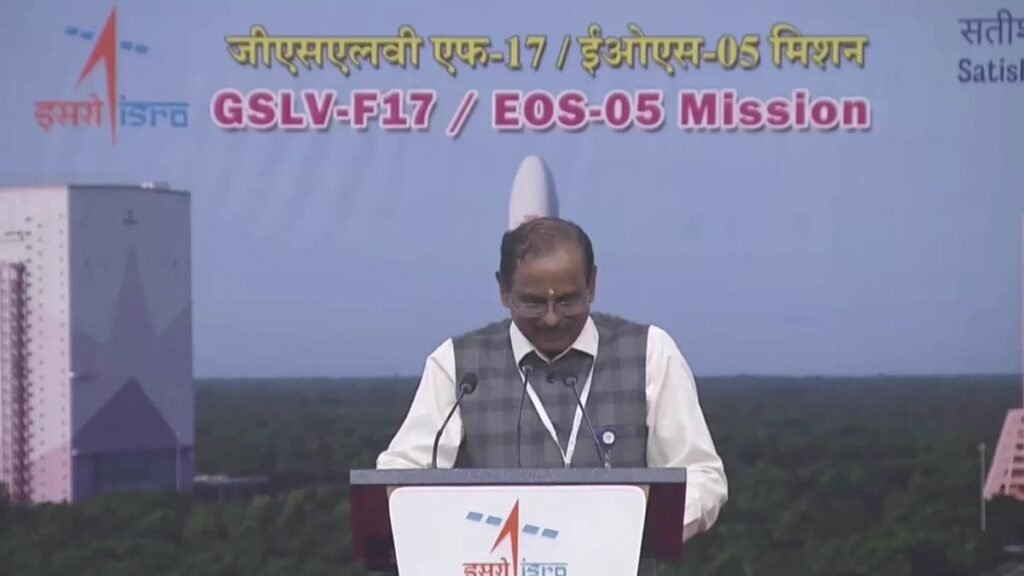
Highlights of Successful GSLV-F17 Mission
- Launch: GSLV-F17 was successfully launched on 4 September 2026 from the Second Launch Pad (SLP), Satish Dhawan Space Centre, Sriharikota.
- It is the 19th flight of India’s Geosynchronous Satellite Launch Vehicle (GSLV).
- Details: It carried the approximately 2,367-kg Earth-Observation Satellite (EOS-05).
- The mission used the GSLV Mk II configuration with a 4-metre-diameter composite ogive payload fairing.
- The vehicle is 51.7 metres high, has a lift-off mass of 420.5 tonnes, and uses a three-stage architecture.
- Its first stage, GS1, combines the S139 solid core with four L40H liquid strap-ons; the second stage, GL40HT, uses UH25 and N2O4; and the third stage, CUS15, uses liquid hydrogen and liquid oxygen.
- The mission used the GSLV Mk II configuration with a 4-metre-diameter composite ogive payload fairing.
- Success: The mission profile targeted a Sub-Geosynchronous Transfer Orbit (Sub-GTO) with a nominal 170-km perigee, 28,934-km apogee and 19.28° inclination, before EOS-05 proceeds towards its operational geosynchronous orbit.
What is Earth-Observation Satellite (EOS-05)?
- About: EOS-05, also associated with the GISAT-1A designation, is a state-of-the-art Earth-observation spacecraft.
- It is India’s first imaging satellite intended to operate from geosynchronous orbit.
- Unlike conventional Low Earth Orbit (LEO) remote-sensing satellites, a geosynchronous platform can maintain a persistent view of a large geographic region.
- It is India’s first imaging satellite intended to operate from geosynchronous orbit.
- Features: It is capable of high temporal resolution—the ability to repeatedly observe the same broad region at short intervals.
- It uses a 700-mm Ritchey–Chrétien telescope, together with advanced detector systems covering Visible and Near-Infrared (VNIR) and Short-Wave Infrared (SWIR) portions of the electromagnetic spectrum.
- Its imaging architecture combines multispectral and hyperspectral observation, allowing the satellite to extract information beyond ordinary visible-light photography.
- It incorporates a high-agility, jitter-free platform and an electronically steerable phased-array antenna, enabling rapid targeting and communication functions.
- Its geosynchronous vantage point is designed to permit near-real-time observation, with mission descriptions indicating the capability to image selected priority areas at intervals of roughly five minutes and the wider Indian landmass at approximately 30-minute intervals under cloud-free conditions.
- Significance:
- In agriculture, repeated multispectral and hyperspectral observations can help identify vegetation condition, crop stress, changes in crop cover and broader agricultural patterns.
- It can also support monitoring of cropping patterns, drought conditions, irrigation-related changes and vegetation health.
- Frequent imaging can support monitoring of cyclones, floods, cloudbursts, forest fires, drought conditions and other rapidly changing events.
- It can strengthen ISRO’s existing Disaster Management Support System.
- It can assist authorities in preparedness, early warning, evacuation planning, rescue operations, relief distribution and post-disaster damage assessment.
- It will be capable to monitor 24-hour vigil over India’s border areas and oceanic economic zones.
- This unique capability has led to it being called the “Eye in the Sky,” or India’s third eye in space.
- In agriculture, repeated multispectral and hyperspectral observations can help identify vegetation condition, crop stress, changes in crop cover and broader agricultural patterns.
What is Geosynchronous Orbit?
- About: A Geosynchronous Orbit (GSO) is an orbit whose orbital period matches Earth’s rotational period, approximately one sidereal day.
- In this orbit, a satellite takes 24 hours (specifically 23 hours, 56 minutes, and 4 seconds) to complete one revolution.
- Altitude: The geostationary orbital altitude is approximately 35,786 km above the equator.
- Coverage: It stays synchronized with the Earth’s rotation and returns to the exact same place in the sky at the same time each day.
- Movement Relative to Earth: A general geosynchronous satellite can have an inclination (tilt) relative to the equator.
- Because of this tilt, it traces a characteristic figure-eight (analemma) pattern in the sky when viewed from a fixed ground point.
- It is different from Geostationary Orbit (GEO).
- It has zero inclination (0° tilt, directly above the equator) and zero eccentricity (perfect circle).
- This makes the satellite appear completely stationary over a single fixed point on the Earth’s equator.
- Every geosynchronous orbit is geostationary because eccentricity can cause apparent north-south or east-west movement.
- Applications: It is used widely for communication relays and TV broadcasting.
- It provides continuous observation of specific regional weather patterns and cloud movements.
Geosynchronous Satellite Launch Vehicle (GSLV)
- About: The Geosynchronous Satellite Launch Vehicle (GSLV) is a fourth-generation, three-stage launch vehicle developed by the Indian Space Research Organisation (ISRO) to place heavier communication and imaging payloads into GTO.
- Stages:
- First Stage (GS1) uses a 138-tonne solid rocket motor (S139) augmented by four liquid engine strap-on motors powered by the Vikas engine.
- Second Stage (GS2) employs a single liquid propellant Vikas engine carrying roughly 37.5 tonnes of liquid fuel.
- Third Stage (GS3) features a Cryogenic Upper Stage (CUS) utilizing liquid hydrogen and liquid oxygen for high thrust efficiency.
- Varients:
- GSLV Mk I: The first generation relied on Russian-supplied cryogenic upper stages due to initial technological hurdles, executing flights between 2001 and 2010.
- GSLV Mk II: The operational variant featuring the indigenously developed CE-7.5 cryogenic engine, capable of lifting up to 2,500 kg to GTO.
- GSLV Mk III (LVM3): The heavy-lift successor powered by S200 solid strap-ons, an L110 liquid core stage, and the indigenous high-thrust CE-20 cryogenic engine capable of launching up to 4 tonnes to GTO.
- Successful Missions:
- NVS Series (GSLV-F12 & GSLV-F15): The GSLV-F12 (May 2023) and GSLV-F15 (January 2025) successfully deployed the NVS-01 and NVS-02 second-generation navigation satellites.
- These payloads introduced an indigenous atomic clock and added the L1 band frequency to augment India’s sovereign navigation system, NavIC (IRNSS).
- INSAT-3DR (GSLV-F05): Marked a key milestone by successfully placing an advanced meteorological satellite into GTO using the indigenous cryogenic stage.
- South Asia Satellite / GSAT-9 (GSLV-F09): Launched in May 2017, this served as a unique space-diplomacy milestone. The communication satellite provides crucial data, tele-education, and disaster management support to neighboring SAARC nations (excluding Pakistan).
- GSAT-7A (GSLV-F11): Deployed a dedicated military communication satellite to boost the strategic connectivity of the Indian Air Force.
- Chandrayaan-2 (LVM3/Mk III): Successfully inserted India’s lunar orbiter-lander-rover stack into a super-GTO in 2019.
- Chandrayaan-3 (LVM3-M4): Launched on July 14, 2023, the vehicle precisely injected the integrated lunar stack into orbit, paving the way for India’s historic soft landing near the Lunar South Pole.
- Commercial OneWeb Launches (LVM3-M2 & M3): Executing its first commercial contracts for NewSpace India Limited (NSIL), the LVM3 launched 36 OneWeb Gen-1 satellites in October 2022, followed by another 36 satellites in March 2023.
- These payloads together weighed over 5.4 tonnes, successfully demonstrating India’s competitiveness in the heavy commercial launch sector.
- CMS-03 Mission (LVM3-M5): Launched in November 2025, it placed a 4,400 kg multi-band communication satellite into GTO. This configuration marked the heaviest communication payload launched directly from Indian soil.
- Blue Bird Block 2 (LVM3-M6): Launched in December 2025, this mission successfully validated high-throughput commercial satellite platforms via the heavy-lift LVM3 architecture.
- NVS Series (GSLV-F12 & GSLV-F15): The GSLV-F12 (May 2023) and GSLV-F15 (January 2025) successfully deployed the NVS-01 and NVS-02 second-generation navigation satellites.
Significance of This Mission Success
- Space Economy and Strategic Autonomy: The successful GSLV-F17/EOS-05 mission strengthens India’s end-to-end space capability—from spacecraft design and advanced sensors to launch vehicles.
- A reliable domestic launch capability reduces dependence on foreign launch providers for strategically important spacecraft and supports the expansion of India’s space economy.
- India’s space-sector reforms have increasingly encouraged participation by private industry and non-government entities, while ISRO focuses more strongly on advanced technology and national missions.
- IN-SPACe has projected a long-term ambition of expanding India’s space economy towards US$44 billion by 2033, with an 8% share of the global space economy.
- EOS-05 can contribute to this ecosystem by generating high-frequency Earth-observation information that can support geospatial applications.
- National Security and Future Missions: The mission also strengthens India’s space-based situational awareness and strategic information capability.
- Persistent Earth observation can improve awareness of changing conditions across large geographic areas.
- Indigenous access to advanced Earth-observation data supports national resilience, disaster preparedness and strategic autonomy.
- The mission also validates the continuing relevance of GSLV Mk II and indigenous cryogenic technology, while India simultaneously develops heavier systems such as LVM3 and human-spaceflight capabilities under Gaganyaan.
Frequently Asked Questions (FAQs):
1. What is the ISRO GSLV-F17 EOS-05 Launch and why is it important for India?
GSLV-F17 successfully placed EOS-05 into Sub-GTO, marking India’s first geosynchronous imaging satellite mission.
2. What is the EOS-05 satellite and what is its primary purpose?
EOS-05 is a state-of-the-art Earth-observation spacecraft, primarily designed for frequent imaging and monitoring from geosynchronous orbit.
3. What is GSLV-F17 and why was it selected to launch EOS-05?
GSLV-F17 is India’s 19th GSLV flight, selected for its capability to place EOS-05 into the required high-energy transfer orbit.
4. How will the EOS-05 Earth observation satellite strengthen India’s Earth observation capabilities?
EOS-05 adds high-temporal-frequency geosynchronous imaging, complementing India’s existing low-Earth-orbit Earth-observation satellite constellation.
5. What is a geosynchronous orbit satellite and why is this orbit important for EOS-05?
A geosynchronous satellite matches Earth’s rotation period, enabling repeated observation of large regions and improving timely Earth monitoring.
6. Why is EOS-05 significant for imaging satellite India capabilities?
EOS-05 is India’s first imaging satellite from geosynchronous orbit, expanding indigenous capabilities for persistent, large-area Earth observation.
Disclaimer: Information in this article is based on official announcements and public records. Regulations and implementation details may evolve over time.