



Afghanistan Inaugurates Wakhan Corridor Road Linking to China, Implications for India
| General Studies Paper II: India and Its Neighbors, Impact of Policies and Politics of Countries on India’s Interests |
Why in News?
Recently, Afghanistan inaugurated a 121-km Wakhan Corridor road to China, enhancing strategic connectivity, and potential trade diversification.
- This is Afghanistan’s first direct land link to China.
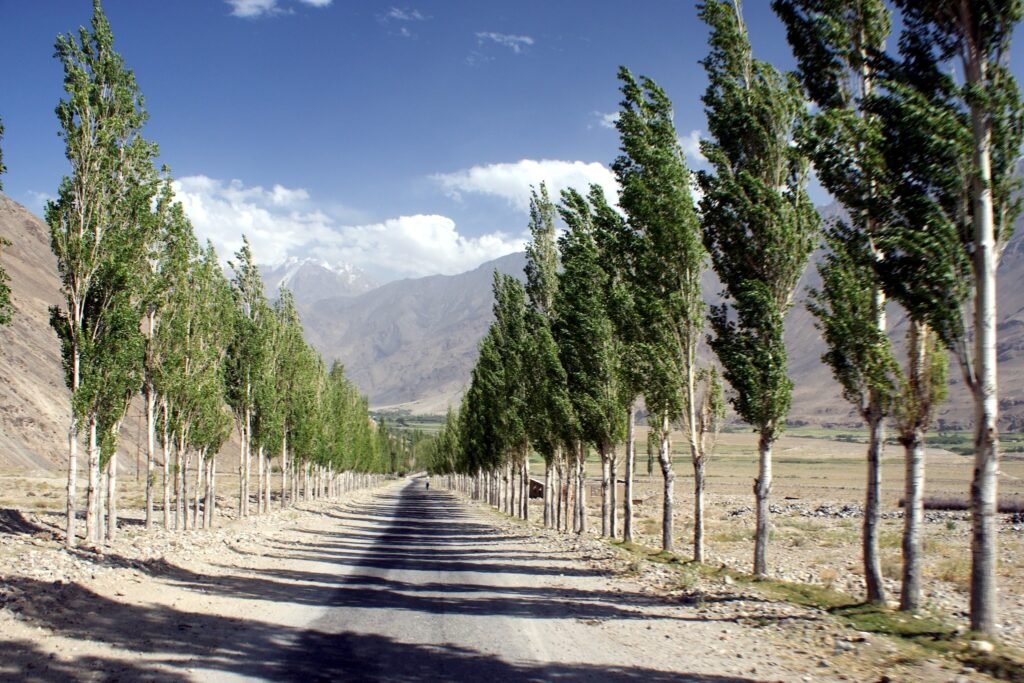
What is Wakhan Corridor?
- About: The Wakhan Corridor is a narrow, mountainous extension of Afghanistan’s Badakhshan Province.
- It forms Afghanistan’s only direct geographical connection with China’s Xinjiang region.
- Dimensions: The corridor is roughly 350 km long, while its width varies considerably, approximately 16–64 km depending on the section measured.
- Its landscape consists predominantly of the Pamir and Hindu Kush mountain systems, making transportation exceptionally difficult.
- Borders: The corridor’s northern side borders Tajikistan, while its southern side adjoins areas administered by Pakistan, from Pakistan’s Khyber Pakhtunkhwa province and Pakistan-administered Kashmir/Gilgit-Baltistan.
- At its eastern extremity, Afghanistan meets China, creating a short but strategically significant Afghanistan–China boundary of roughly 92–96 km.
- Pass:
- The most important pass is the Wakhjir Pass, located at approximately 4,923 metres above sea level.
- It is the principal geographical gateway between Afghanistan and China and lies along the watershed of the Mustagh Range.
- The southern mountain barrier contains the Broghil Pass, providing access towards Pakistan’s Khyber Pakhtunkhwa, and the Irshad Pass, linking towards Gilgit-Baltistan.
- The Dilisang Pass is another historical route but is largely disused.
- The most important pass is the Wakhjir Pass, located at approximately 4,923 metres above sea level.
- Hydrology: The region contains the headwaters of the Wakhan River, which joins the Pamir River and ultimately contributes to the Panj–Amu Darya river system.
- The corridor has significance not only for connectivity but also for the wider Central Asian hydrological geography.
- Background: Wakhan historically formed part of the wider Silk Road network, connecting regions around Central Asia, the Tarim Basin and the Indian subcontinent.
- Its modern political geography emerged during the 19th-century Great Game between the British Empire and Tsarist Russia. Agreements in 1873 and 1895 helped establish boundaries that kept Afghanistan as a buffer between competing imperial spheres.
- Afghanistan and China formally settled their boundary through the 1963 Boundary Treaty. The frontier follows the mountainous watershed and includes the Wakhjir area.
- Road Inauguration: On 4 October 2026, Afghanistan officially opened a 121-km gravel road running from the Broghil/Sarhad-e Broghil area in Wakhan to the Chinese border.
- The project reportedly cost 365 million Afghanis, with bridges, culverts and retaining structures incorporated into the route.
- The road creates the physical basis for direct Afghanistan–China overland connectivity, reducing Kabul’s dependence on routes through other neighbours.
Significance of China–Afghanistan Connectivity
- The Wakhan road potentially gives landlocked Afghanistan a direct route towards Xinjiang, offering an additional avenue for trade with China.
- China has gradually deepened engagement with the Taliban authorities since 2021, balancing pragmatic relations with concerns over terrorism and regional stability.
- Afghanistan traditionally depends heavily on neighbouring countries and third-country routes for external commerce.
- A functioning Wakhan route could provide route diversification, improving Kabul’s bargaining position in regional transit negotiations and reducing vulnerability to border closures.
- Potential Afghan exports include minerals, gemstones, agricultural products, dry fruits, carpets and other high-value, low-volume commodities. However, commercially competitive movement would require reliable logistics.
- Afghanistan possesses significant deposits of copper, iron, lithium and other mineral resources.
- China has long shown interest in Afghan mineral development, including the Mes Aynak copper project.
- Better connectivity could eventually support mineral-related supply chains.
- Xinjiang provides Afghanistan with geographical proximity to the wider Chinese market.
- The route could therefore become an instrument for expanding bilateral trade, investment and logistical cooperation.
- Afghanistan relied upon Pakistan, Iran and Central Asian routes for external connectivity. Wakhan offers another option, potentially improving Afghanistan’s resilience against disruptions along existing corridors.
- China’s interest is not purely economic. Research published in Pacific Focus in 2026 argues that Beijing’s approach is fundamentally security-first, with connectivity dependent upon credible security guarantees.
- The corridor fits conceptually within China’s broader Belt and Road Initiative, which seeks interconnected transport and economic networks across Eurasia.
- This would give Kabul another Chinese connection and could marginally reduce Pakistan’s geographic leverage over Afghan–Chinese commerce.
- Wakhan also has implications for Tajikistan and the wider Central Asian region because the corridor lies immediately south of Tajikistan’s Gorno-Badakhshan area.
- A stable Afghanistan–China connection could eventually form part of broader Central Asia–South Asia connectivity.
Security Dimensions: Border Management, Militancy and Stability
- Wakhan is one of Afghanistan’s most remote regions, characterised by high mountains, sparse settlements and difficult access.
- These characteristics can facilitate isolation but simultaneously make effective border surveillance and infrastructure protection difficult.
- The East Turkestan Islamic Movement (ETIM) is particularly relevant to Chinese security calculations because Beijing associates it with separatist violence in Xinjiang.
- China’s approach to Afghanistan is closely connected with preventing Afghan territory from becoming a base for anti-China militant activity.
- The Islamic State–Khorasan Province (ISIS-K) remains another regional security concern. Its activities create risks for Afghanistan, neighbouring Central Asian states and Chinese interests, making counter-terrorism cooperation an important component of regional diplomacy.
- Opening a road increases the movement of people, vehicles and commodities, creating a need for customs, immigration, identity verification and cargo inspection.
- Without such institutions, legitimate connectivity can simultaneously create opportunities for smuggling and illicit trafficking.
- A new transit route requires effective monitoring to prevent the movement of narcotics and other contraband.
- Bridges, culverts, retaining walls and road sections in such mountainous terrain are vulnerable to avalanches, landslides, floods and extreme weather.
- The newly inaugurated route contains 66 culverts, four major bridges and about 3,100 metres of retaining walls.
India’s Concerns & Strategy
- Wakhan lies close to the broader Afghanistan–Pakistan–China–Central Asia intersection. The eastern end of the corridor is particularly sensitive because of its proximity to areas connected with Pakistan-administered Kashmir and China’s Xinjiang region.
- It affects India’s Central Asian connectivity, Pakistan’s strategic relevance and India’s broader neighbourhood security environment.
- A stronger China–Afghanistan physical connection could expand China’s economic and strategic presence in Afghanistan.
- For India, this matters because Chinese influence in Afghanistan and Pakistan simultaneously could reshape the strategic environment surrounding India’s northwestern neighbourhood.
- India must also assess the development against the background of China–Pakistan strategic cooperation and CPEC. It could give Afghanistan greater autonomy from Pakistan and create a new China–Afghanistan.
- The development also occurs against the backdrop of unresolved India–China boundary issues and China’s growing infrastructure presence across India’s wider neighbourhood.
- India’s established connectivity strategy relies significantly on Chabahar Port in Iran, which provides an alternative route to Afghanistan and Central Asia while bypassing Pakistan.
- India and Central Asian countries have continued to emphasise Chabahar and the International North-South Transport Corridor (INSTC) as important connectivity mechanisms.
- India’s Connect Central Asia approach is strengthened by diversified regional transport options.
- The 2025 India–Central Asia Dialogue specifically stressed greater use of INSTC, development of Chabahar’s transit potential.
Frequently Asked Questions (FAQs):
1. What is the Wakhan Corridor?
The Wakhan Corridor is a narrow mountainous region of northeastern Afghanistan connecting the country geographically with China’s Xinjiang.
2. Where is the Wakhan Corridor located?
It lies in Badakhshan Province, bordered by Tajikistan to the north and Pakistan-administered areas to the south.
3. Why is the Wakhan Corridor strategically important?
It provides Afghanistan’s only direct land connection with China, offering strategic connectivity, trade diversification and regional geopolitical significance.
4. How does the Wakhan Corridor connect Afghanistan and China?
The Wakhjir Pass provides the geographical gateway, while Afghanistan’s newly inaugurated 121-km road reaches the Chinese border.
5. What is the importance of the Wakhan Corridor for India?
It affects India’s Central Asian connectivity, China’s regional presence, Pakistan’s strategic relevance and India’s broader neighbourhood security environment.
6. Why is the Wakhan Corridor important in geopolitics?
It intersects China’s Xinjiang security interests, Afghanistan’s connectivity ambitions, Pakistan’s influence and Central Asian regional integration.
Disclaimer: Information in this article is based on official announcements and public records. Details may evolve over time.
| Also Read: Afghanistan to Build Dam over Kunar River |