




Delhi Right of Citizen to Time-Bound and Ease of Delivery of Service Bill 2026
| General Studies Paper II: Government Policies & Interventions |
Why in News?
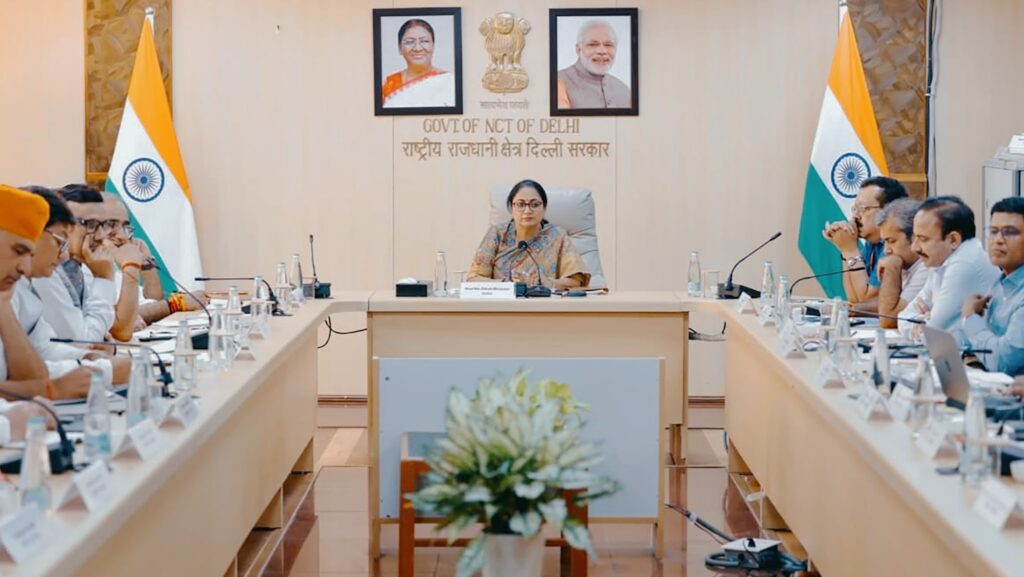
Recently, the Delhi Cabinet approved the Delhi Right of Citizen to Time-Bound and Ease of Delivery of Service Bill, 2026, strengthening digital governance.
Provisions of Delhi Right of Citizen to Time-Bound and Ease of Delivery of Service Bill, 2026
- Legal Right to Public Services: The Bill makes time-bound delivery of notified government services a legal right for every Delhi citizen.
- It replaces the Delhi (Right of Citizen to Time-Bound Delivery of Services) Act, 2011 with a modern governance framework.
- Technology-Driven Governance: The legislation mandates an end-to-end digital system for applications, approvals, tracking and communication.
- It aims to reduce paperwork, increase transparency and improve administrative efficiency through digital governance.
- Fixed Service Timelines: Every notified public service must be delivered within a prescribed statutory time limit.
- Factory plans by the Labour Department must be approved within 15 days.
- Citizens can legally demand timely service instead of depending solely on administrative discretion.
- Automatic Escalation Mechanism: If the designated officer fails to act within the prescribed period, the application automatically moves to the higher authority, reducing procedural delays.
- Independent Service Commission: The Bill proposes establishing a Delhi Right to Service Commission for independent oversight.
- It will responsible for grievance resolution, monitoring compliance and strengthening institutional accountability.
- Strong Grievance Redressal: Citizens receive a structured appeal and grievance redressal mechanism against delayed, rejected or deficient public services.
- Penalties on Defaulting Officials: Officials responsible for unjustified delays or wrongful rejection may face ₹250 per day penalty, subject to a maximum of ₹5,000, replacing the earlier ₹10 per day provision.
- Enhanced Accountability: The Bill fixes personal responsibility on designated officials, promoting answerability, transparency and performance-based governance in public administration.
- Digital Framework: All citizens will be able to apply online for services and every application will receive a unique application number to track its progress in real time.
- Service Expansion: The proposed framework expands coverage to additional public authorities and notified services.
- The total services now cover 584 across departments such as Labour, Energy, Real Estate Regulatory Authority, Tourism, Excise, Forest, and Jal Board.
- It includes registration under the Shops and Establishments Act within one day.
Significance of Delhi Public Service Delivery Bill
- Strengthens Citizen Rights: The Bill transforms timely public service delivery into a statutory right, empowering services within prescribed timelines. It reinforces rights-based governance.
- Promotes Good Governance: The legislation institutionalises efficiency, transparency, accountability and responsiveness, which are the four pillars of good governance.
- Improves Ease of Living: Time-bound delivery of certificates, licences and welfare-related services reduces transaction costs, and repeated office visits, making governance more citizen-friendly and improving the Ease of Living.
- Accelerates Digital Governance: The Bill encourages end-to-end online processing, and electronic communication. This supports Delhi’s transition towards paperless and technology-driven administration.
- The Bill advances Minimum Government, Maximum Governance, aligning with broader governance reforms and citizen-centric public administration.
Citizen’s Right to Public Services: Constitutional and Policy Framework
- Constitutional Basis: Articles 14, 19 and 21 collectively require governance to be fair, transparent and non-arbitrary.
- Time-bound public services strengthen equality before law, dignity and efficient administration.
- Article 38 directs the State to promote social justice and public welfare.
- Under Article 41, the State should secure public assistance and essential services within available resources.
- The Fundamental Duty [Article 51A(j)] encourages citizens to use lawful institutional mechanisms.
- Judicial Basis: In Maneka Gandhi v. Union of India (1978), the Supreme Court expanded Article 21 to require fair, just and reasonable State action.
- In E.P. Royappa (1974) and Ajay Hasia (1981), the Supreme Court held that arbitrariness violates Article 14, supporting transparent government decision-making.
- Initiatives: The Citizen’s Charter Programme (1997) introduced service standards, delivery timelines and grievance mechanisms.
- The Sevottam Quality Management Framework integrates Citizen’s Charter, grievance redress and service delivery capability.
- The Centralized Public Grievance Redress and Monitoring System (CPGRAMS) provides a nationwide online grievance platform, enabling digital complaint filing and monitoring across Central Ministries.
- Central initiatives such as Digital India, National e-Governance Service Delivery Assessment (NeSDA) and DARPG governance reforms promote paperless administration, online services, transparency and citizen-centric governance.
Ease of Living Reforms by Delhi Government
- E-District Digital Service Portal: The E-District Delhi platform provides end-to-end online delivery of government services, including application, verification, certificate download and grievance tracking.
- Time-Bound Online Services: Delhi prescribes service-specific timelines for numerous online services. For example, OBC Non-Creamy Layer Certificates have a 14-day timeline, while EWS Income and Assets Certificates are issued within 15 days.
- CM Jan Sunwai Portal: The government launched the CM Jan Sunwai portal and mobile application for integrated grievance redressal across Delhi Government departments, MCD, DDA and Delhi Police.
- Common Service Centres Expansion: More than 75 e-District services have been integrated with over 7,000 Common Service Centres (CSCs), enabling citizens to access certificates and public services near their homes.
- Universal e-Office Adoption: More than 200 government departments now function through the e-Office platform, enabling paperless administration, faster file movement, and digital approvals.
- Integrated Command and Control Centre: The proposed Integrated Command and Control Centre (IC3) will combine real-time information from transport, utilities and emergency services to strengthen urban governance.
- Ayushman Arogya Mandirs: Delhi is expanding Ayushman Arogya Mandirs, targeting 100 new centres every month. Existing centres provide 12 categories of primary healthcare services, bringing affordable healthcare.
- Support to Urban Street Vendors (SUSV): The SUSV programme strengthens livelihoods through vendor surveys, identity cards, vending zones, skill development, financial inclusion, institutional credit and social security linkages, promoting ease of living.
FAQs:
1. What is the Delhi Time-Bound Public Service Delivery Bill?
It makes time-bound delivery of notified government services a legal right for Delhi citizens.
2. Why has the Delhi government approved this bill?
To improve transparency, accountability, efficiency and technology-driven citizen-centric governance.
3. How will the bill benefit citizens?
Citizens receive timely services, digital tracking, automatic escalation and an independent grievance mechanism.
4. Which public services will be covered under the bill?
All notified government services under the Act, with additional services notified by the government.
5. Will officials be held accountable for delays?
Yes. Officials may face ₹250 daily penalties, up to ₹5,000, for unjustified delays or wrongful rejections.
Disclaimer: Information in this article is based on official announcements and public records. Regulations and implementation details may evolve over time.